
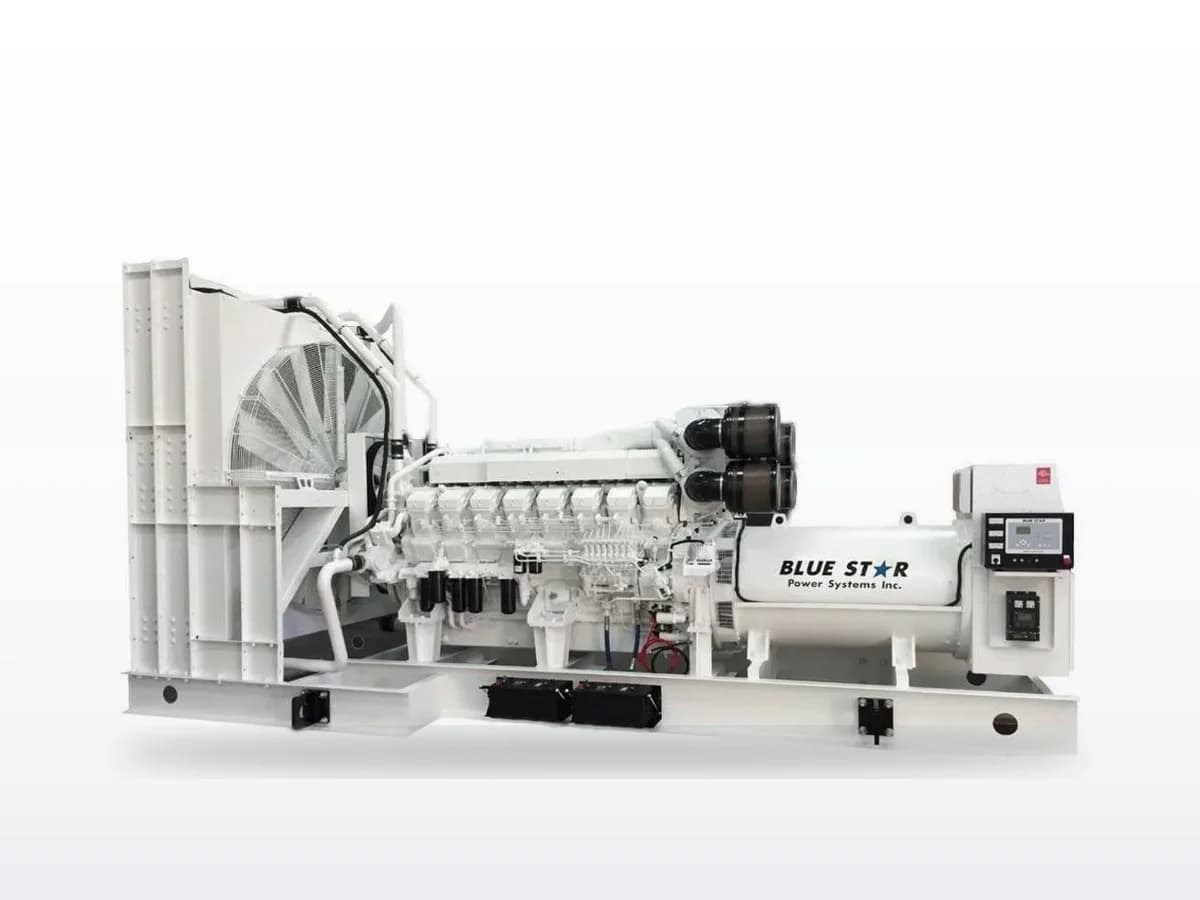
Series Overview#
The Blue Star Volvo Penta Diesel Standby series — designated VD — is the largest model-count series in Blue Star's diesel portfolio, covering 100 kW to 700 kW standby output across 22 models on Volvo Penta inline-four and inline-six engine platforms. The series spans three EPA emissions tiers: Tier 4 Final (the current-production models), Tier 3 (available for applications where Tier 4 Final is not required or desired), and Tier 2 (the VD500-01, VD550-01, VD600-03, and VD700-01). Single-phase configurations are available through the 275 kW class; models from 300 kW up are three-phase only. Available voltages include 120/208V, 120/240V, 277/480V, 347/600V, and 4160V.
The Tier 4 Final models (designated -04FT4) carry dual EPA Tier 4 Final and EU Stage 5 certification and represent Blue Star's current production emphasis in this power class. These units use SCR/DPF/DOC triple aftertreatment on Volvo Penta's latest engine variants — the TAD58xVE four-cylinder family at 100–125 kW, the TAD881VE seven-liter six-cylinder at 150 kW, the TAD1180VE 10.8-liter at 200 kW, and the TAD1381VE/TAD1383VE 12.8-liter platform at 250–300 kW. Tier 3 models remain available in the 230–550 kW range for applications where Tier 4 Final is not mandated.
Blue Star Power Systems (North Mankato, Minnesota; DEUTZ AG subsidiary since 2024) assembles all VD units with an open-architecture Basler DGC-2020 controller on current-production models. DSE DCP7310 controllers appear on some updated production models. The open-architecture approach allows any qualified controls technician to service the system without OEM involvement — a meaningful advantage for the commercial, municipal, and campus applications that dominate this series' application profile.
How to Choose#
VD100-04FT4 and VD125-04FT4 (100–125 kW, Tier 4 Final): The entry models on Volvo Penta's 5.13-liter four-cylinder platform (TAD581VE and TAD582VE respectively). Both are current production and share the same physical footprint — the VD125-04FT4 is a drop-in upgrade when 100 kW proves marginal. The VD125-02FT4 is an older second-generation Tier 4 Final model using the TAD572VE and is being superseded by the VD125-04FT4.
VD150-04FT4 (150 kW, Tier 4 Final): Steps up to the Volvo Penta TAD881VE 7.7-liter six-cylinder — a platform transition that reflects the displacement needed for 150 kWe with Tier 4 Final aftertreatment. Current production active model.
VD200-04FT4 (200 kW, Tier 4 Final): Moves to the TAD1180VE 10.8-liter six-cylinder — a platform unique to the Tier 4 Final lineup that fills a gap not present in the Tier 3 range.
VD230-01, VD250-03, VD275-01 (230–275 kW, Tier 3): The 7.7-liter TAD851GE, TAD852GE, and TAD853GE family in three output calibrations. All three share footprint characteristics; choose by whether 230, 250, or 275 kW is the appropriate standby rating for the load study. The VD250-04FT4 and VD300-04FT4 are the Tier 4 Final replacements at 250 and 300 kW.
VD300-01, VD300-02FT4, VD300-04FT4 (300 kW): Three variants at 300 kW covering Tier 3 (VD300-01, TAD1351GE 12.8L) and Tier 4 Final in two generations (VD300-02FT4 TAD1373VE, VD300-04FT4 TAD1383VE). The VD300-04FT4 is the current-production replacement. Altitude deration performance differs — the VD300-01 Tier 3 unit is specifically noted for a higher altitude ceiling (6,560 ft) versus the higher-boosted VD350-01 (3,280 ft).
VD350-01 through VD450-01 (350–450 kW, Tier 3): The 12.8-liter TAD1352GE/TAD1353GE family (VD350/VD400) and the 16.1-liter TAD1650GE (VD450). The VD450 footprint (140×72 in) is noticeably larger than the 12.8-liter models (approximately 120×66 in) — verify site dimensions before specifying.
VD500-01 through VD700-01 (500–700 kW, Tier 2): The large-frame Tier 2 models use the largest Volvo Penta platforms available in this series. The VD700-01 introduces Common Rail injection via the TWD1744GE, a meaningful difference in fuel system service requirements versus the electronic unit injector engines throughout the rest of the series.
Common Applications#
- Municipal infrastructure: The VD series is rated for municipal use across 21 of 22 models — from water treatment plants (VD300–VD700) to smaller pump stations and government facilities (VD100–VD200).
- Large commercial buildings: The 19 models rated for large-commercial use make this the primary standby diesel series for office towers, convention centers, and large mixed-use developments in the 100–500 kW range.
- Non-critical hospital loads: Healthcare facilities that do not require NFPA 110 Level 1 power quality may use diesel standby in this range for equipment branches, HVAC, and non-life-safety loads.
- Schools and campuses: School districts and mid-size campuses with 100–300 kW emergency power requirements are well served by the Tier 4 Final and Tier 3 models in the 100–300 kW range.
- Hotels and hospitality: 14 of 22 VD models are rated for hotel applications — the 150–400 kW range aligns with full-service hotel emergency power requirements for elevators, common area lighting, HVAC, and kitchen equipment.
Service & Maintenance#
The universal VD series service schedule is: oil changes at 500 hours or 12 months, fuel filter replacement at 500 hours, air filter inspection at 1,000 hours, and coolant changes at 6,000 hours. These intervals apply to all 22 models regardless of emissions tier.
Battery failure is the most common documented failure mode across the series (15 of 22 models), presenting as slow cranking or failed starts. Standby generators in this class typically use either 12V or 24V starting systems depending on the engine displacement. Replace batteries on a preventive 2–4 year schedule.
DEF system failure is a Tier 4 Final-specific risk that affects 10 of 22 models. SCR catalyst derates, NOx faults, and DEF quality alerts typically appear around 4,380 hours. Preventive measures include: using DEF that meets ISO 22241 quality standards, keeping the DEF tank filled to avoid concentration changes from evaporation, and replacing DEF filters at the OEM-specified interval.
Fuel quality degradation affects multiple model classes in moderate severity. Standby diesel stored in low-turnover tanks degrades into microbial-contaminated fuel that clogs filters and fouls injectors. Quarterly fuel sampling and biocide treatment are the standard preventive measures.
Turbocharger wear at approximately 12,000 hours is a moderate-to-severe failure mode across models from the 7.7-liter six-cylinder class and above. Include turbocharger condition assessment in the 10,000-hour service event. For the VD700-01 with Common Rail injection, also note that Common Rail injector service intervals and pressure specifications differ from the EUI-equipped models throughout the rest of the series.
Application Guidance#
The Blue Star Volvo Penta Diesel Standby series is purpose-built for commercial, municipal, campus, and light-industrial standby applications in the 100–700 kW range where an open-architecture controller and broad emissions-tier options are priorities. With 22 models spanning Tier 4 Final, Tier 3, and Tier 2, this is the most model-diverse diesel standby series in the Blue Star lineup — giving specifiers the flexibility to match current Tier 4 Final requirements for new installations, deploy Tier 3 where the local AHJ permits it, or maintain compatibility with existing Tier 2 infrastructure in the upper range (VD500–VD700). The 4160V medium-voltage output is available across both Tier 4 Final and legacy models, enabling direct integration with campus and industrial medium-voltage distribution systems. Single-phase configurations through the 275 kW class extend the series' applicability to facilities where three-phase distribution has not yet been installed.
This series is not appropriate when the standby load exceeds 700 kW — at that point the Blue Star Mitsubishi Diesel Standby (800–2,000 kW) and CAT 3500 Series Large Diesel (1,000–3,000 kW) are the correct alternatives. For mobile trailer-mounted deployment on the same Volvo Penta Tier 4 Final platforms, the Blue Star Volvo Penta Diesel Mobile series covers 100–600 kW. When natural gas standby is preferred over diesel in the 100–200 kW range, the Blue Star PSI Mid Gaseous (130–200 kW) or PSI Large Gaseous (265–500 kW) provide equivalent coverage on piped natural gas without diesel storage requirements.