Series Overview#
The Airman EBOSS Hybrid Series is a line of diesel-battery hybrid energy systems that combine Airman diesel generators with Lithium Titanate Oxide (LTO) battery banks to dramatically reduce fuel consumption, engine runtime, and noise at construction sites, events, and temporary power applications. Five models span the range from 22 kW standby (EBOSS 25-25) to 336 kW standby (EBOSS 400-220), with battery storage capacities from 25 to 220 kWh. The EBOSS name stands for Energy Battery Optimized Smart System — an automated power management platform that continuously decides whether to draw from the battery, the diesel engine, or both.
The core operational principle of the EBOSS is load-following hybrid logic: when facility load is low (as on construction sites at night, or between activities), the diesel engine shuts down and the battery carries the load. When load spikes — during tool starts, HVAC compressor cycling, or peak event demand — the battery and diesel work together to meet the demand without the diesel running at partial load for extended periods. The diesel engine runs at efficient load points and for shorter periods than a conventional generator serving the same site.
The Isuzu engine family covers most of the range: the 4LE2T powers the EBOSS 25-25, the 4JJ1X powers the EBOSS 70-45, the BR-4HK1X powers the EBOSS 125-65, and the 6WG1X powers the EBOSS 400-220. The EBOSS 220-125 uses a John Deere 6068. All EBOSS units are built by Hokuetsu Industries in Japan, the same manufacturer as the SDG Series, and all feature Airman's standard 110% fluid containment for environmentally sensitive sites.
How to Choose#
EBOSS model selection follows the same load-sizing logic as conventional generators, with an added consideration for battery capacity relative to expected standby and low-load duration:
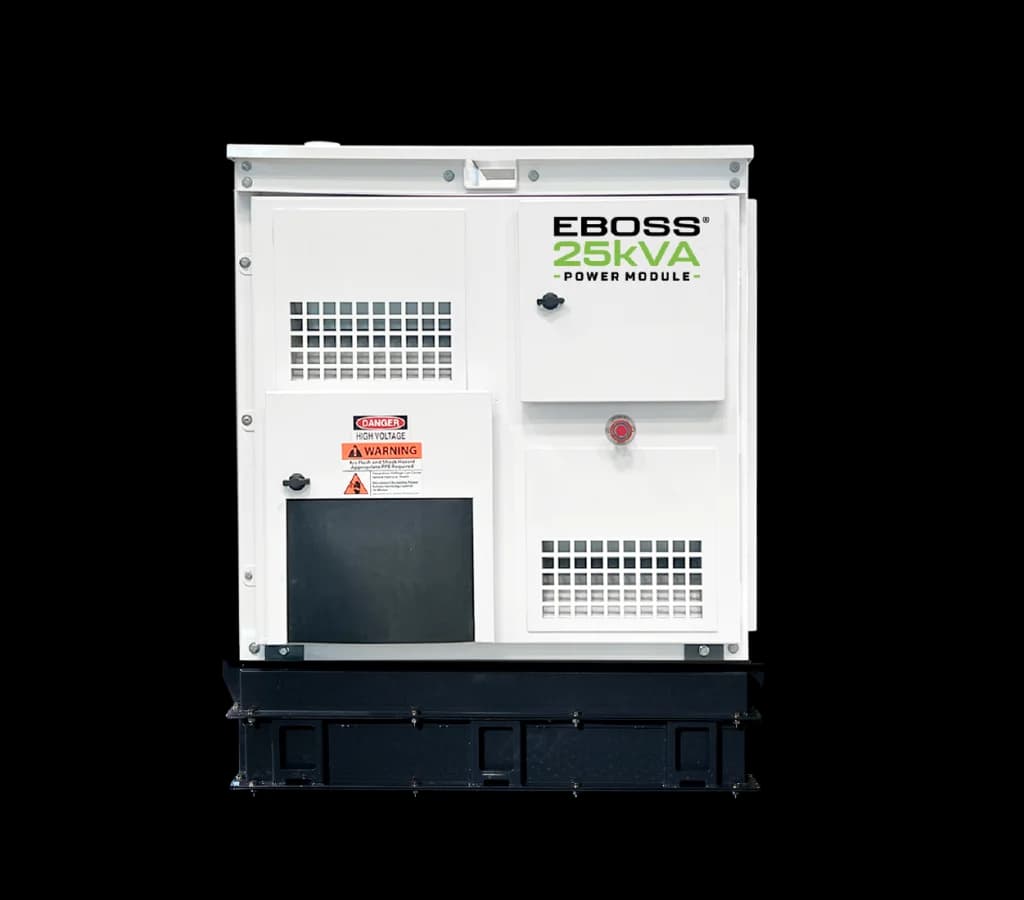
EBOSS 25-25 (22 kW standby, 25 kWh): Entry-level hybrid for small construction sites, small events, or light temporary power. 25 kWh of storage covers a typical overnight low-load period on a small site. Isuzu 4LE2T engine.
EBOSS 70-45 (60 kW standby, 45 kWh): Mid-small commercial. Covers the range of most construction sites with 20–50 workers and multi-tool operations. The 45 kWh storage provides meaningful runtime reduction at light loads. Single and three-phase output to 480V.
EBOSS 125-65 (110 kW standby, 65 kWh): Building-scale temporary power. At 100 kW prime, this covers mid-size construction sites, large events, or temporary facility power. The Isuzu BR-4HK1X engine. Three-phase output at 277/480V.
EBOSS 220-125 (194 kW standby, 125 kWh): Large construction and data center temporary power. The John Deere 6068 engine. Three-phase 277/480V only. The 125 kWh battery bank can independently power significant loads for extended periods.
EBOSS 400-220 (336 kW standby, 220 kWh): Flagship. The largest EBOSS model delivers 320 kW prime with the largest battery bank (220 kWh) in the series. Three-phase 277/480V only. Suitable for large construction sites, data center temporary power, and large-scale events.
Common Applications#
- Urban construction sites: The primary market for EBOSS. Noise ordinances, emissions restrictions, and fuel cost pressure in urban construction environments make the hybrid's reduced runtime and noise profile particularly valuable. The EBOSS operates at lower sound levels than a conventional diesel generator at equivalent loads because the diesel engine runs less frequently and at higher loads when it does run.
- Event power: Sound-sensitive events — festivals, concerts, outdoor markets — benefit from the EBOSS's ability to run on battery alone during low-demand periods, eliminating generator noise between performances or during quiet activities.
- Rental fleet: The EBOSS platform addresses fleet operators' need to differentiate on fuel savings and emissions performance when competing for noise-sensitive or environmentally sensitive project specifications.
- Data center temporary power: Temporary backup for data centers during maintenance or construction requires clean, reliable power at controlled load levels. The EBOSS's battery provides instant response to load changes while the diesel provides sustained capacity.
- Remote temporary facilities: For temporary camps, field operations, or remote facilities with variable load profiles, the EBOSS's fuel efficiency reduces the resupply frequency compared to a conventional generator running continuously.
Service & Maintenance#
EBOSS Series generators share the same base diesel service intervals as the SDG Series: oil and fuel filter changes every 500 hours or 12 months, air filter service every 500 hours. Because EBOSS diesel engines accumulate significantly fewer hours than conventional generators at equivalent sites — due to the battery taking load during low-demand periods — the calendar interval (annual) typically governs service rather than the 500-hour meter reading.
The three consistent failure modes are fuel filter clogging from contaminated or stale diesel, starting battery degradation during extended storage, and coolant hose weeping at clamp points from thermal cycling. These are identical to the SDG Series because the diesel generator component is the same platform. Fuel quality management remains critical even in hybrid applications because the diesel engine must be ready to start and assume full load at any moment.
The LTO battery management system adds a maintenance layer unique to the EBOSS: battery health monitoring, cell balance checking, and BMS firmware maintenance. Consult the EBOSS operations manual for battery system service intervals, which differ from the diesel engine service intervals.
Application Guidance#
The EBOSS Hybrid Series is purpose-built for sites with highly variable load profiles — construction sites with overnight idle periods, sound-sensitive events, and temporary facility deployments where the diesel engine would otherwise run at low, inefficient loads for extended hours. Spanning 22 to 336 kW standby with LTO battery banks from 25 to 220 kWh, the EBOSS delivers meaningful fuel savings specifically when load swings are wide and predictable: high demand during active periods, low or zero demand between them. The LTO chemistry handles the high charge/discharge rates and thermal extremes of outdoor construction and rental environments better than NMC or LFP alternatives.
The EBOSS is not the right choice when load is steady and near-continuous — a construction site running a concrete pump at constant load for 10-hour shifts gains little from hybrid buffering, and you are paying a significant capital premium for battery capacity that rarely discharges. For straight high-utilization temporary power, the Airman SDG Series delivers the same Isuzu and John Deere engine platforms without the battery overhead at lower acquisition cost. For applications where noise reduction is the primary driver but load is relatively stable, the Atlas Copco QAS Series offers consistent 5–8 dBA quiet operation across 22–616 kW without the battery management complexity. Reserve the EBOSS for jobs where the hybrid's fuel savings and runtime reduction are actually achieved — variable-load, noise-sensitive, or emissions-restricted sites where the payback calculation works.