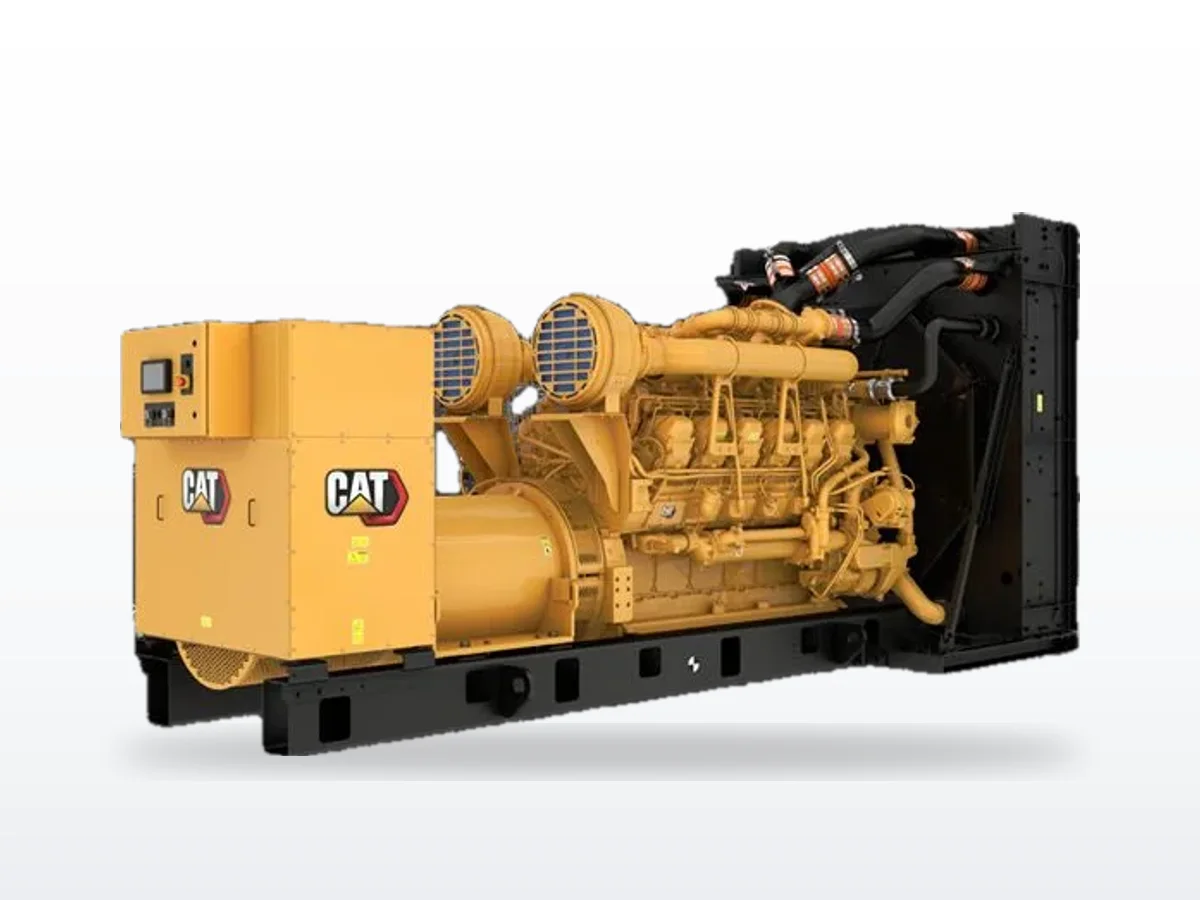
Series Overview#
The Cat 3500 Series is Caterpillar's core megawatt-class diesel generator platform, spanning 1,000 to 3,000 kW across seven models organized around two engine families: the V-12 3512 platform (1,000–1,500 kW) and the V-16 3516 platform (1,600–3,000 kW). The series covers every major duty cycle — standby, mission-critical, prime, and continuous — making it the most versatile large-diesel product family in Caterpillar's lineup and a reference specification in data center, hospital, and industrial power infrastructure.
The 3500 Series engine architecture has been continuously developed from the original 3512 and 3516 platforms through multiple generations: the B-suffix models introduced Electronic Unit Injection and ADEM III controls; the C-suffix models added ATAAC aspiration and Tier 2 emissions compliance; and the 3516E extended the V-16 to 3,000 kW with a 78.1-liter displacement variant and ADEM A5 controls. This generational continuity means parts interoperability extends across decades of production, and service technicians familiar with one generation can generally work on others within the same engine family.
The voltage range across the 3500 Series is among the broadest of any large-diesel platform: low-voltage configurations at 277/480V, 346/600V, and international three-phase voltages, through medium-voltage outputs at 2,400V, 4,160V, 12,470V, 13,200V, and 13,800V. Medium-voltage capability is particularly significant for large data center and campus installations where distributing power at 4,160V or 13,800V reduces conductor costs and losses relative to low-voltage distribution over long distances.
How to Choose#
V-12 vs V-16 engine family: The 3512-platform models (3512, 3512B, 3512C) max out at 1,500 kW standby and use 51.8-liter displacement. The 3516-platform models (3516, 3516B, 3516C, 3516E) begin at 1,600 kW and reach 3,000 kW using 69–78.1 liters across 16 cylinders. If your standby requirement is at or below 1,500 kW, evaluate whether the V-12 platform meets the load — it carries lower capital cost and reduced footprint versus the V-16.
Legacy vs current-generation controls: The original 3512 uses a Woodward 2301A governor and Direct Unit Injection — capable but without modern electronic control capabilities. If remote monitoring, PowerCommand integration, or advanced load sharing is required, specify 3512C, 3516C, or 3516E with ADEM A5 controls and EMCP 4.x panel compatibility.
Medium voltage requirement: If your distribution voltage is 4,160V, 12,470V, 13,200V, or 13,800V, confirm the specific alternator configuration with your Cat dealer. Medium-voltage alternators are available across the B and C suffix variants, but not all output voltages are available on all models.
Paralleling arrays: Six of the seven 3500 Series models are documented for paralleling applications. The 3516C and 3516E are the most common choices for paralleling arrays at 2,000–3,000 kW per unit due to their current-generation controls and broad voltage support.
Data center vs hospital vs industrial: All three application categories appear across the 3500 Series. Data centers typically specify medium-voltage configurations with paralleling for redundancy. Hospitals often specify 3512C or 3516B for their balance of power and code compliance. Industrial applications may run prime or continuous duty ratings, which differ from standby ratings — confirm the appropriate rating with your application in mind.
Common Applications#
-
Mission-critical data centers: All seven models are documented for mission-critical use. The 3516C (2,500 kW) and 3516E (3,000 kW) are standard specifications for large data center pods requiring 2+ MW per generator with medium-voltage distribution and N+1 paralleling.
-
Large hospital campuses: The 3512C and 3516B appear frequently in hospital large-campus applications where NFPA 110 compliance, 10-second load acceptance, and long-term parts availability are non-negotiable requirements. CAT's dealer density supports emergency service response times critical for healthcare.
-
Campus and university power systems: Campus installations commonly deploy multiple 3500 Series units in paralleling switchgear to build 4–8 MW total backup capacity with N+1 redundancy. Individual units can be maintained without dropping the entire array.
-
Industrial prime power: The 3500 Series supports prime and continuous duty cycles, making it suitable for industrial facilities running extended hours or off-grid sites where the generator is the primary power source rather than a standby backup.
-
Commercial high-rise standby: High-rise buildings requiring sub-megawatt to 1.5 MW backup commonly specify the 3512C or 3516 for their combination of output, voltage flexibility, and well-established service network.
Service & Maintenance#
All 3500 Series diesel models share consistent service intervals: oil changes every 500 hours or 12 months, fuel filter replacement every 500 hours, coolant changes every 6,000 hours (documented across 6 models), and air filter service every 1,000 hours. These intervals apply across both the V-12 and V-16 engine families and represent Caterpillar's published maintenance schedule for the platform.
Three failure modes appear consistently across the 3500 Series field data. First, 24V battery banks are the most frequent minor failure cause — batteries degrade on standby-duty generators that rarely run, and weak batteries account for the majority of failed start events during actual outages. Test batteries every six months and replace on a defined schedule rather than waiting for a failure event. Second, fuel quality degradation causes injector fouling and hard starting, particularly in installations where the diesel tank sits for 12–18 months between load tests. Implement a fuel polishing program with annual fuel sampling to detect microbial contamination and oxidation before they cause field failures. Third, turbocharger wear at 15,000–20,000 hours produces reduced power, oil in the intake manifold, and increased exhaust smoke — plan turbocharger inspection and rebuilding into the long-term maintenance budget.
The EUI injectors on B-suffix models have a known wear mode at approximately 18,000 hours that causes rough running and power imbalance between cylinder banks. If you operate a 3512B or 3516B with high runtime hours, include EUI injector inspection in your major service planning.
Application Guidance#
The CAT 3500 Series Large Diesel is purpose-built for mission-critical standby, prime power, and campus applications in the 1,000–3,000 kW range where single-OEM parts availability, medium-voltage output capability, and documented paralleling infrastructure are the baseline requirements. Seven models across V-12 (3512 family) and V-16 (3516 family) engine platforms cover every major duty cycle — the 3516C and 3516E are the reference specification for hyperscale data center pods at 2,500–3,000 kW, while the 3512C is the standard for large hospitals and campus installations requiring 1,000–1,500 kW with NFPA 110 compliance. Medium-voltage output to 13,800V reduces distribution conductor costs on large campus and industrial installations. Parts availability extends back across decades of production volume, and approximately 200 US Cat dealer locations support emergency service response for critical facilities.
This series is not appropriate below 1,000 kW — the 3500 Series footprint, capital cost, and maintenance complexity are not justified when smaller platforms adequately serve the load. For commercial and municipal standby from 100 to 750 kW, the Blue Star Volvo Penta Diesel Standby and Blue Star Perkins Diesel Standby series are correctly sized. For standby requirements above 3,000 kW from a single unit, the CAT C175 Series (3,100–4,000 kW) is the appropriate platform. For direct competition at comparable megawatt-class power levels from an alternative OEM, the Cummins QSK Series Large Diesel and Blue Star Mitsubishi Diesel Standby are the primary alternatives — the Mitsubishi with an open-architecture controller advantage, the Cummins with integrated OEM controls and vertical manufacturing.