Series Overview#
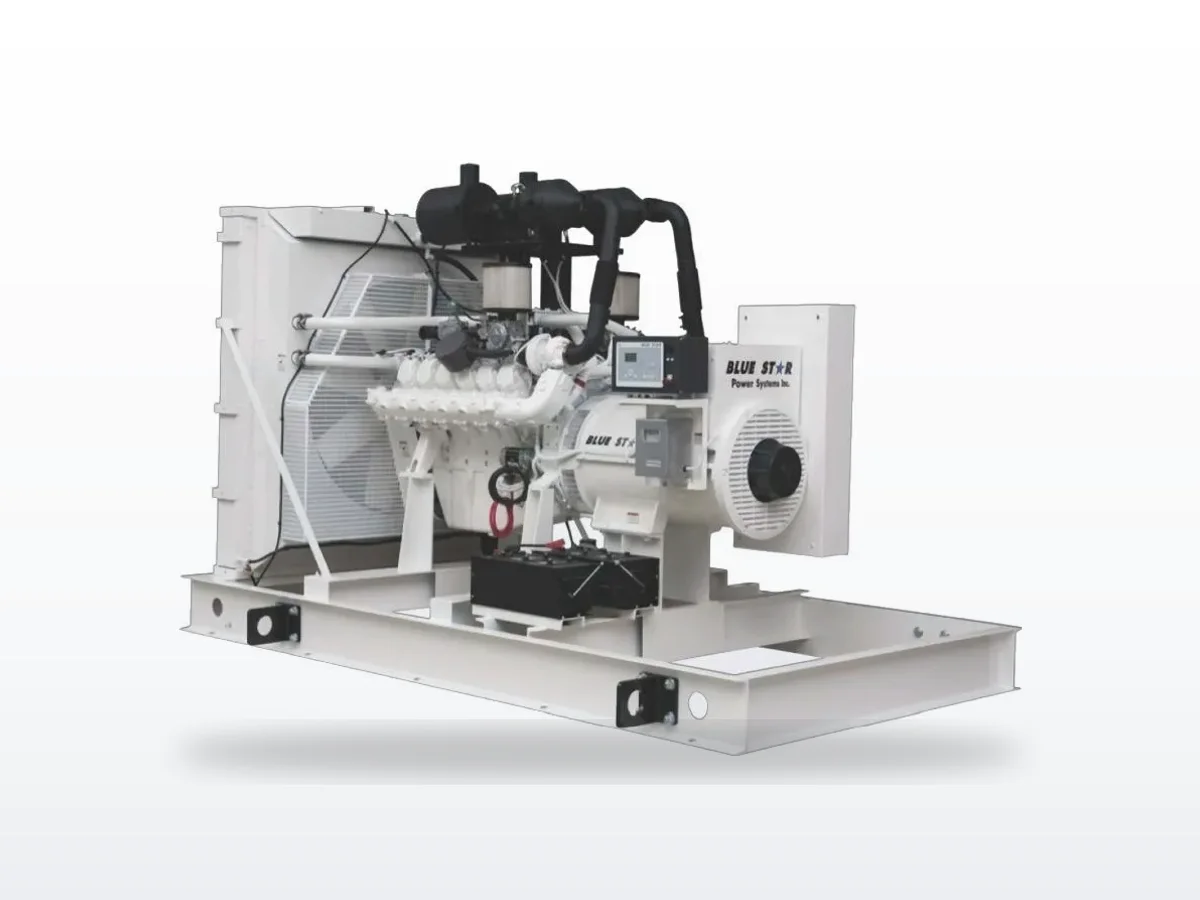
The Blue Star PSI Mid Gaseous series covers the 130 kW to 200 kW natural gas and LP standby segment using Power Solutions International (PSI) spark-ignition V8 and inline-six engine platforms. Six models span the range across two naming conventions: the PS-prefix models (PS130-01, PS150-01) use the PSI 8.8LTCAC turbocharged V8; the NG-prefix models (NG150-01, NG150-01P, NG200-01, NG200-01P) use the PSI 8.1LT inline-six at 150 kW and the PSI 11.1L inline-six at 200 kW. All six models are available in both single-phase and three-phase configurations — an unusual breadth of single-phase availability at this power level.
This series bridges the gap between Blue Star's smaller PSI Small Gaseous lineup (ending at 100 kW) and the PSI Large Gaseous series (beginning at 265 kW). It addresses commercial and light-industrial installations where the load study places the natural gas standby requirement between 130 and 200 kW — a common range for mid-size commercial buildings, hotels, schools, multi-family residential developments, and light-industrial facilities that have access to a natural gas supply of adequate pressure.
Blue Star Power Systems (North Mankato, Minnesota; DEUTZ AG subsidiary since 2024) pairs all models with the DSE DCP7310 controller and Stamford alternators, using the same open-architecture philosophy as the rest of the Blue Star lineup. The DSE DCP7310 is programmable by any qualified controls technician and integrates with third-party building management systems without OEM involvement. Fuel pressure requirement is standard utility-grade natural gas service (typically 11 in. water column, per the PS150-01 spec sheet).
How to Choose#
PS130-01 (130 kW standby, PSI 8.8LTCAC V8): The entry model in this series and the one with the closest LP-to-NG output ratio — 125 kWe on LP versus 130 kWe on NG. Choose when the load study is firmly at 130 kW on natural gas and dual-fuel LP capability with minimal derating is a priority.
PS150-01 (150 kW standby, PSI 8.8LTCAC V8): The same 8.8LTCAC V8 as the PS130-01, calibrated to 150 kWe. LP output is 125 kWe. Available in single-phase and three-phase. Standby rated — no prime-duty variant. Choose when 130 kW is marginal and you want to stay on the 8.8L V8 platform.
NG150-01 / NG150-01P (150 kW standby / 125 kW prime, PSI 8.1LT inline-six): A different architecture at the same standby output level as the PS150-01 — the PSI 8.1LT is an inline-six rather than a V8. LP output is 115 kWe standby, 95 kWe prime. The -01P variant provides a prime-duty rating for applications requiring continuous-duty operation. Choose this model over the PS150-01 when prime-rated operation is needed.
NG200-01 / NG200-01P (200 kW standby / 175 kW prime, PSI 11.1L inline-six): The top of the series, using the PSI 11.1-liter inline-six — the engine platform that steps above the 8.1L. Standby output is 200 kWe on natural gas (130 kWe on LP); prime output is 175 kWe (115 kWe on LP). The NG200-01 is one of the volume models in the Blue Star gaseous line at this power level. Choose for hotel, large school, hospital non-critical, and large multi-family applications where 150 kW is marginal.
For voltage selection: all six models support 120/208V, 120/240V (single-phase), 240V, 277/480V, and 347/600V. Specify based on the facility's distribution system voltage — the breadth of options allows the generator to directly feed most commercial distribution architectures without additional step-down transformers.
Common Applications#
- Light-industrial facilities: The 130–200 kW range covers machine shops, light manufacturing buildings, and warehouse facilities where a natural gas standby generator eliminates the permitting and storage requirements of a diesel tank.
- Commercial and medium-commercial buildings: Mid-size office buildings, retail centers, and commercial tenants in the 130–200 kW emergency load range use this series for life-safety system backup, elevator power, and HVAC.
- Schools and educational facilities: Individual school buildings and small campus facilities with 130–200 kW standby requirements for emergency lighting, HVAC, and server rooms are a common application for the NG150 and NG200 models.
- Multi-family residential: Mid-rise apartment and condominium buildings with elevator, common area, and life-safety emergency loads in the 130–200 kW range use this series where natural gas service is available to the mechanical room.
- Hotels: The NG200-01 is specifically rated for hotel applications — covering emergency power for elevators, common areas, kitchen equipment, and guest corridor lighting in mid-size hotel properties.
Service & Maintenance#
PSI spark-ignition engines require more frequent oil changes than diesel: every 250 hours or 12 months, whichever comes first. Spark plug replacement is at 1,500 hours, air filter inspection at 1,000 hours, and coolant changes at 4,000 hours. These intervals are uniform across all six models and must not be extended — gaseous spark-ignition combustion deposits accelerate oil breakdown more rapidly than diesel combustion chemistry.
The four failure modes documented across this series (all appearing in every model) are:
Turbocharger wear (moderate): Power loss and excessive exhaust smoke under load at approximately 12,000 hours. Both the 8.8LTCAC V8 and the 8.1LT/11.1L inline-six are turbocharged; turbocharger condition assessment should be included in the 10,000-hour service event.
Spark plug and ignition degradation (minor): Misfire at load, rough running — presenting around the 1,500-hour plug replacement interval. Multi-cylinder PSI platforms require that all spark plugs be replaced at the same interval, not selectively. Using plugs outside OEM specification accelerates combustion chamber fouling.
Charge air cooler fouling (moderate): Reduced power output and elevated intake temperatures at approximately 10,000 hours. Scheduled charge air cooler cleaning at the 6,000–8,000 hour mark is the standard preventive measure.
Battery failure (minor): All six models document battery failure as a risk — a failed start during an actual outage is the only failure mode that matters for standby operation. Replace batteries on a 2–3 year preventive schedule and include a load test in each annual inspection.
Application Guidance#
The Blue Star PSI Mid Gaseous series is purpose-built for the 130–200 kW natural gas and LP standby band — the range that covers most mid-size commercial buildings, hotels, schools, multi-family developments, and light-industrial facilities where natural gas eliminates diesel storage and permitting complexity. All six models are available in both single-phase and three-phase configurations, which is unusual at this power level and addresses facilities where single-phase distribution is the norm. Prime-rated variants on the NG150 and NG200 provide a path to continuous-duty or prime power operation on the same hardware, useful for extended outage coverage or applications that blend standby and prime duty cycles.
This series is not appropriate below 130 kW — at that point the Blue Star PSI Small Gaseous (20–100 kW) series provides the same PSI engine approach in a more compact, lower-cost package. For loads above 200 kW on natural gas, the Blue Star PSI Large Gaseous (265–500 kW) series scales on larger V8 and V12 platforms with structural steel base construction. Keep in mind that LP output is substantially lower than natural gas on every model in this series — the NG200-01 drops from 200 kWe on natural gas to 130 kWe on LP. If LP is the primary fuel, confirm that the LP-rated output meets the load study before specifying; do not size to the natural gas nameplate. For diesel standby at comparable output levels with lower service frequency (500-hour oil changes versus 250-hour for gaseous), the Blue Star John Deere Diesel Standby series covers 30–300 kW.