
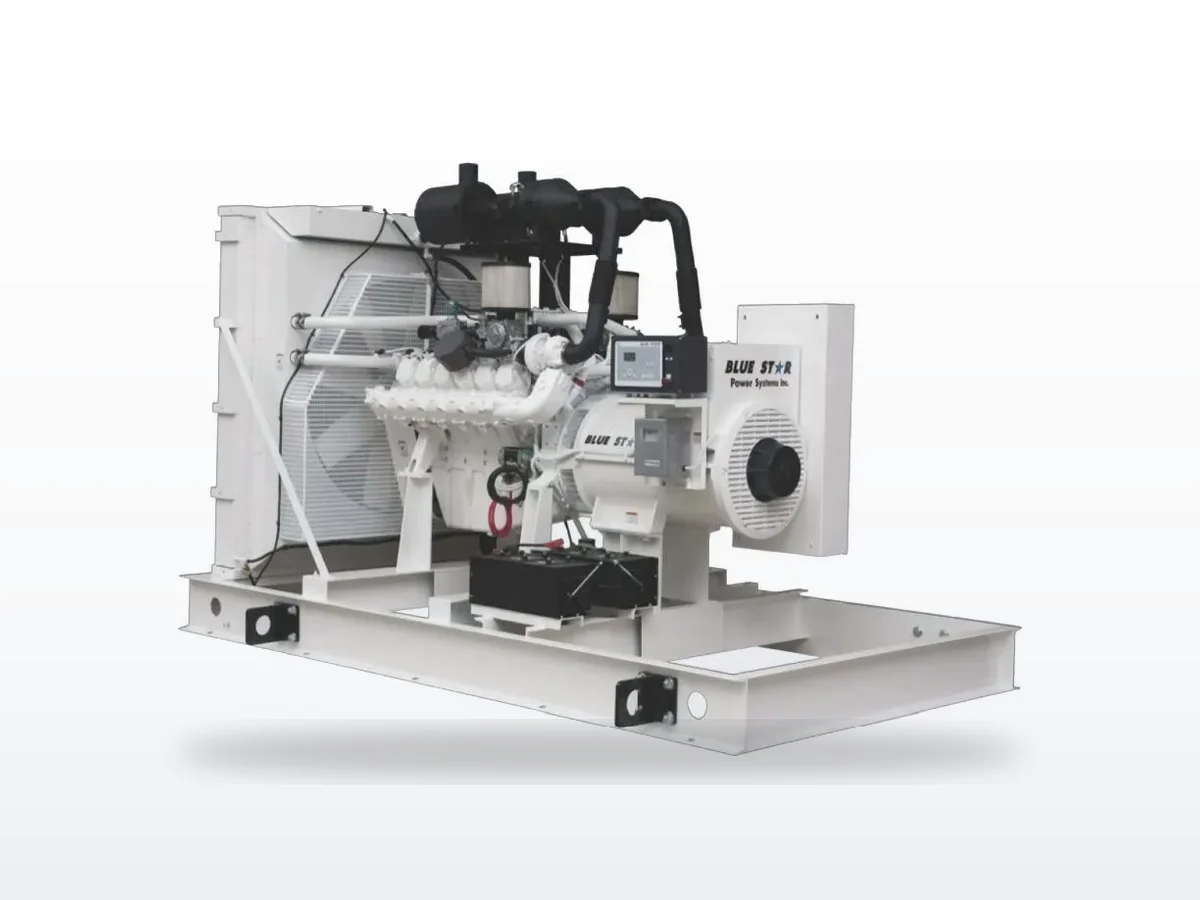
Series Overview#
The Blue Star PSI Large Gaseous series covers the 265 kW to 500 kW natural gas and LP standby segment using Power Solutions International (PSI) V8 and V12 spark-ignition engine platforms. Ten models span the range: the NG265-01, NG265-01P, NG300-01, and NG300-01P are built on the PSI 14.6L V8; the NG350-02 uses the high-output PSI 14.6LHO V8; the NG400-01, NG400-01P, NG425-01, and NG450-01 use the PSI 21.9L V12; and the NG500-02 uses the high-output PSI 21.9LHO V12. All units are three-phase (except the dual-phase NG265 variants), liquid-cooled, and EPA Stationary Spark Ignition compliant.
This series occupies the power band between Blue Star's mid-range gaseous lineup (PSI Mid Gaseous, ending at 200 kW) and the industrial gaseous lineup (PSI Industrial Gaseous, beginning at 500 kW). It is the appropriate series when the load study places the natural gas standby requirement between 265 kW and 500 kW — a segment that includes large commercial facilities, non-critical hospital loads, large multi-family developments, school campuses, and light-industrial facilities where natural gas infrastructure eliminates diesel storage and permitting complexity.
Blue Star pairs each unit with the open-architecture Basler DGC-2020 controller, assembled at its North Mankato, Minnesota facility (a DEUTZ AG subsidiary since 2024). The structural steel base construction that begins with the NG265-01 is standard throughout the series — a platform upgrade from the formed-steel bases used in smaller units that reflects the engine size and base torque loads at these power levels.
How to Choose#
NG265-01 / NG265-01P (265 kW standby / 250 kW prime, PSI 14.6L V8): The entry point into the series and the only model available in single-phase (120/240V) as well as three-phase. The standby variant delivers 265 kWe on natural gas (200 kWe on LP); the prime variant delivers 250 kWe (175 kWe on LP). Choose the -01P when continuous-duty prime operation is needed rather than emergency standby only.
NG300-01 / NG300-01P (300 kW standby / 260 kW prime, PSI 14.6L V8): The NG300 extracts an additional 35 kWe from the same 14.6L V8 and same structural steel base as the NG265. Three-phase only. LP standby output stays at 200 kWe regardless of the NG output step. Choose when the load study requires 300 kW natural gas standby and the site does not need single-phase output.
NG350-02 (350 kW standby, PSI 14.6LHO V8, natural gas only): The high-output calibration of the 14.6L V8 that tops the V8 platform range at 350 kW. Natural gas only — no LP option. Three-phase only. Positioned at the ceiling of the 14.6L platform before the engine step-up to the 21.9L V12.
NG400-01 / NG400-01P (400 kW standby / 375 kW prime, PSI 21.9L V12): The transition to the PSI 21.9L V12 brings significantly more output headroom and higher ambient temperature tolerance than the 14.6L platform. LP standby output is 300 kWe — more useful for dual-fuel operation than the 14.6L models. Three-phase only.
NG425-01 and NG450-01 (425–450 kW standby, PSI 21.9L V12): Both share the same engine, footprint, and enclosure as the NG400-01 — the output step is achieved through calibration. LP standby output is 300 kWe for both. Choose the NG425 or NG450 when 400 kW is marginal and you want to remain on the 21.9L V12 platform without stepping to the NG500.
NG500-02 (500 kW standby, PSI 21.9LHO V12, natural gas only): The high-output 21.9LHO tops the series at 500 kW on natural gas. LP is not available. Three-phase only (208V, 240V, 480V, 600V). This is one of two 500 kW natural gas standby options in the Blue Star lineup — the other (NG500-01) uses the larger PSI 32L V12 and belongs to the PSI Industrial Gaseous series; compare both before specifying at 500 kW.
Common Applications#
- Large commercial buildings: The 265–500 kW range covers large office campuses, high-rise commercial buildings, and large retail centers where natural gas is preferred and the standby load exceeds what the mid-range PSI series can address.
- School and university campuses: The series covers multi-building campus emergency power in a single natural gas standby unit, eliminating the logistics of diesel supply for extended outages.
- Non-critical hospital and medical facilities: Large outpatient centers, medical office buildings, and hospital non-life-safety branches with 265–500 kW emergency loads use natural gas generators in this range where diesel is not code-mandated.
- Large multi-family residential: High-rise multi-family buildings and large condominium complexes with shared emergency loads in the 265–400 kW range use this series for elevator, common area lighting, and life-safety system backup.
- Data centers (edge and small colocation): Edge data centers and small colocation facilities that prefer natural gas standby for fuel reliability over diesel storage constraints are in the natural customer segment for the NG400–NG500 range.
Service & Maintenance#
PSI spark-ignition engines require more frequent maintenance than diesel: oil changes every 250 hours or 12 months, spark plug replacement at 1,500 hours, air filter inspection at 1,000 hours, and coolant changes at 4,000 hours. Do not extend the 250-hour oil change interval — combustion deposits in gaseous engines accelerate oil degradation beyond what diesel schedules account for.
The documented failure modes across this series are consistent with other PSI gaseous lines:
Turbocharger wear (moderate to severe): Power loss and heavy exhaust smoke at approximately 12,000 hours. Affects the 14.6LHO (NG350) and 21.9L/21.9LHO (NG400–NG500) models particularly. Scheduled turbocharger assessment at 10,000 hours mitigates unplanned failures.
Spark plug and ignition system degradation (minor to moderate): Misfires at load, rough running, and output derating — presenting at approximately 1,500 hours on the multi-cylinder ignition systems in V8 and V12 platforms. Strict adherence to the 1,500-hour spark plug replacement schedule and the use of OEM-specified plugs are the primary controls.
Charge air cooler fouling (moderate): Reduced output and elevated intake temperatures at approximately 10,000 hours. Oil vapor deposits in the charge air cooler (aftercooler) restrict airflow over time. Scheduled inspection and cleaning at the 6,000–8,000 hour mark prevents thermal derating.
Battery failure (minor): Standby generators are most vulnerable to battery failure during actual outages. Replace batteries on a 2–3 year preventive schedule regardless of apparent condition.
Application Guidance#
The Blue Star PSI Large Gaseous series is purpose-built for the 265–500 kW natural gas and LP standby segment — large commercial buildings, school campuses, large multi-family residential towers, and non-critical hospital branches where piped gas is available and diesel storage is either impractical or undesirable. Two PSI engine families (14.6L V8 and 21.9L V12) with standard and high-output calibrations provide ten model options that can match almost any load study in this range without forcing over-specification. Prime-rated variants on several models give the series flexibility for facilities needing continuous-duty operation — backup generators during extended construction, peak-shaving, or prime power at sites with intermittent grid access.
This series is not the right fit below 265 kW — the structural steel base and V8/V12 platforms are appropriately scaled for this power class, but at lower loads the Blue Star PSI Mid Gaseous (130–200 kW) and PSI Small Gaseous (20–100 kW) series are more compact, simpler to service, and lower in capital cost. For requirements above 500 kW on natural gas, the Blue Star PSI Industrial Gaseous (500–1,250 kW) series scales to 1,250 kW on PSI V12 and V16 platforms, and the CAT 3500 Series Gas covers 750–2,519 kW for cogeneration and prime power. Note that the NG350-02 and NG500-02 high-output models are natural gas only — if LP is the primary fuel, stay with the standard-calibration NG300, NG400, or NG450 variants and verify LP output against the actual load requirement before specifying.