
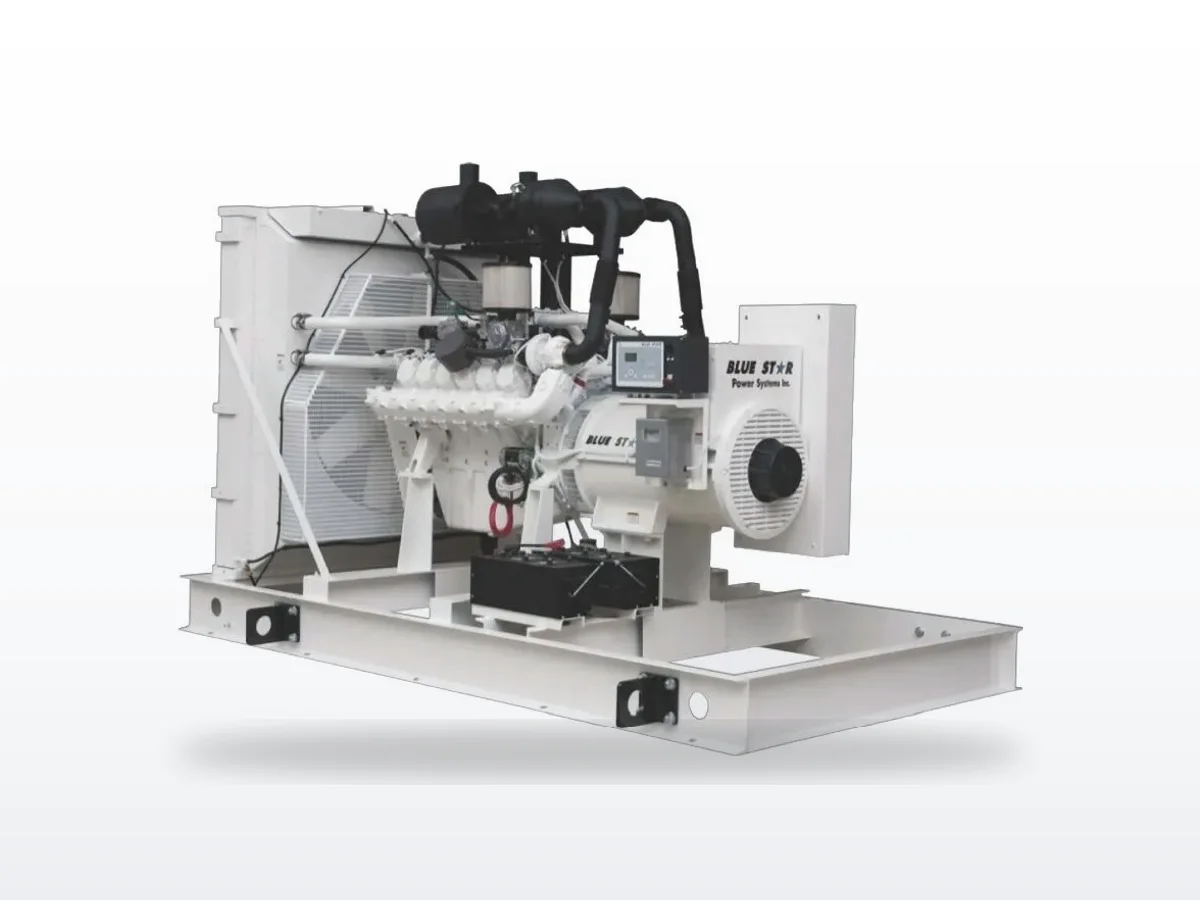
Series Overview#
The Blue Star PSI Industrial Gaseous series covers 500 kW to 1,250 kW standby output using natural gas and LP fuel, built on Power Solutions International (PSI) spark-ignition engine platforms. Eleven models span the range, organized across three engine families: the PSI 32L V12 (31.8 liters) for the NG500, NG600, and NG650 models; the PSI 40L V12 (39.2 liters) for the NG800 models; and the PSI 53L and 53LHO V16 (52.3 liters) for the NG1050 and NG1250. All models are three-phase, liquid-cooled, and EPA Stationary Spark Ignition compliant. Standby (-01) and prime (-01P) variants are available for most models, sharing the same engine platform and physical enclosure but differing in rated output and warranty terms.
For facilities that cannot use diesel — or prefer the operational simplicity of a piped gas supply over on-site diesel storage — the PSI Industrial Gaseous series represents the highest-output natural gas standby option in the Blue Star lineup. The 500–650 kW range (32L platform) is the volume segment, appropriate for large commercial buildings, non-critical hospitals, school campuses, and large multi-family developments. The NG800 (40L) steps into medium-large commercial and edge data center territory. The NG1050 and NG1250 (53L/53LHO V16) move into large data center, industrial, and campus-level standby power.
Blue Star pairs each engine with an open-architecture Basler DGC-2020 controller — the same platform used across the diesel lineup. Any qualified controls technician can service it, and it integrates with third-party BMS systems without OEM involvement. This is a meaningful differentiator in the industrial gaseous segment where long-term serviceability at scale matters. Blue Star Power Systems (North Mankato, Minnesota; a DEUTZ AG subsidiary since 2024) assembles the complete genset.
How to Choose#
NG500-01 / NG500-01P (500 kW) — 32L V12 entry: The lowest-output model on the 32L platform. The standby variant delivers 500 kWe on natural gas (400 kWe on LP); the prime variant delivers 450 kWe on natural gas (350 kWe on LP). Available in 208V through 600V three-phase.
NG600-01 / NG600-01P (600 kW) and NG650-01 / NG650-01P (650 kW) — 32L V12 stepped output: The NG600 and NG650 extract progressively more output from the same 32L engine and same physical enclosure as the NG500. LP output remains 400 kWe regardless of standby rating — natural gas output is the differentiator. Choose NG650 when 600 kW is marginal and you want to remain on the 32L platform without stepping to the 40L.
NG800-01 / NG800-01P (800 kW) — 40L V12: The step up to the PSI 40L V12 (39.2 liters) adds output headroom and the 4160V medium-voltage option. Standby output is 800 kWe on natural gas (475 kWe on LP). This is the appropriate model when the load study exceeds the 32L platform's ceiling and medium-voltage distribution is under consideration.
NG1050-01 / NG1050-01P (1,050 kW) — 53L V16: Moving to the PSI V16 platform, the NG1050 delivers 1,050 kWe standby on natural gas (700 kWe on LP). Available in 480V, 600V, and 4160V three-phase only — no 208V or 240V options at this power class. Prime variant delivers 900 kWe on natural gas.
NG1250-01 (1,250 kW) — 53LHO V16, natural gas only: The top of the series uses the high-output PSI 53LHO V16. Natural gas only — no LP option. Available in 480V, 600V, and 4160V three-phase. This is the largest single-unit natural gas standby generator in the Blue Star lineup; confirm AHJ certifications (UL 2200, cUL, CSA) before specifying.
Common Applications#
- Large commercial buildings: The NG500–NG650 range (32L platform) is the standard for large office towers, convention centers, and mixed-use developments over 200,000 sq ft where piped natural gas eliminates diesel logistics and storage permitting.
- Data centers (edge and mid-tier): The NG800 through NG1250 range addresses edge data centers and mid-tier colocation facilities where natural gas standby is preferred for fuel availability, extended runtime, and reduced permitting burden versus large on-site diesel tanks.
- Non-critical hospital loads: Generator codes for healthcare distinguish between life-safety and equipment branch loads. Natural gas standby in the 500–1,250 kW range handles non-critical branches in large hospitals, medical office campuses, and outpatient facilities where diesel is not mandated by code.
- School and university campuses: Campus-wide standby using natural gas generators eliminates refueling logistics during extended outages. The NG500–NG650 range covers most mid-size campus emergency power requirements.
- Large multi-family and mixed-use: High-rise residential buildings and large mixed-use developments with 400–800 kW emergency loads are a natural fit for the 32L and 40L platform models — especially in jurisdictions where natural gas piping to the generator room is straightforward.
Service & Maintenance#
PSI spark-ignition engines require more frequent maintenance than comparable diesel engines. The full-series service schedule is: oil changes every 250 hours or 12 months; air filter inspection at 1,000 hours; spark plug replacement at 1,500 hours; and coolant changes at 4,000 hours. The 250-hour oil change interval — half that of diesel — reflects higher combustion temperatures and oil degradation rates in spark-ignition engines and must not be extended.
The three failure modes that appear across all 11 models are:
Turbocharger failure (severe): Significant power loss and heavy exhaust smoke, typically around 12,000 hours. At 500–1,250 kW output, a full turbocharger failure causes total load shed. Proactive inspection starting at 10,000 hours — bearing play, oil consumption trend, boost pressure under load — is the industry-standard approach.
Ignition system (multi-cylinder) degradation (moderate): Multiple misfires and output derating, occurring around the 1,500-hour spark plug replacement interval. Spark plug condition deteriorates with fuel quality and combustion temperature. Following the 1,500-hour replacement schedule strictly, and using plugs meeting the OEM specification, is the primary mitigation.
Charge air cooler fouling (moderate): Reduced output and elevated intake temperatures around 10,000 hours. The charge air cooler (aftercooler) accumulates oil vapor deposits over time that restrict airflow. Scheduled inspection and cleaning at the 6,000–8,000 hour mark prevents thermal derating before a full service event.
For sites with LP fuel, monitor LP tank levels carefully — LP generators derate significantly versus natural gas, and fuel pressure drop under high-demand winter conditions can push the engine below rated output before the tank reads empty.
Application Guidance#
The Blue Star PSI Industrial Gaseous series is purpose-built for facilities that cannot or prefer not to use diesel in the 500–1,250 kW standby range — large commercial towers, non-critical hospital branches, edge data centers, and large campuses where piped natural gas eliminates diesel storage permits, tank maintenance, and fuel degradation risk. Three PSI engine platforms (32L V12, 40L V12, 53L/53LHO V16) cover the range with standby and prime-rated variants sharing the same enclosure, giving specifiers flexibility between emergency-only and continuous-duty operation without a separate product family. The open-architecture Basler DGC-2020 controller is serviceable by any qualified technician — meaningful at this scale where proprietary controls lock operators into single-OEM service contracts.
This series is overkill for applications below 500 kW — the PSI spark-ignition oil change interval is 250 hours (half the diesel standard), so you are accepting more frequent maintenance on a larger, more complex engine when a smaller unit would suffice. For natural gas standby from 130 to 500 kW, the Blue Star PSI Large Gaseous (265–500 kW) and PSI Mid Gaseous (130–200 kW) series are correctly sized. For diesel users at comparable power levels, the Blue Star Mitsubishi Diesel Standby covers 800–2,000 kW with 4160V output and Tier 2 diesel. For the largest natural gas generation requirements in a CAT platform — especially cogeneration and prime power — the CAT 3500 Series Gas covers 750–2,519 kW on continuous-duty ratings.