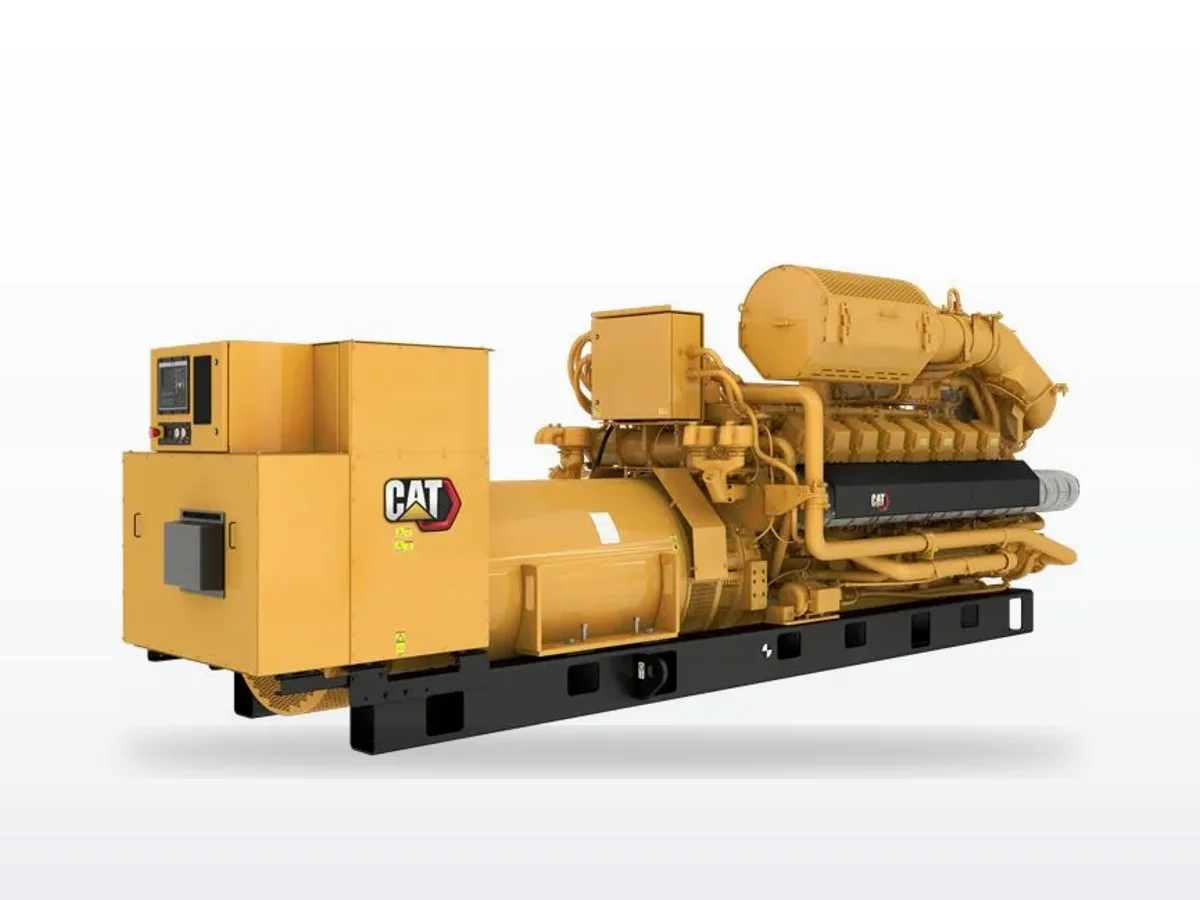
Series Overview#
The Cat 3500 Series gas engine platform spans 750 to 2,519 kW on natural gas, comprising five models: the G3512 (750 kW), G3516, G3516H, G3520E (approximately 2,022 kW), and G3520H (2,519 kW). Unlike the diesel variants in the 3500 family, these are purpose-built for continuous-duty baseload operation — cogeneration, distributed generation, and industrial prime power — rather than standby backup. Unlimited annual hours at continuous ratings, combined with EPA Stationary Spark Ignition certification, position this series for facilities that run generators as primary or co-primary power sources rather than emergency backup.
The platform's key technical differentiator is the SCAC (separate circuit aftercooling) system used on the G3516H and G3520H, which maintains charge air temperature independently from the jacket water circuit. This enables higher power density, better detonation control, and more consistent emissions compliance under varying ambient conditions — factors that matter when the engine runs thousands of hours per year rather than a few hours during monthly load tests.
The G3520H represents the ceiling of the series at 2,519 kW continuous from a 97.5-liter V-20 engine with ADEM A4 electronic controls. Its support for up to 25% hydrogen blending by volume makes it one of the few large gas generators positioned for a fuel transition pathway as hydrogen infrastructure develops. Multiple models in the series are also documented for landfill gas and biogas applications, expanding the addressable market beyond pipeline natural gas installations.
How to Choose#
Output requirement: The G3512 (750 kW) covers medium industrial and campus cogeneration loads. The G3516 and G3516H bridge the 1,000–2,027 kW range for larger campus and industrial CHP applications. The G3520E and G3520H (2,022–2,519 kW) serve the largest single-engine gas generation requirements — utility peaking, large industrial baseload, and multi-MW distributed generation sites.
H-suffix models (G3516H, G3520H): The H-suffix variants represent the current high-efficiency generation of the platform. The G3516H achieves 43.5% electrical efficiency and 85.9% total CHP efficiency — specifications that are decisive for energy project economics when the unit runs continuously. If CHP efficiency and emissions performance are the primary selection criteria, specify the H-suffix models over earlier G3516 and G3520 variants.
Voltage configuration: The series covers low-voltage (277/480V, 380V, 400V, 415V, 480V) and a broad medium-voltage range (3,300V, 4,160V, 6,300V through 11,000V, and 13,800V). For industrial distribution at 4,160V or international medium-voltage networks, confirm alternator availability at your target voltage before specifying.
Fuel flexibility: If your site has access to landfill gas, biogas, or is planning for hydrogen blending, the G3520H is the documented choice for alternative gas applications. Other models may be compatible but require fuel quality analysis and Caterpillar application engineering review before committing to non-pipeline fuels.
Paralleling arrays: Three models in the series are documented for paralleling applications. Utility peaking and distributed generation projects commonly parallel multiple G3516H or G3520H units to achieve 5–10 MW of total capacity with flexible dispatch.
Common Applications#
-
Cogeneration (CHP): All five models are documented for cogeneration. The G3516H and G3520H, with their SCAC cooling and high electrical efficiency, are the preferred platforms for combined heat and power projects where simultaneous electrical and thermal output is captured for facility use.
-
Distributed generation: All five models appear in distributed generation applications — grid-parallel operation, peak demand reduction, and utility interconnection programs. EPA Stationary Spark Ignition certification enables operation within NSPS and state air district permit frameworks.
-
Industrial baseload: The G3520E and G3520H are specified for industrial facilities with large continuous loads — manufacturing plants, refineries, and process operations — where the gas engine serves as a baseload generation source rather than a backup.
-
Utility peaking: Two models (G3520E class and G3520H) are documented for utility peaking applications, where fast start capability and dispatchability are required to respond to grid demand signals or peak pricing events.
-
Landfill gas and biogas: Two models are documented for waste gas fuels. These applications require fuel quality analysis — particulate content, Wobbe index, siloxane levels — before specifying gas engine models. Caterpillar application engineering review is required for non-pipeline fuels.
Service & Maintenance#
The Cat 3500 gas engine series has significantly different service intervals from the diesel variants. Oil changes are required every 2,000 hours (approximately annually for units running 6–8 hours per day), compared to 500 hours on the diesel platform. Air filter service is required at 4,000-hour intervals, and spark plug replacement is required at approximately 4,000 hours — a critical interval that must be tracked rigorously, as missed spark plug service leads to misfiring, rough running, and elevated emissions that can trigger permit violations.
Four failure modes appear consistently across the series. First, spark plug degradation is the highest-frequency maintenance event: at 4,000 hours, misfiring and rough running develop and emissions climb. Replace as complete sets on schedule without exception. Second, the prechamber and ignition system (on V-16 and V-20 models with prechamber combustion) develops hard starting and detonation symptoms at approximately 16,000 hours — budget for prechamber component inspection at major overhaul intervals. Third, turbocharger bearing wear at high hours (30,000+ hours) produces oil consumption, reduced boost, and elevated exhaust temperatures — plan turbocharger rebuilds as a life-cycle maintenance item for high-runtime units. Fourth, SCAC (separate circuit aftercooler) fouling on the G3516H and G3520H elevates manifold air temperature and creates detonation risk; monitor aftercooler circuit coolant temperature separately from jacket water temperature and clean the SCAC core on schedule.
The ADEM4 air-fuel ratio control system on the G3516H requires up to 180 seconds to stabilize after a load step during commissioning. Verify ignition timing and air-fuel ratio calibration at each major service interval to prevent timing drift that causes cylinder dropout.
Application Guidance#
The CAT 3500 Series Gas is purpose-built for continuous-duty baseload operation on natural gas — cogeneration (CHP), distributed generation, utility peaking, and prime power at industrial scale from 750 to 2,519 kW. Unlike standby-oriented gas generators, these platforms are designed for unlimited annual hours at continuous ratings, with the G3516H achieving 43.5% electrical efficiency and 85.9% total CHP efficiency at conditions that justify the capital investment only when the engine runs thousands of hours per year. The G3520H's support for up to 25% hydrogen blending positions it as one of the few large gas generators with a documented fuel transition pathway. Medium-voltage output from 3,300V through 13,800V enables direct integration with industrial and utility distribution infrastructure without step-up transformers.
This series is not appropriate for emergency standby backup duty — you are paying for a continuous-duty platform built around CHP economics, and the 2,000-hour oil change interval and 4,000-hour spark plug schedule are calibrated for high-runtime operation, not the annual exercise cycles of a standby generator. For natural gas standby below 750 kW, the Blue Star PSI Industrial Gaseous (500–1,250 kW) covers emergency and standby-rated applications on PSI V12 and V16 platforms at lower capital cost per kW. For prime power in the industrial range where diesel is preferred over gas, the CAT 3500 Series Large Diesel (1,000–3,000 kW) or CAT C175 Series (3,100–4,000 kW) provide equivalent scale on diesel with the same CAT dealer and parts infrastructure.