
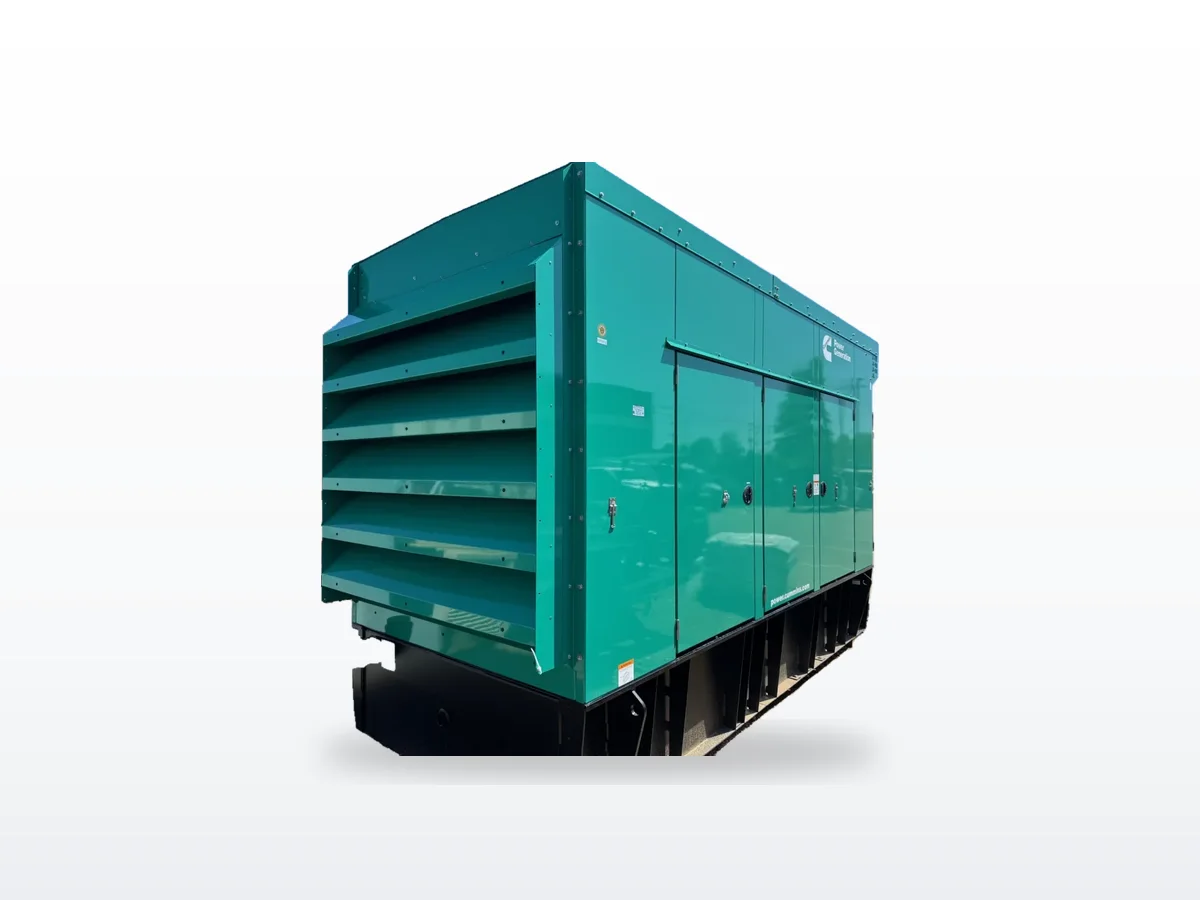
Series Overview#
The Cummins large gas series at 750–1,000 kW comprises two models: the C750 N6 (750 kW standby, GTA50 engine) and the C1000 N6 (1,000 kW standby, QSK60G engine). Both are fully integrated natural gas standby generator systems with PowerCommand 3.3 controls, AmpSentry protective relay, and UL 2200 certification — the same control and protection infrastructure used across Cummins' commercial and industrial standby lineup. This control consistency simplifies fleet management for facilities that operate multiple Cummins units across different output classes.
The C750 N6's GTA50 engine is a 50.3-liter, 16-cylinder heavy-duty industrial spark-ignited platform designed for the loads and duty cycles that large commercial and industrial standby applications impose. The C1000 N6's QSK60G uses the same 60-liter V-16 block as the diesel QSK60, adapted for natural gas operation, with turbocharged and charge air aftercooled aspiration for high power density. Both models accept full rated load in a single step per NFPA 110 Type 10 requirements, which is the critical specification for hospital and data center applications where transfer time directly affects operational continuity.
Voltage availability across this segment is particularly broad on the C1000 N6: 277/480V through 13,800V medium voltage, covering the full range of low-voltage and medium-voltage distribution systems used in large commercial, campus, and industrial installations. The C750 N6 supports a wide voltage range through the international three-phase spectrum as well as North American low-voltage configurations.
How to Choose#
C750 N6 vs C1000 N6: The 250 kW output gap between these two models is significant at this power level. If your standby requirement is between 500 and 750 kW, the C750 N6 covers the load with margin. If loads approach or exceed 750 kW, the C1000 N6 provides adequate headroom without moving to a paralleling arrangement. Confirm peak demand load profiles — not just average demand — before selecting between these models.
Voltage selection: The C1000 N6's medium-voltage capability (2,400/4,160V, 12,470V, 13,800V) makes it directly compatible with campus and industrial medium-voltage distribution systems. If your distribution runs at 4,160V or 13,800V, the C1000 N6 eliminates the need for an intervening step-up transformer, reducing capital cost and potential single-point failure risk. The C750 N6 is primarily configured for low-voltage applications.
Gas supply pressure verification: The C1000 N6 fuel gas supply pressure is documented as a severe failure risk — inadequate gas pressure during a load step causes lean misfire, governor hunting, and potential shutdown. Before specifying either unit, coordinate with your gas utility on minimum supply pressure under peak demand conditions. This is particularly important for urban installations where gas system pressure can vary during peak heating seasons.
CHP consideration: The C1000 N6's documented thermal efficiency (52.4%) supports evaluation for combined heat and power applications where recovered heat from the jacket water and exhaust systems can be used for space heating, process heat, or absorption cooling. CHP project economics at 1,000 kW are generally favorable when heat can be effectively captured and utilized.
Common Applications#
-
Commercial standby: Large commercial properties — office towers, shopping centers, and hotels — that prefer natural gas over diesel for fuel management simplicity specify C750 N6 or C1000 N6 based on load profile. Both meet NFPA 110 single-step load acceptance requirements.
-
Hospital standby: Hospitals that face diesel storage permitting restrictions or operational preferences for natural gas specify large-format gas generators at this output level. NFPA 110 compliance is a non-negotiable requirement; confirm load acceptance performance with your Cummins dealer.
-
Campus standby: Educational and corporate campuses with centralized standby power infrastructure and access to high-pressure natural gas service specify C750 N6 or C1000 N6 as primary building-block generators in centralized standby systems.
-
Industrial standby: Industrial facilities with substantial natural gas infrastructure that need 750–1,000 kW of emergency standby without diesel storage complexity specify these models for their industrial engine platforms and single-source Cummins integration.
-
Data center natural gas backup: Data centers where diesel storage is restricted by local code or where natural gas is specified as a sustainability initiative evaluate the C1000 N6 for its medium-voltage capability and NFPA 110-compliant load acceptance performance.
Service & Maintenance#
Both C750 N6 and C1000 N6 require oil changes every 500 hours or 12 months, and air filter service every 1,000 hours. At 16 cylinders, both engines have a significant spark plug count — the C750 N6 (GTA50, 16 cylinders) and C1000 N6 (QSK60G, 16 cylinders) each require all 16 plugs replaced at approximately 2,000 hours. Budget for this labor- and parts-intensive interval; misfiring, rough running, and power loss develop when spark plug replacement is deferred.
The charge air aftercooler on the C1000 N6 is a documented failure mode at approximately 15,000 hours — elevated charge air temperature causes detonation risk and power derate. Inspect and clean the aftercooler circuit at major service intervals and monitor charge air temperature under load during routine testing.
Fuel gas supply pressure is the most critical operational parameter on both models. The C750 N6 data is insufficient to specify an exact pressure threshold, but both models require stable minimum supply pressure under full load to prevent lean misfire events. Coordinate with your gas utility for peak demand pressure guarantees, and install gas pressure monitoring at the generator inlet as a standard commission item.
The wet cylinder liners on the C750 N6 (GTA50 platform) are a documented severe failure mode at approximately 30,000 hours — coolant leakage into the combustion chamber from liner erosion requires major overhaul. Plan major overhaul budgeting as a life-cycle maintenance item for high-hour C750 N6 installations. Battery banks on both models should be tested semi-annually and replaced on a scheduled cycle given the consequences of a failed start on a large natural gas generator.
Application Guidance#
The Cummins C750 N6 and C1000 N6 are the right specification for mission-critical and large commercial facilities requiring 750–1,000 kW of natural gas standby where diesel storage is operationally impractical or code-restricted — large hospitals preferring gas fuel management, data centers with natural gas sustainability mandates, campus central plants with access to high-pressure gas service, and industrial facilities with existing large natural gas infrastructure. The C1000 N6's medium-voltage output capability (up to 13,800V) is a direct disqualifier for competitor products in applications where medium-voltage distribution eliminates the cost and failure risk of step-up transformers. Both models' NFPA 110 single-step load acceptance compliance is non-negotiable for hospital and data center specifications; confirm this with your Cummins dealer for your specific configuration.
For loads below 750 kW on natural gas, this series is overkill — evaluate the Cummins N6 Commercial Gas (80–500 kW) or Cummins C-Series Commercial Gaseous (60–400 kW) instead. At similar output levels, the CAT 3500 Series Gas and Generac SG Series are the primary competing platforms; evaluate on medium-voltage options, CHP suitability, and OEM service coverage in your region. If diesel is acceptable at this output level — and fuel management complexity is manageable — the Gillette SPMI Series (800 kW–2 MW Mitsubishi diesel) and the Generac IDLC1250 serve similar facility types with larger per-unit capacity and without gas supply pressure dependence.