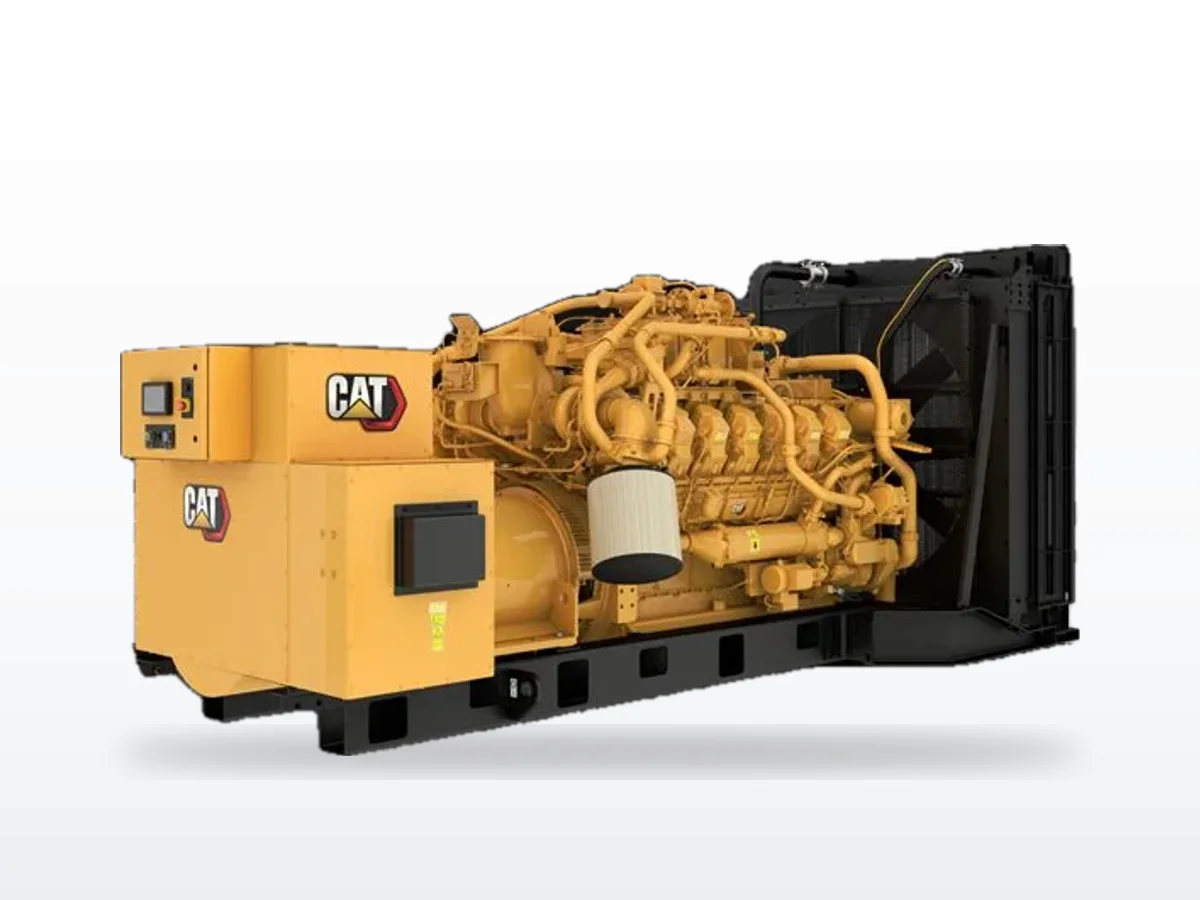
Series Overview#
The Cat G-Series natural gas generator line comprises two models built on the gaseous-fuel versions of Cat's classic 3400 Series engine blocks: the G3406 at 300 kW standby and the G3412 at 512 kW standby. The G3406 TA is a 14.6-liter inline-6 spark-ignited engine — the natural gas counterpart to the diesel 3406C — while the G3412C is a 27-liter V-12 that mirrors the architecture of the diesel 3412C. Both are turbocharged-aftercooled, EPA Stationary Spark Ignition certified, and designed for standby applications where pipeline natural gas is the preferred fuel over on-site diesel storage.
The key advantage of the G-Series over diesel alternatives is fuel management simplicity. On pipeline natural gas, there is no on-site fuel tank to permit, no diesel degradation to monitor, no fuel polishing schedule to maintain, and no fuel delivery logistics to manage. For hospitals, campus facilities, and commercial properties in jurisdictions with restrictive diesel storage permitting or fuel management requirements, this operational simplicity often justifies the gas generator specification even where the upfront cost differential is meaningful.
Both G-Series models carry EPA Stationary Spark Ignition certification, making them compliant for standby and emergency use under federal NSPS standards. The shared engine heritage with the diesel 3400 Series means parts availability and technician familiarity are strong — a practical consideration for facility managers who maintain mixed diesel and gas generator fleets.
How to Choose#
Output: G3406 vs G3412: The G3406 at 300 kW covers medium commercial buildings, hospital branches, and single-building campus standby. The G3412 at 512 kW serves larger commercial facilities, hospitals requiring greater single-generator capacity, and industrial applications that need more than 300 kW from a natural gas unit. If your load exceeds 512 kW and natural gas is required, evaluate the Cat 3500 Series gas engines (G3512 at 750 kW and above).
Voltage configuration: The G3406 supports 277/480V and 346/600V configurations. The G3412 extends the voltage range to include 208V, 220V, and 440V — covering more single-phase and international three-phase configurations. Confirm that your required output voltage is available on the specific model and alternator configuration before specifying.
Paralleling: The G3412 is documented for paralleling applications. If your campus or industrial site needs 750+ kW of natural gas backup capacity, two G3412 units in parallel provide that capacity with N+1 redundancy, avoiding the need to step up to the larger G3500 gas engine platform.
Hospital applications: Both models appear in hospital applications. The G3406 is documented for medium hospital branches; the G3412 for large hospital campuses. Gas generator specifications in healthcare settings require NFPA 110 compliance verification — confirm load acceptance time and steady-state voltage/frequency performance with your Cat dealer.
Legacy vs current availability: Like the diesel 3400 Series, the G-Series models are legacy platforms. Confirm parts and service availability for your region through a Cat dealer before specifying new installations; for most markets, support is adequate.
Common Applications#
-
Campus and university standby: Both G3406 and G3412 appear in campus standby applications. Natural gas eliminates the fuel management burden that multi-building campus diesel programs impose, and the G3412's paralleling capability supports redundant arrays for critical campus loads.
-
Hospital and healthcare: Medium and large hospitals specify G-Series generators to avoid diesel storage permitting complexity and to reduce fuel management overhead in facilities with already complex operational requirements.
-
Industrial standby: Industrial facilities that have natural gas utility infrastructure and prefer to avoid diesel storage permitting or spill risk specify the G-Series for their standby needs in the 300–512 kW range.
-
Large commercial standby: Office buildings, hotels, and large retail facilities that prefer natural gas over diesel for operational or permitting reasons specify the G3406 or G3412 based on their load profile.
Service & Maintenance#
Gas engine service intervals differ materially from diesel. The G-Series requires oil changes every 250 hours or 12 months — twice the frequency of equivalent diesel platforms — reflecting the different lubrication demands of spark-ignited gaseous fuel engines. Coolant changes are required at 4,000 hours (versus 6,000 on diesel), and air filters at 1,000 hours consistent with other Cat platforms.
The most distinctive maintenance item is spark plug replacement at 1,500 hours on both models. This interval is relatively short and must be tracked rigorously — missed spark plug service produces misfires, rough running, and elevated emissions. Replace plugs as a complete set on schedule rather than individually as symptoms develop.
Three failure modes are documented across the G-Series. Turbocharger degradation at approximately 12,000 hours causes loss of power and excessive smoke under load — plan turbocharger inspection at major overhaul intervals. Charge air cooler performance degrades at around 10,000 hours, reducing power output and elevating intake temperatures; inspect and clean the charge air cooler at each major service. Battery failure on the starting system (12V or 24V depending on configuration) is the most common cause of failed starts during actual outage events — test batteries semi-annually and replace on a scheduled basis.
Application Guidance#
The CAT G-Series is purpose-built for the 300–512 kW natural gas standby segment at hospitals, campuses, large commercial buildings, and industrial facilities where pipeline gas connectivity eliminates diesel storage permitting, fuel management, and spill risk. The G3412 at 512 kW is the larger and more versatile of the two models — its paralleling capability and extended voltage range (including 208V and international configurations) make it the preferred specification for campus applications requiring 750+ kW of natural gas backup from paralleled units, avoiding the step-up to the much larger Cat G3500 gas engine platform. The shared engine heritage with the diesel 3400 Series means service technicians with diesel 3400 Series experience can work on the G-Series with limited additional training — a practical advantage for facilities maintaining mixed diesel and gas generator fleets or in markets where Cat diesel technicians are more available than dedicated gas generator specialists.
This series is not appropriate when the load requirement is below 300 kW — the CAT DG Series (DG200 at 200 kW, DG400 at 400 kW) covers that range on natural gas with the additional advantage of non-emergency EPA certification for demand response use. Above 512 kW, the Cat G3500 Series gas engines serve continuous-duty cogeneration and distributed generation applications; for standby-only use above 512 kW, diesel platforms — the CAT C-Series (C18 at 600 kW, C27 at 800 kW) — are more commonly specified since the G-Series' fuel management advantage is reduced at higher power levels where diesel storage requirements are proportionally smaller relative to capital cost. Buyers comparing the G-Series against the Kohler REZX Series (300–500 kW enclosed gaseous) and Cummins N6 commercial gas should confirm spark plug service intervals and oil change frequency — gas engine maintenance costs are higher than diesel equivalents and should be factored into total cost of ownership.