
Series Overview#
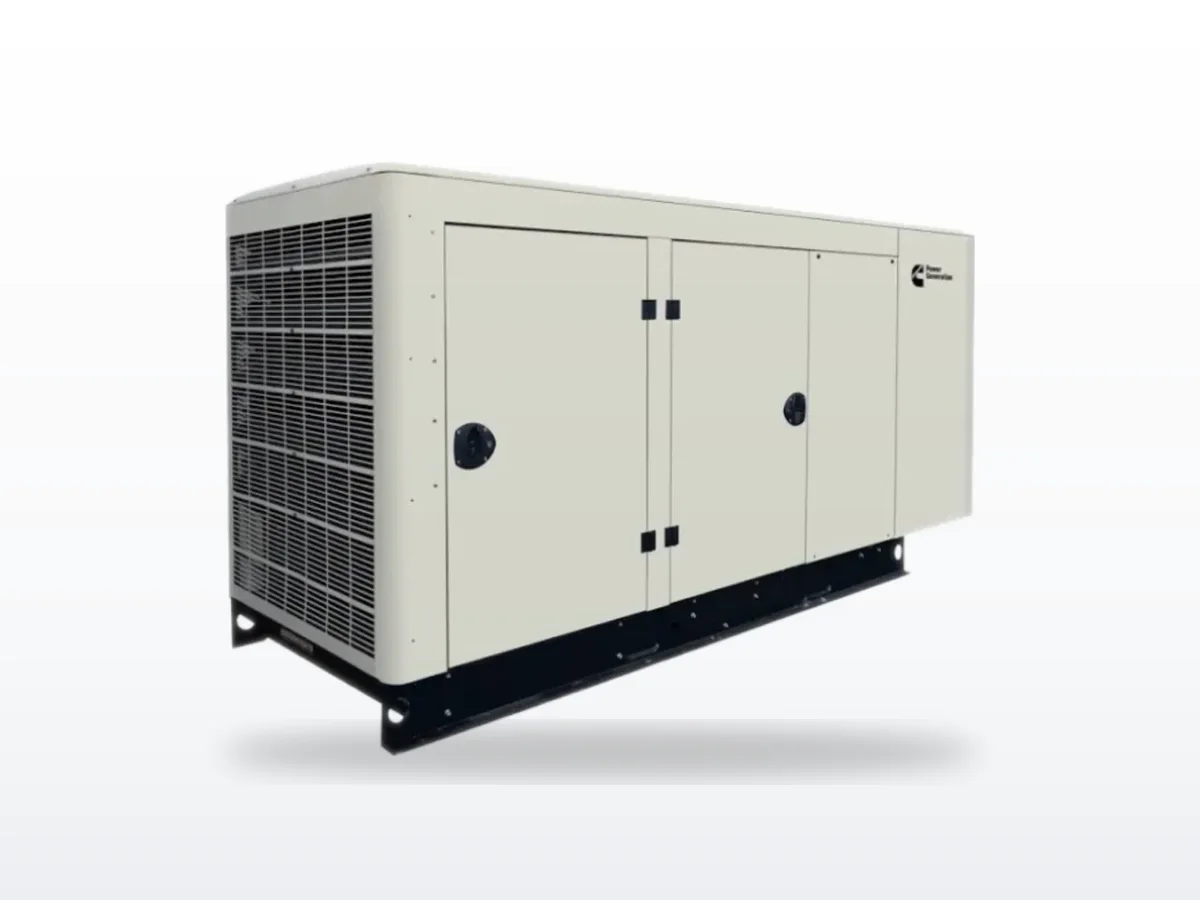
The Cummins N6 Commercial Gas series covers 80 to 500 kW natural gas standby across six models: the C80 N6, C100 N6, C125 N6, C175 N6, C300 N6, and C500 N6. These are fully integrated standby generator systems with Cummins-manufactured engines, alternators, and controls — the same vertical integration advantage that characterizes the broader Cummins product line. At this output range, the N6 series targets the commercial and light industrial standby market where natural gas is preferred over diesel for its pipeline fuel supply, elimination of on-site storage permitting, and reduced fuel management overhead.
The series uses a progression of engine platforms as output increases. At the smaller end, the QSJ5.9G and QSJ8.9G are turbocharged inline-6 spark-ignited engines in the 5.9–8.9 liter displacement range, optimized for the 80–175 kW commercial output class. The C300 N6 steps up to the GTA 855E, a 14-liter inline-6 with a well-established service history in stationary power. The C500 N6 uses the GTA 28E, a 28-liter V-12 — the only N6 model with a V-12 architecture — providing conservative power density and a documented major overhaul interval of 30,000 hours.
Most N6 models in the small-to-medium range (C80 through C125) are available in the Quiet Connect RS sound-attenuated enclosure configuration, with documented sound levels in the 71–73 dB(A) range at 23 feet. This acoustic performance is relevant for installations in urban commercial environments, suburban zoning districts with noise ordinances, or healthcare campuses where generator sound levels are a design constraint.
How to Choose#
Output by application: The C80 and C100 N6 cover small commercial standby — retail storefronts, small offices, and light commercial locations with 60–100 kW essential loads. The C125 and C175 N6 address medium commercial facilities — hotels, apartment buildings, and mid-size commercial properties. The C300 N6 serves large commercial buildings and industrial standby applications in the 250–300 kW class. The C500 N6 targets large industrial standby and commercial facilities with 400–500 kW essential loads — the highest-output model before stepping to the large gas series (C750 N6 and above).
Enclosure and sound level: The C80 N6 (RS80) and C125 N6 (RS125) have documented dB(A) ratings in their Quiet Connect enclosures. Specify these models when sound level at the property line is a zoning or design requirement. Confirm specific sound level ratings for other N6 models with your Cummins dealer if acoustic performance is a project specification criterion.
Single-phase vs three-phase: The N6 series supports both single-phase and three-phase configurations. Small commercial sites commonly use single-phase 120/240V distribution; most commercial and industrial standby applications require three-phase output. Confirm distribution panel voltage before specifying.
Wet liner considerations (C175 N6): The C175 N6's GTA 8.3G engine uses replaceable wet cylinder liners. This is a documented severe failure mode at high hours — liner erosion causes coolant leakage into the combustion chamber. For high-runtime applications, factor major overhaul costs into the total cost of ownership analysis. Lower-runtime standby-only applications face negligible risk from this failure mode.
V-12 vs inline-6 (C500 N6): The C500 N6 is meaningfully different from other N6 models in engine architecture, footprint, and service requirements. Its 28-liter V-12 provides very conservative power density at 500 kW — a positive for durability and overhaul intervals — but the physical footprint and service access requirements of a V-12 are greater than the inline-6 models below it. Ensure your mechanical room or pad location can accommodate the C500 N6 footprint before specifying.
Common Applications#
-
Commercial standby: All six N6 models are rated for commercial standby. The C80–C125 N6 range is the most common natural gas standby specification in light commercial construction — small retail, fast food, small medical offices — where eliminating diesel permitting is a project simplification goal.
-
Industrial standby: Five of six N6 models are documented for industrial standby applications. The C300 N6 and C500 N6 serve light manufacturing, warehousing, and industrial facilities that have natural gas utility infrastructure and prefer its operational simplicity over diesel.
-
Hotel and hospitality: The C125–C250 N6 range is commonly specified for hotel standby applications where natural gas is the site's primary energy source and diesel storage represents an unnecessary operational burden.
-
Healthcare (non-critical): Hospitals and medical facilities with non-critical branch standby requirements specify N6 models for branches where natural gas is permissible under NFPA 99 and where the lower kW requirements of specific branches match the N6 output range.
Service & Maintenance#
All N6 models require oil changes every 500 hours or 12 months, and spark plug replacement every 1,000 hours. Air filter service is required every 500 hours — more frequent than the 1,000-hour interval on diesel generators, reflecting the sensitivity of gaseous engine air-fuel ratios to air filter restriction. With 6 to 12 spark plugs depending on model, and a 1,000-hour replacement interval, spark plug maintenance is the most frequent scheduled cost item in the N6 series.
Five failure modes are documented across the N6 series. Spark plug misfiring at around 1,000 hours causes rough running, elevated emissions, and check-engine lamp activation. Air-fuel mixer and fuel regulator issues (rich/lean hunting, unstable idle, poor transient response) develop from regulator wear or calibration drift — a documented issue across multiple N6 models. Battery failure on 12V or 24V starting systems (depending on model) causes fail-to-start events, particularly on cold mornings; test and replace batteries on schedule. Coolant system issues — hose weeping, thermostat failure, and low coolant alarms — appear across multiple models and are a practical reminder to inspect coolant hoses and clamps at every annual service. Wet cylinder liner erosion on the C175 N6 (GTA 8.3G) is a severe failure mode at high hours that causes coolant intrusion into the combustion chamber.
The C500 N6's lube oil system (72-qt capacity) requires monitoring at extended high-load operation for elevated sump temperature. Budget appropriately for the significant oil volume at each 500-hour service.
Application Guidance#
The Cummins N6 Commercial Gas series is well matched to natural gas standby from 80 to 500 kW across the full range of commercial and light industrial applications — small retail and offices (C80/C100 N6), mid-commercial hotels and multi-family buildings (C125/C175 N6), large commercial campuses (C300 N6), and large industrial standby (C500 N6) — where pipeline natural gas is available and diesel storage is operationally undesirable. The Quiet Connect RS sound-attenuated enclosure configurations on the C80 and C125 N6 (71–73 dB(A) at 23 ft) are a specific differentiator for urban commercial installations or suburban zoning districts where neighbor-facing generator noise is a design constraint. The C100 N6's documented propane vapor capability also makes it the only small N6 model with a fallback fuel option for sites where natural gas supply reliability is a concern.
This series lacks EPA Stationary Spark Ignition documentation on most models — if EPA SI certification is a hard permit requirement for your jurisdiction's NSPS compliance or non-emergency operation hours, the Cummins C-Series Commercial Gaseous (60–400 kW, all EPA SI certified) is the correct path. For natural gas prime power (continuous-duty) rather than standby, the N6 series is not rated for that duty cycle — evaluate the Gillette PR Series (80–540 kW natural gas prime) instead. Above 500 kW on natural gas standby, this series has no upward path — step to the Cummins Large Gas 750–1000 kW series or the Gillette SP Series (up to 1,050 kW) for larger natural gas standby requirements.