Series Overview#
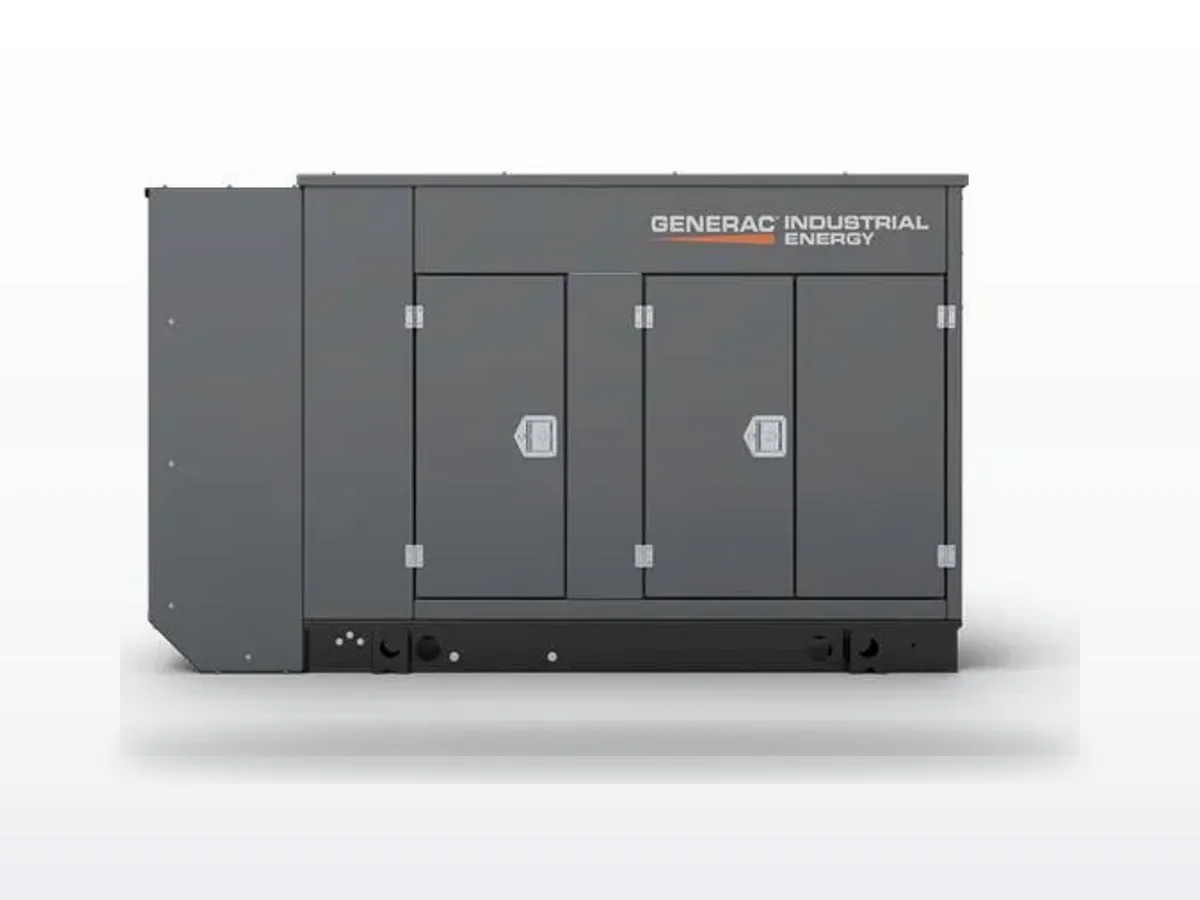
The Generac SG Series is Generac's complete industrial gaseous generator lineup, covering 23 models from 35 to 1,000 kilowatts of standby power. All models run on natural gas or LP vapor with liquid-cooled, Generac-built spark-ignited engines. EPA certified for stationary spark ignition applications, the SG Series is available in single-phase and three-phase configurations across voltages from 120/208V through 347/600V, and most models at 60 kW and above carry a demand response rating in addition to the standby rating — enabling participation in utility peak-load programs.
Generac builds all SG Series engines in-house, from the compact 4.5L inline-4 at the bottom of the range through the 49.0L V12 at the SG1000. This vertical integration keeps parts in Generac's own dealer network and simplifies warranty and service coordination across the full range. The engine platform progression follows the power tiers: 4.5L naturally aspirated (SG035) and turbocharged (SG045–SG070), 9.0L V8 (SG080–SG150), 14.2L inline-6 (SG175–SG500), and the V12 (SG625–SG1000). Each platform transition involves meaningful differences in service requirements, parts, and support.
The SG Series occupies an important niche for commercial and institutional standby: facilities with reliable natural gas supply that want to eliminate diesel fuel storage obligations, simplify emissions permitting, and retain demand response eligibility. From a 35 kW small commercial office up to the megawatt-class SG1000 serving large campuses and hospitals, the SG Series is Generac's answer to the full commercial gaseous market.
How to Choose#
Selecting within the SG Series requires matching the load requirement to the engine platform and considering the demand response eligibility:
35–50 kW (SG035–SG050, Generac 4.5L inline-4): Entry-level commercial. Naturally aspirated on the SG035, turbocharged starting at SG045. The SG040 uses an older 5.4L V8 carbureted platform — check the spec sheet carefully if you encounter SG040 units in the field, as service procedures differ from the current inline-4 line. Single-phase and three-phase available.
60–70 kW (SG060–SG070, Generac 4.5L turbocharged): The 4.5L platform running at its highest output. These models run at elevated BMEP — exhaust temperatures above 1,300°F are documented, which increases exhaust valve and coolant system maintenance sensitivity. Demand response rated.
80–150 kW (SG080–SG150, Generac 9.0L V8): Platform transition to the V8. The SG080 uses the naturally aspirated 9.0L; SG130 and SG150 add turbocharging and aftercooling. Demand response rated on most models. The 8-cylinder spark plug set needs coordinated replacement — defer service at your peril on this platform.
175–500 kW (SG175–SG500, Generac 14.2L inline-6): The highest-volume commercial range for the SG Series. Power Zone Pro Sync controller with 7-inch touchscreen and Ethernet communications becomes standard at SG175. Exhaust temperatures in the 1,285–1,440°F range across this platform — coolant system and exhaust valve maintenance are the priority items.
625–1,000 kW (SG625–SG1000, Generac V12): Large-scale single-unit gaseous standby. The SG1000 uses a 49.0L V12 with 4,620–5,862 scfh of full-load gas demand — gas supply sizing is a project-critical design element. Verify that the site's gas utility and distribution system can sustain full-load demand before specifying.
For voltage selection, models from SG035 through SG150 are available in both single-phase (120/240V) and three-phase (277/480V, 346/600V, 347/600V). Models at SG175 and above are predominantly three-phase. Confirm single-phase availability on your target model with the spec sheet.
Common Applications#
- Commercial standby (offices, retail, small industrial): 21 of 23 SG Series models are tagged for commercial standby — the broadest coverage of any Generac gaseous line. The elimination of diesel storage makes the SG Series straightforward to permit in urban and suburban commercial zones.
- Demand response programs: 16 of 23 models carry a demand response rating. For facilities enrolled in utility DR programs, the SG Series can offset energy costs during peak periods — a financial advantage that diesel standby generators typically cannot offer.
- Healthcare facilities: 14 of 23 models are specified for healthcare. NFPA 110 permits natural gas generators in some healthcare classifications — confirm with the AHJ before specifying. The SG Series covers clinic-level standby (SG060–SG100) through full hospital standby (SG500–SG1000).
- Campus and data center standby: 13 models are specified for campus applications; 11 for data centers. Multi-generator paralleling arrays using SG Series units allow campus power plants to add capacity in increments without changing engine or service platforms.
- Industrial standby: 14 models cover industrial-standby applications. For industrial facilities with existing natural gas infrastructure, the SG Series avoids the cost of diesel tank installation and the permitting complexity of on-site diesel storage.
Service & Maintenance#
The SG Series has a tighter spark plug replacement schedule than the diesel SD Series — 1,000 hours on most models, 1,500 hours on some larger units. This is the most important scheduled maintenance interval unique to gaseous generators. Deferring spark plug replacement causes misfires, rough running, elevated exhaust temperatures, and accelerated valve seat wear. The 6-cylinder platform (SG175 and above) requires coordinated multi-plug replacement; the cost is modest but requires scheduling.
Fuel regulator diaphragm failure is the most widely documented failure mode across the SG Series (12 of 23 models), causing frequency instability or fuel starvation. Regulators should be inspected at each major service interval and replaced proactively based on hours rather than waiting for a fault. Higher fuel demand at the large-displacement models (SG625 and above) makes regulator condition especially consequential.
Exhaust valve seat recession from high exhaust temperatures is documented as a severe failure mode across 8 models in the turbocharged NG platforms. Natural gas combustion runs hotter than diesel, and the turbocharged platforms push exhaust temperatures above 1,200°F. Follow the coolant change schedule (4,000 hours) strictly, as coolant degradation accelerates heat buildup in the cylinder head. Facilities operating these generators in non-emergency (demand response) duty cycles — where hours accumulate significantly faster than standby-only units — should treat the spark plug and coolant intervals as firm maxima.
Application Guidance#
The Generac SG Series is the right choice for commercial and industrial facilities with reliable natural gas supply that want to eliminate on-site diesel fuel storage, simplify emissions permitting, and retain demand response eligibility — most SG models from 60 kW and above carry a DR rating that diesel standby generators cannot offer. Available from 35 to 1,000 kW across 23 models on Generac-built engines, it covers small commercial offices through large hospital campuses and multi-generator paralleling arrays.
This series is not appropriate when utility gas supply is unreliable, when the facility is in an area prone to gas shutoffs during disasters, or when extended prime power operation is needed without a firm gas supply commitment. For those scenarios, the diesel equivalent is the Generac SD Series (10–1,500 kW). For facilities that prefer a gaseous standby platform with a different engine and single-phase output options at 40–200 kW, the Kohler KG Series is a direct alternative with Kohler-built engines and dual-fuel (NG/LPG) switching capability.