
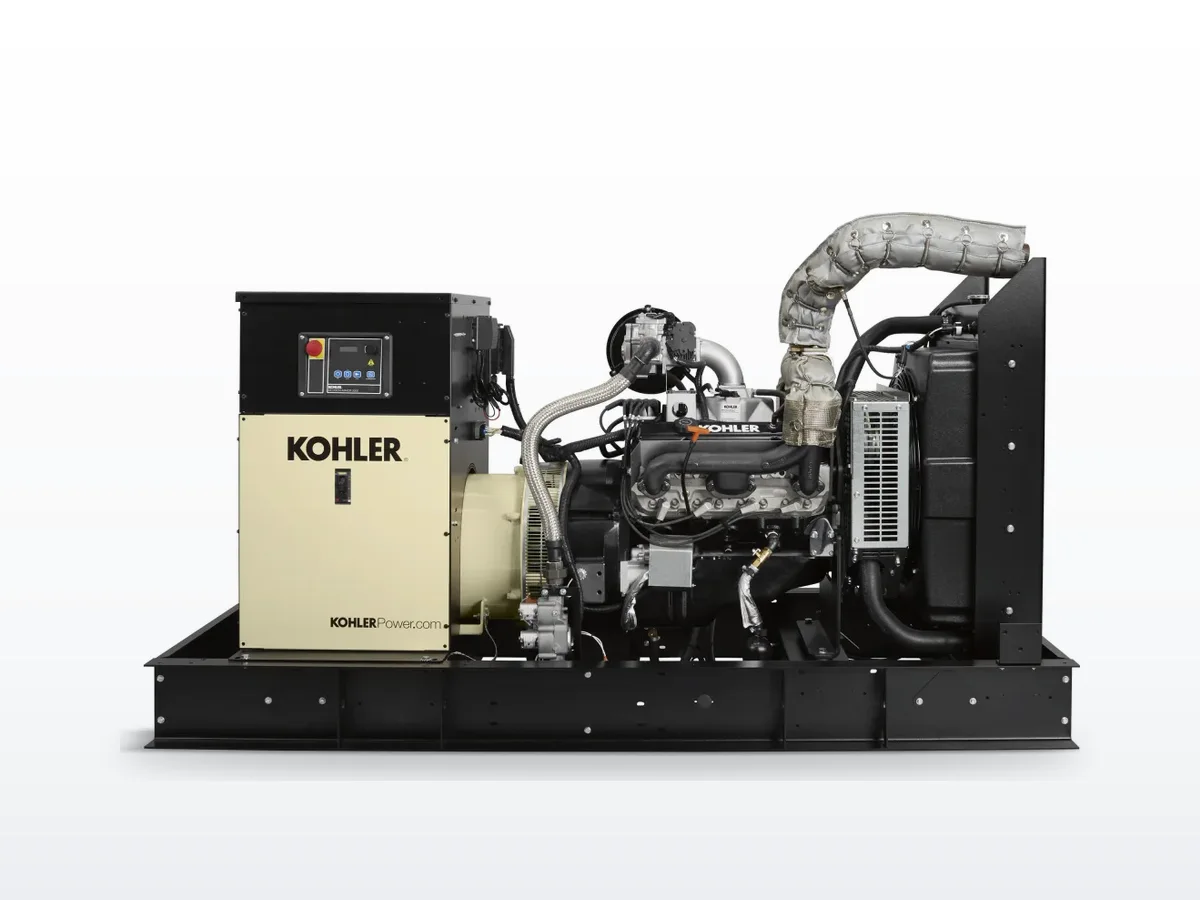
Series Overview#
The Kohler KG Series is the primary commercial-to-industrial gaseous generator line from Kohler covering 40 to 200 kW standby, built entirely around Kohler-manufactured engines. From the entry-level KG40 through the KG200 flagship, every model uses a Kohler-branded spark-ignition gaseous engine — a design philosophy that mirrors the KD Series diesel line's reliance on Kohler-built engines rather than third-party OEMs. The series is EPA certified to Subpart JJJJ for stationary spark ignition, supports natural gas, LPG, and dual-fuel configurations with field-selectable fuel switching, and is available in both single-phase 120/240V and three-phase 208V/240V/480V configurations.
The KG Series covers a fundamentally different application than the REZX and RZX lines. Where those series are purely three-phase industrial platforms, the KG line includes single-phase outputs that bridge the residential-to-commercial boundary. The KG40 through KG60 serve the light-commercial sweet spot: convenience stores, small restaurants, telecom huts, multi-tenant retail, and data closets. Moving up, the KG80 and KG100 address medium commercial buildings — hotels, multi-family residential complexes, schools, and light industrial operations. The KG125 and KG200 serve larger commercial facilities where gaseous fuel is preferred over diesel.
Engine architecture transitions at two key points in the lineup. The KG40 through KG80 use the naturally-aspirated KG6208 6.2L V8 (KG6208 base designation). At 80 kW, forced induction begins: the KG80 uses the turbocharged KG6208TSD, and the KG100–KG125 step up to the KG6208THD. At 200 kW, the architecture transitions completely — the KG200 uses the Kohler KG10V08T, a purpose-built 10.3L turbocharged and aftercooled V8 with heavier rotating assembly and larger bearings designed for longer-cycle operation. The KG6208 family is the same industrial-grade engine block used in Kohler's commercial standby diesel line through the KG designation, providing service technician familiarity across product lines.
All KG Series units operate at 1800 RPM and include Brushless Rare-Earth Permanent-Magnet alternators on most models, providing fast excitation response and sustained short-circuit capability up to 300% of rated current for 10 seconds — important for facilities with significant motor-starting loads.
How to Choose#
40–60 kW: KG40, KG45, KG50, KG60 (naturally-aspirated KG6208). These four models cover the light-commercial bracket. If your load calculation falls below 35 kW, the KG40 (36 kW prime) is appropriate. The KG45 and KG50 are mid-steps; select based on whether your peak load sits above or below 45 kW prime-rated output. The KG60 (54 kW prime) is the top of the naturally-aspirated range and the most common choice for full-service restaurants, small hotels, and light commercial multi-tenant buildings.
80 kW: KG80 (turbocharged KG6208TSD). The KG80 is the entry point for turbocharged output. At 72 kW prime, it bridges the gap between the KG60 and the larger KG100. This is the right choice when your load calculation sits in the 55–70 kW range and you need headroom beyond what the KG60 provides.
100–125 kW: KG100 and KG125 (turbocharged KG6208THD). The KG100 (90 kW prime) and KG125 (113 kW prime) use the same KG6208THD engine with different alternator windings. If your load is in the 70–100 kW range, the KG100 is sufficient; for 100–110 kW loads, the KG125 is correct. Both models share the same enclosure and service parts family.
200 kW: KG200 (KG10V08T). The KG200 (180 kW prime) is in a separate engine class from everything below it. This is a direct competitor to small diesel units at the 150–180 kW prime level. Buyers comparing the KG200 to diesel alternatives should weigh fuel infrastructure and storage requirements — the KG200 on natural gas eliminates on-site diesel storage entirely.
Common Applications#
-
Hotels and multi-family residential. Hotel properties with significant HVAC, elevator, and lighting loads in the 50–120 kW range are one of the primary KG Series applications. Multi-family buildings with common loads — corridors, elevators, fire systems, parking — fall in the same power range. Natural gas connectivity is almost universally present in these building types.
-
Cold storage and refrigeration facilities. Cold storage operations where power loss means product loss have a strong preference for continuously-available fuel — natural gas or LP vs. diesel storage. The KG Series is a common choice for cold storage backup where diesel tank management is burdensome.
-
Light industrial and manufacturing. Small manufacturing facilities, machine shops, and process operations in the 60–150 kW demand range use KG Series generators where gaseous fuel is available and diesel storage is impractical.
-
Healthcare non-critical applications. Medical office buildings, outpatient clinics, and non-critical hospital loads (administrative, parking, non-life-safety) in the 80–150 kW range use KG Series units with gaseous fuel for reliable standby without the fuel management complexity of diesel.
-
Telecom and data closets. The KG40 and KG60 are frequently specified for telecom central offices, distributed cell sites, and small data closets where continuous natural gas service is the reliable fuel option.
Service & Maintenance#
The KG Series oil change schedule is primarily 12-month calendar-based for low-cycle standby generators, with 500-hour interval benchmarks applicable to higher-cycle prime power applications (on 3 of 8 models). Coolant replacement is scheduled at 4,000 hours (on 6 of 8 models) — approximately every 4–8 years for typical standby use. Air filter service is at 1,000 hours (6 of 8 models), and spark plug replacement is at 2,000 hours (3 of 8 models).
Starting battery failure is the most consistently observed failure mode across the KG Series fleet, present in units across all kW classes. The weekly exercise cycle helps keep batteries charged, but a battery that reads adequate voltage under float charge may fail to deliver sufficient cold-cranking current after extended dormancy. Annual battery load testing and proactive replacement on a two-to-three-year cycle is recommended.
Turbocharger bearing and seal wear on the turbocharged models (KG80–KG200) typically manifests around 12,000 hours with symptoms of oil in the intake, blue smoke, and reduced power. Coolant hose degradation appears around 5,000 hours — weeping clamps and soft hoses are early indicators that should be addressed before a hose failure causes a low-coolant fault. Spark plug and ignition system issues across the naturally-aspirated models can appear as early as 500 hours in some deployments; the fuel pressure regulator is the other primary failure mode, with hard starting and gas pressure faults appearing around 6,000 hours.
Application Guidance#
The Kohler KG Series is best suited to commercial and light industrial gaseous standby in the 40–200 kW range — hotels, multi-family buildings, cold storage, non-critical healthcare, and data closets — where natural gas or LP is the preferred fuel and Kohler-built engine vertical integration (single-vendor warranty, consistent parts sourcing) is a priority. The series' single-phase output availability at all kW ratings is a practical differentiator versus purely three-phase commercial platforms when the distribution system is single-phase.
Above 200 kW on gaseous fuel, the KG Series has no upward path within Kohler's residential and commercial lineup; for gaseous standby from 35–1,000 kW with demand response eligibility and a broader model selection, the Generac SG Series is the natural alternative. For KG Series applications in a similar kW range that require diesel fuel instead of gaseous — typically when natural gas supply reliability is a concern — the Cummins D6 Commercial Diesel (80–350 kW) or Generac SD Series (10–1,500 kW) cover the same commercial standby market on diesel.