
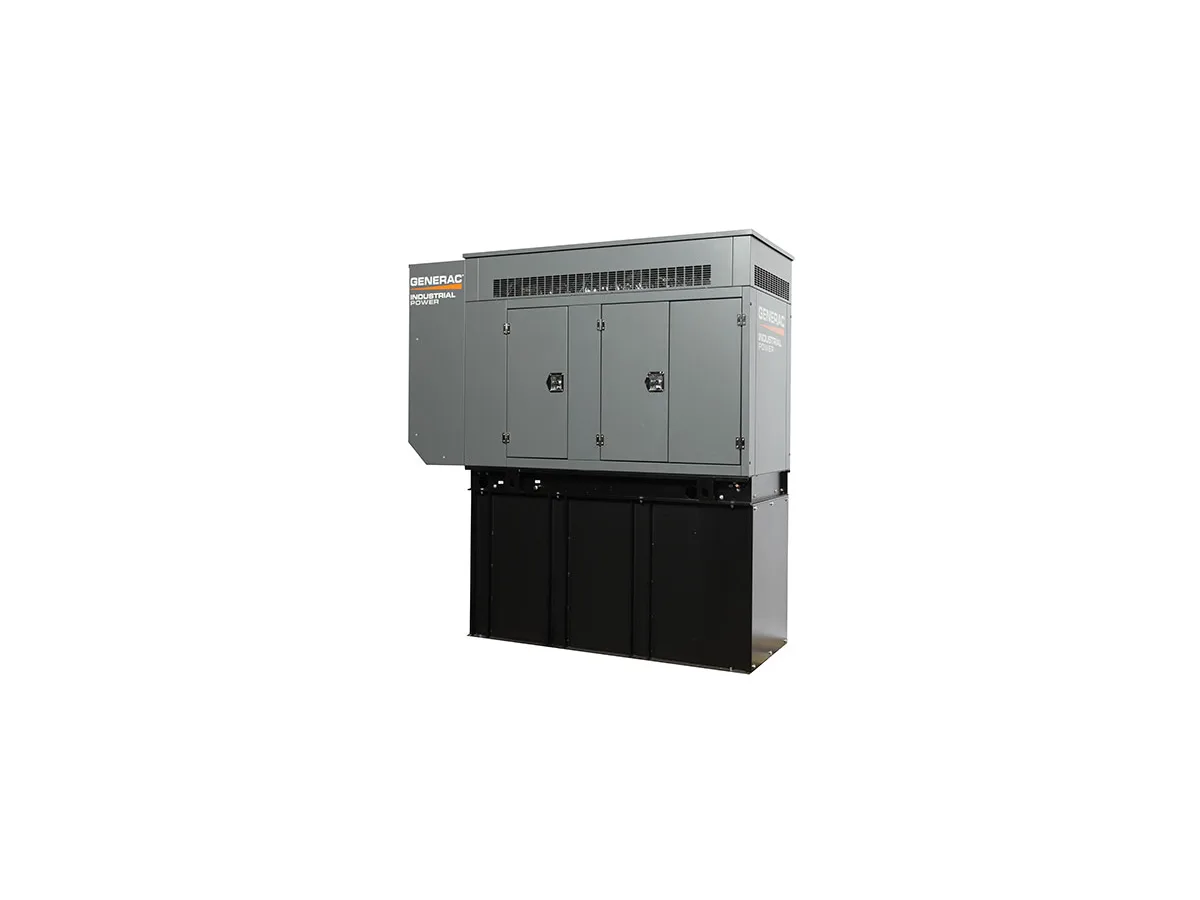
Series Overview#
The Generac SD Series is Generac's core industrial diesel generator lineup, spanning 20 models from 10 to 1,500 kilowatts of standby power. It is the broadest diesel line Generac offers — broader than the IDLC Series (one model at 1,250 kW) and the SD/MD Series (three models at 2,250–3,000 kW) — and covers the full range of commercial standby applications from small office buildings to large healthcare and data center installations. Available in single-phase and three-phase configurations across voltages from 120/208V through 346/600V, the SD Series is the answer for most specifiers looking at diesel standby in the under-1,500 kW range.
Engine selection across the SD lineup reflects Generac's strategy of using purpose-matched OEM platforms at each power tier. The smallest models — SD010 through SD020 — run on Perkins 2.22L engines, a well-proven small diesel with a broad service network. The SD035 and SD050 use Generac's own 3.4L proprietary engine, built at Generac's Wisconsin facilities. The critical mid-range from 60 to 300 kW transitions to Iveco/FPT engines: 4.5L four-cylinder platforms at 60–80 kW, 6.7L six-cylinder platforms at 100–175 kW, 8.7L at 200–250 kW, and 10.3L at 275–300 kW. At the top of the line, the SD1500 uses a Mitsubishi S16R-Y2PTAW-1 65.4L V16 — a heavy-duty industrial engine in a different class entirely from the rest of the series.
SD Series generators are EPA certified for stationary emergency applications — larger models (250 kW and above) carry Tier 2 certification. All models use liquid cooling with enclosed enclosures. Mobile Link remote monitoring is standard on most configurations, providing cellular-based status alerts, fault codes, and maintenance reminders — a feature that distinguishes Generac's commercial line from many competitors at this price point.
How to Choose#
The SD Series is organized into distinct platform tiers that matter for both performance and maintenance:
10–20 kW (SD010–SD020, Perkins 2.22L): Single-phase or three-phase. These share a common compact footprint. Choose SD010 for minimal loads, SD015 for a small step up, SD020 for the maximum output on this platform. Perkins parts and service access are well-established through both Generac dealers and Perkins' own network.
35–50 kW (SD035–SD050, Generac 3.4L): Single-phase or three-phase. Generac's proprietary engine — service must go through Generac's dealer network. The SD035 (32 kW prime) and SD050 (45 kW prime) cover the mid-small commercial range where Perkins power is insufficient but Iveco/FPT power is cost-prohibitive.
60–80 kW (SD060–SD080, Iveco/FPT 4.5L): These models mark the transition to a larger engine family and a belt-driven water pump design. Single-phase or three-phase. Note that the SD060 and SD080 share the same 4.5L displacement; the SD080 runs at significantly higher BMEP, which increases service intensity at the same interval.
100–175 kW (SD100–SD175, Iveco/FPT 6.7L): Three-phase only at most voltages. The SD100 and SD130 use the base 6.7L tune; the SD150 adds a 4-valve head and electronic injection for higher output; the SD175 uses a Generac-branded 6.7L variant with further tuning. The SD175 runs the highest exhaust temperature in this subgroup (1,040°F), making coolant maintenance especially important.
200–300 kW (SD200–SD300, Iveco/FPT 8.7L–10.3L): Three-phase only. The SD200 and SD250 use the 8.7L platform; SD250 steps up to common rail injection with a 24V electrical system. SD275 and SD300 use the 10.3L platform. If you need 250 kW or above, confirm whether the application calls for the 8.7L or 10.3L platform based on prime vs standby duty cycle requirements.
400–750 kW (SD400–SD750): Three-phase only at 277/480V or 346/600V. Mid-range large-commercial. These models serve the range that most large commercial projects specify — consult individual spec sheets for engine details at each rating.
1,500 kW (SD1500, Mitsubishi V16): This is a different category — a full megawatt-and-a-half standby unit on a 65.4L V16. Service complexity is substantially higher than any model below it. Factor in the specialized service requirements before specifying if the IDLC1250 or SD/MD2250 platforms also meet the load requirement.
For voltage configuration: most models below 250 kW support single-phase (120/240V) and three-phase (277/480V, 346/600V) options. Models at 250 kW and above are predominantly three-phase. Confirm single-phase availability on your target model before specifying.
Common Applications#
- Commercial standby (offices, retail, multi-family): The SD Series covers every commercial load size from a small office at 10 kW to a large commercial campus at 1,500 kW. The availability of single-phase models at the lower end makes it suitable for buildings served by 120/240V single-phase utility service.
- Healthcare facilities: All 20 SD Series models carry healthcare as an application. NFPA 99 and NFPA 110 compliance for hospital life-safety branches typically requires diesel standby — the SD Series covers the full range from a small medical office at 50 kW to a regional hospital at 750+ kW.
- Municipal infrastructure: Water treatment plants, pump stations, wastewater facilities, and public buildings. The SD Series' combination of Tier 2 EPA certification and broad voltage options makes it straightforward to specify for government procurement.
- Data centers (small to mid-size): The SD Series from 200 kW through 1,500 kW targets edge data centers, enterprise server rooms, and colocation facilities that need reliable diesel standby without the complexity of the megawatt-class SD/MD platform.
- Light industrial and manufacturing: Factories, warehouses, and process facilities with three-phase 277/480V service and significant motor loads. The mid-range models (SD100–SD300) cover most light-industrial standby requirements with straightforward service access.
Service & Maintenance#
The SD Series shares a consistent baseline service schedule across all 20 models: oil and fuel filter changes every 500 hours or 12 months, air filter service at 1,000 hours for most models (500 hours on some smaller units), and coolant change at 4,000 hours where specified.
Battery failure is the most common failure mode across the SD Series, documented across 14 of 20 models. Standby generators sit for extended periods between exercises and the float charger cannot fully compensate for battery degradation over multiple years. Annual load testing and proactive replacement at 36–48 months is the most reliable preventive measure. Models at 250 kW and above use a 24V dual-battery system — test both batteries independently, as one failed battery in a pair can prevent cranking while the other tests acceptable.
Fuel quality degradation is the second most common failure mode (13 of 20 models): hard starting, filter clogging, and reduced power output from water intrusion or oxidation in low-turnover standby tanks. Annual fuel sampling and polishing for any tank that does not turn over fuel regularly is strongly recommended. Fuel filter replacement should adhere to the 500-hour interval regardless of apparent condition.
Turbocharger wear (power loss, excessive smoke under load) is documented across 13 models. This is a gradual-onset condition that worsens during load testing if not addressed. Note that the SD060–SD300 range uses belt-driven water pumps; the belt should be inspected at each oil change. Belt failure causes rapid overheating and engine shutdown — this is a severe consequence item even though the probability per interval is low.
Application Guidance#
The Generac SD Series is best suited to commercial and municipal diesel standby across the full range from small office and retail locations (SD010 at 10 kW) through mid-size healthcare facilities, water treatment plants, and data center edge deployments (SD250–SD750) and up to the SD1500 for large single-unit industrial standby. Its breadth — 20 models across four engine families — makes it the most versatile single-brand diesel lineup for specifiers who want to standardize on one manufacturer across multiple building sizes. Mobile Link remote monitoring as standard is a practical differentiator for property managers and facilities teams overseeing multiple sites.
This series is not the right choice for mission-critical applications requiring sub-3% THD from a single-vendor integrated drivetrain (engine plus alternator plus controls from one manufacturer) — for that, the Kohler KD Series at 900–4,000 kW or the Cummins QSK Series at 500–3,010 kW are better fits. For facilities where on-site diesel fuel storage is impractical, the SD Series' direct equivalent on gaseous fuel is the Generac SG Series, which covers 35–1,000 kW on natural gas or LP with demand response eligibility.