
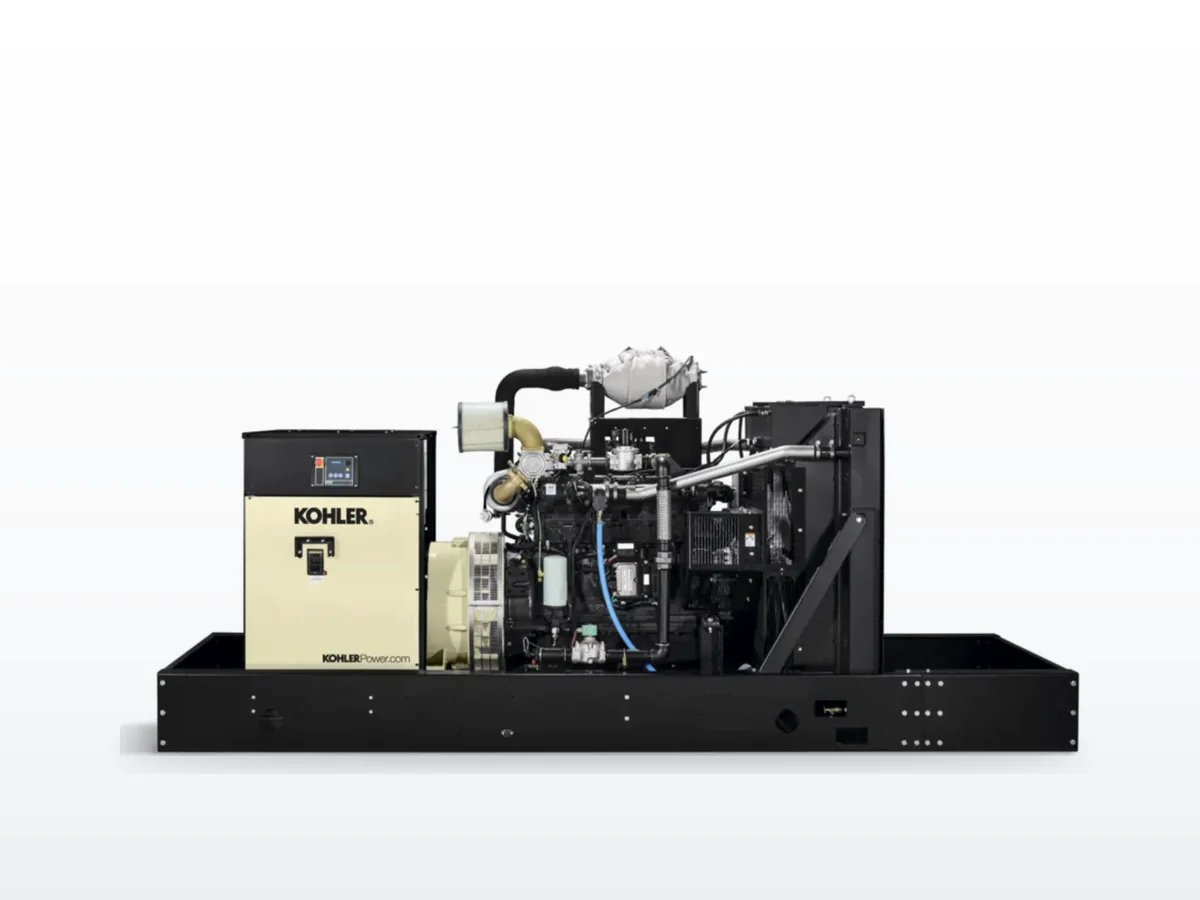
Series Overview#
The Kohler REZX Series is the primary industrial enclosed-configuration gaseous generator line from Kohler, spanning 190 to 500 kW standby across 12 models. All units use Doosan or PSI/Doosan engines paired with brushless permanent-magnet alternators at 1800 RPM. The series covers LPG, natural gas, and dual-fuel configurations, with EPA certification for stationary emergency and — on the REZXD variants — non-emergency applications as well.
The REZX Series occupies a distinct position in Kohler's gaseous lineup: it is the industrial-enclosed counterpart to the open-frame RZX Series (which uses the same engine platform in a skid configuration for indoor mechanical rooms). REZX units are weatherproof enclosure-mounted, rated for outdoor installation, and on REZXD models include enclosure structures rated for 186 mph wind loads. This makes the REZX Series the appropriate choice for outdoor pad installations at commercial facilities, healthcare campuses, and education buildings where an indoor mechanical room is not available.
Engine selection tracks displacement to output class. The 180 and 200 kW models use the Doosan D111TIC. Moving up to 250–300 kW (REZXB variants), the D146L handles the additional output. At 300 kW in the REZXD designation and above, the PSI/Doosan D183L engine (18.3 L) covers the 300–350 kW range, and the D219L (21.9 L V12, turbocharged and aftercooled) powers the 400 kW through 500 kW top of the lineup. The 400REZXB and the models searchable as "KG400" use the Doosan D219TIC (PSI 21.9L) — the same platform in different variant designations.
All REZX Series units operate at 277/480V or 120/208V three-phase. Voltage is selected at the time of order; field reconfiguration is not standard. Single-phase output is not available in this series — for single-phase requirements at these power levels, consult Kohler for transformer options.
How to Choose#
190–260 kW: REZXB with Doosan D111TIC and D146L. The 180REZXB (190 kW) and 200REZXB (200 kW) use the D111TIC. The 250REZXB steps up to the D146L at 260 kW. These are the entry points for commercial and light industrial facilities that have outgrown the 150 kW class but don't yet need the larger PSI/Doosan platform. Hurricane enclosure options are available on REZXB models.
300 kW: REZXC vs REZXD vs REZXB. At 300 kW you have three designations to navigate. The 300REZXC is natural gas rated with a D146L. The 300REZXD is LPG rated with the PSI/Doosan D183L and carries mobile-application certification. The 300REZXB is also available (D146L, LPG). Choose based on your fuel type and whether mobile/non-emergency certification is required.
350–400 kW: REZXB and REZXD with D183L and D219L. The 350REZXB (355 kW, D183TIC) and 350REZXD (355 kW, PSI/Doosan D183L) cover identical output with different engine designations. The 400REZXD and 400REZXB (400 kW, D219L/D219TIC) step up to the large V12 platform. The REZXD variants carry dual stationary/mobile certification.
450–500 kW: Upper REZXD models. The 450REZXD and 500REZXD are both LPG-rated using the PSI/Doosan D219L. At 500 kW, the REZXD is the largest single-unit enclosed gaseous generator in the standard REZX lineup. Buyers searching for a "KG500" gaseous generator should note that the 500REZXD is the actual product — Kohler does not manufacture a model designated KG500.
Common Applications#
-
Commercial buildings and office campuses. The enclosed weatherproof configuration is purpose-built for outdoor pad installation at commercial properties. LPG or natural gas fuel eliminates diesel storage tanks and the associated permit requirements, which matters for urban and suburban commercial properties with limited outdoor footprint.
-
Healthcare facilities. Hospitals, surgery centers, and outpatient clinics in the 300–500 kW standby requirement range frequently specify REZX Series units. Natural gas utility connectivity means fuel is continuously available without tanker deliveries — important for extended disaster scenarios when diesel supply chains may be disrupted.
-
Education campuses. Universities and large K–12 campuses with central mechanical equipment, data centers, and critical research or laboratory loads use REZX units where gaseous fuel infrastructure exists. The enclosed configuration supports outdoor installation alongside HVAC mechanical yards.
-
Retail and large commercial tenants. Large-format retail operations, grocery distribution centers, and enclosed shopping facilities with continuous refrigeration loads commonly specify REZX generators where natural gas or LPG is available and diesel storage is impractical.
-
Light industrial and manufacturing. The 400–500 kW range supports light manufacturing facilities where process continuity is valued and on-site gas supply is established.
Service & Maintenance#
The REZX Series requires more frequent spark plug and air filter attention than diesel equivalents. Spark plug replacement is scheduled at 500 hours across 10 of the 12 models — approximately annually for a generator exercising weekly and running occasional actual outages. Delaying spark plug service is the most common cause of misfire codes, cylinder dropout faults, and rough idle complaints in this fleet.
Oil change intervals are 250 hours or 12 months across the majority of the line. Coolant replacement is scheduled at 3,000 hours. Air filter service is every 500 hours — more frequent than the diesel REOZ series — because gaseous combustion environments can load intake filters differently under certain operating conditions.
The turbocharger seal is the primary wear component to watch between 8,000 and 10,000 hours: symptoms include oil in the intake, blue exhaust smoke, and reduced boost pressure. The fuel pressure regulator and vaporizer are the next failure-mode priority — hard starting, erratic idle, and gas pressure fault codes are typical symptoms around 8,000 hours. Both components require qualified technicians familiar with gaseous fuel systems.
Starting battery condition is the leading cause of failed exercise tests. Battery replacement every two to three years is recommended, and battery load testing should be included in every annual maintenance visit. A starting battery that appears healthy under float charge may fail to deliver adequate cranking current after a period of inactivity.
Application Guidance#
The Kohler REZX Series is purpose-built for outdoor pad-mounted commercial standby at 190–500 kW on LPG, natural gas, or dual-fuel — the enclosed weatherproof configuration makes it the direct alternative to diesel pad installations at facilities where gaseous fuel is preferred. Healthcare campuses and commercial buildings in the 200–500 kW standby range that have natural gas utility connectivity represent the core application: the gas main connection eliminates diesel tank permitting, spill containment, and fuel polishing programs, and the continuous utility gas supply is available indefinitely during extended outages without tanker logistics. REZXD models carrying dual stationary and mobile emergency certification are specified for coastal hurricane-rated installations (186 mph wind load enclosures are available) — a relevant specification for Gulf Coast, Atlantic seaboard, and Caribbean properties.
This series is not appropriate when an indoor generator room is available and an enclosure is unnecessary — the Kohler RZX Series is the open-frame equivalent of the same engine platform at lower installed cost. For requirements below 190 kW on LPG, the Kohler RZG Series covers 100–150 kW, and the KG Series commercial gaseous line covers 40–150 kW on natural gas. At 500 kW, the REZX Series reaches its limit; for larger single-unit gaseous standby needs, the Kohler Industrial Gaseous 500REZK covers 500 kW on natural gas via the Siemens SGE-24SL engine. Buyers comparing the REZX against the CAT G-Series and Cummins N6 commercial gas at similar power levels should verify which fuel type and voltage configuration is available from each OEM at the specific output required.