Series Overview#
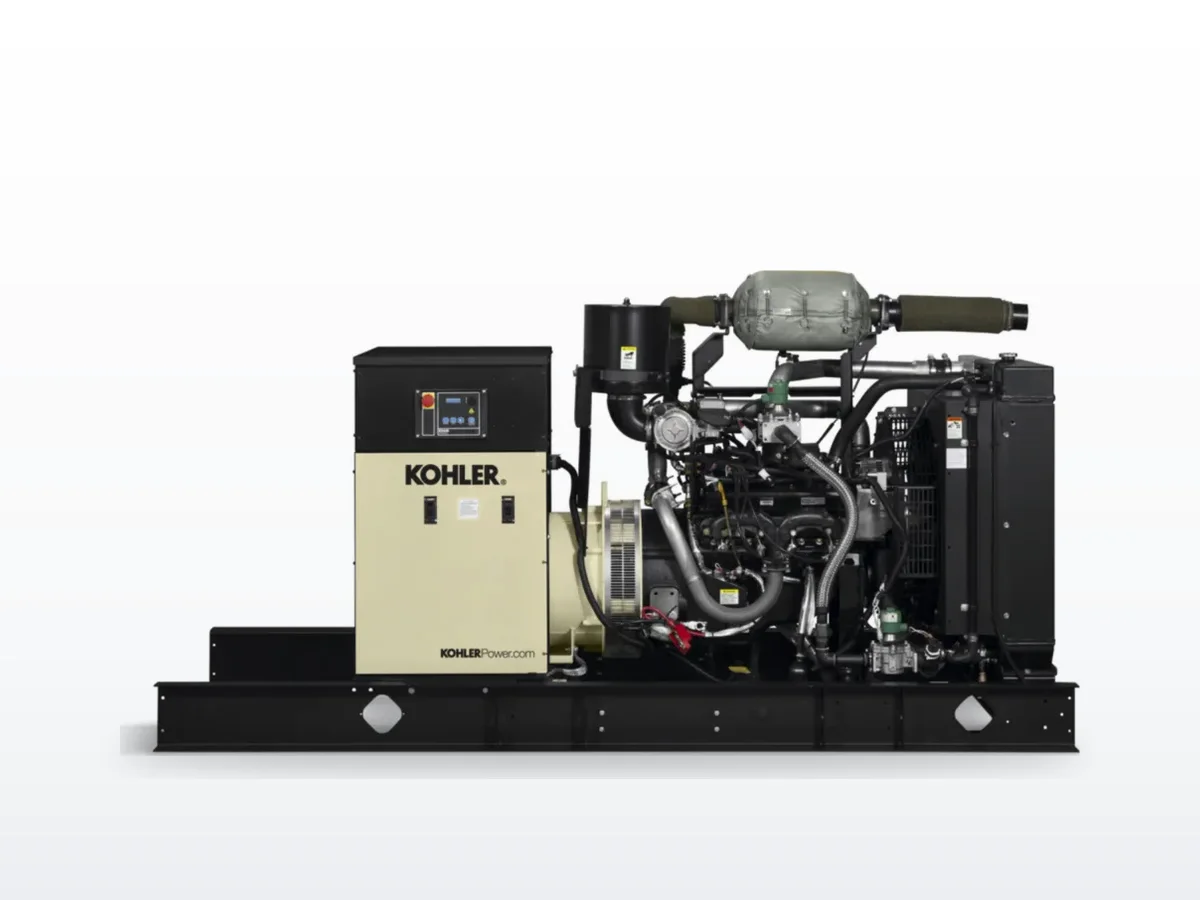
The Kohler RZG Series is a focused four-model lineup covering 100 and 150 kW LPG standby power, available in both enclosed (REZG designation) and open-frame (RZG designation) configurations. The series uses two engine platforms: the General Motors Vortec 5.7L V8 for the 100 kW class and the PSI 8.8L industrial engine for the 150 kW class. All four models operate at 1800 RPM with brushless permanent-magnet alternators at 120/208V or 277/480V three-phase.
The RZG Series occupies the 100–150 kW LPG niche in Kohler's gaseous lineup — a power range also served by the Kohler KG100 and KG125 models, which use natural gas, LPG, or dual-fuel with Kohler-branded engines. The primary distinction is fuel type and engine heritage: the RZG/REZG line is LPG-only with GM Vortec and PSI engine platforms, while the KG100/KG125 are dual-fuel capable with Kohler-built engines. Buyers who have established LPG infrastructure and prefer the GM Vortec engine's wide parts availability may find the RZG Series advantageous.
The enclosed REZG variants (100REZGD, 150REZGC) are rated for outdoor pad installation, weatherproof and EPA certified for stationary emergency applications. The open-frame RZG variants (100RZGD, 150RZGC) are designed for indoor mechanical rooms or generator buildings where the structure provides weather protection. Both configurations use identical engine and alternator specifications.
How to Choose#
100 kW: 100REZGD vs 100RZGD. Both use the General Motors Vortec 5.7L V8. The only practical difference is enclosure type. If the unit will be installed outdoors on a pad without a dedicated generator building, specify the 100REZGD (enclosed). If the installation is in an existing mechanical room with adequate combustion air and exhaust routing, the 100RZGD (open-frame) is appropriate.
150 kW: 150REZGC vs 150RZGC. Both use the PSI 8.8L industrial engine. The same enclosure logic applies. The 150REZGC is the enclosed outdoor-ready unit; the 150RZGC is the open-frame indoor unit. Rated output on the open-frame 150RZGC is 135 kW standby depending on voltage (slightly lower than the 150 kW on the enclosed REZGC), reflecting the voltage-dependent derating typical of gaseous generators at three-phase outputs.
100 kW vs 150 kW selection. If your calculated standby load is in the 75–95 kW range, the 100 kW models provide appropriate margin. For loads in the 110–130 kW range, the 150 kW models are correct. Avoid oversizing by more than 30% — LPG generators running at sustained very light loads can develop regulator and spark plug issues faster than appropriately sized units.
Common Applications#
-
Commercial buildings with LPG supply. Mid-sized commercial properties — office buildings, retail centers, and mixed-use developments — that have established LPG bulk storage or access to LPG truck delivery use RZG/REZG generators for standby without the diesel tank permitting complexity.
-
Healthcare facilities. Medical office buildings and outpatient clinics with critical loads in the 75–130 kW range specify these units where LPG is the available fuel. The EPA-certified REZGD and REZGC are the appropriate choice for installations subject to air district permitting.
-
Education campuses. Schools and university buildings with LPG as the primary fuel source use RZG Series generators for backup of critical building systems: HVAC, fire systems, and security.
-
Large retail. Grocery stores and large-format retail operations with significant refrigeration loads in the 100–130 kW range commonly specify LPG-fueled standby where on-site LPG bulk tanks are already installed for heating or cooking equipment.
-
Light industrial. Small manufacturing facilities and warehouses with established LPG supply and loads in the 75–130 kW range use RZG units where diesel storage is not desired.
Service & Maintenance#
The GM Vortec 5.7L-powered 100 kW models have a 200-hour oil change interval — more frequent than the 250-hour standard on the Doosan-powered REZX Series. For low-cycle standby generators, the 12-month calendar trigger will typically fire before the hour-based interval. Coolant replacement on these models is scheduled at 2,000 hours.
Across all four RZG models, spark plug replacement at 500 hours is a firm service requirement. The spark plug and ignition system are the leading failure mode in this series — misfire under load, rough idle, and cylinder dropout codes are the typical symptoms. Given that this series often operates in commercial facilities where generator uptime during outages is critical, deferring spark plug service is a reliability risk.
The fuel pressure regulator and vaporizer are the primary mechanical failure point beyond the ignition system — hard starting, gas pressure faults, and erratic idle typically appear around 6,000 hours. Starting battery condition is the second most common cause of failed exercise tests; annual load testing and two-to-three-year replacement cycles are recommended. On the 150 kW PSI-engined models, turbocharger seal wear appears around 10,000 hours — oil in the intake and blue smoke are the indicators to watch.
Coolant thermostat issues are observed on some units: overcooling at light load and high fuel consumption are typical symptoms at approximately 8,000 hours. For generators that spend most of their time at light load during exercises, thermostat inspection should be included in major maintenance events.
Application Guidance#
The Kohler RZG Series is purpose-built for the 100–150 kW LPG standby niche — commercial properties, healthcare offices, retail operations, and education buildings that have established on-site LPG bulk storage and prefer propane over diesel fuel management. The series' availability in both enclosed outdoor (REZG) and open-frame indoor (RZG) configurations gives facility engineers flexibility in installation approach without changing the engine or alternator specification. All four models output three-phase 120/208V or 277/480V only — this is not a single-phase product. The GM Vortec 5.7L V8 in the 100 kW models carries wide parts availability through automotive and industrial supply channels, independent of Kohler's own dealer network, which is a practical advantage for facilities in areas with limited Kohler dealer coverage.
This series is not appropriate when natural gas is the available fuel — the KG Series (KG100, KG125) covers the same 100–150 kW range on natural gas, LPG, or dual-fuel with Kohler-built engines and is the correct Kohler specification for gas-main-connected facilities. For requirements above 150 kW on LPG, the Kohler RZX Series (open-frame, 190–400 kW) and Kohler REZX Series (enclosed, 190–500 kW) serve the larger LPG standby market. Single-phase output is not available in this series; facilities needing 100–150 kW single-phase on gaseous fuel should consult Kohler for alternative configurations. Buyers comparing the RZG against the Cummins C-Series commercial gaseous and Blue Star PSI mid-gaseous at similar power levels should verify LPG-only versus dual-fuel capability and confirm three-phase voltage availability for their service configuration.