Series Overview#
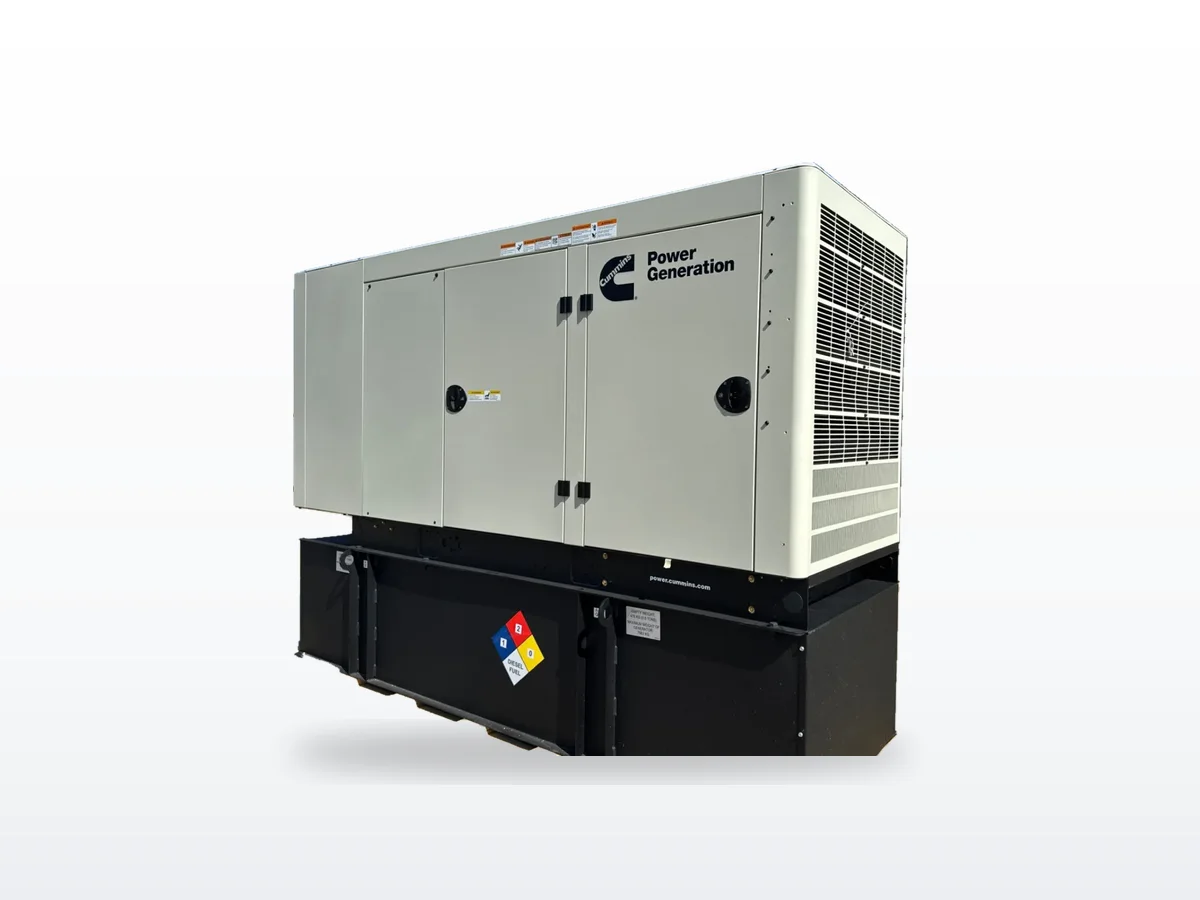
The Cummins D6 Commercial Diesel series covers 80 to 350 kW across five models: C80 D6, C100 D6, C150 D6, C200 D6, and C350 D6. All are Tier 3 emissions certified — making this the Cummins commercial standby lineup with the best emissions compliance in the sub-400 kW class, an advantage in California air basins and other jurisdictions with strict stationary emergency engine regulations. The series uses three engine platforms: the QSB5-G13 (4.5-liter, 4-cylinder) for the 80–100 kW class, the QSB7-G5 (6.7-liter, inline-6) for the 150–200 kW class, and the QSG12-G1 (11.8-liter, inline-6 with HPCR injection) for the 350 kW class.
Cummins' vertical integration provides consistent system behavior across the D6 series — the engine, alternator, and PowerCommand controls are all manufactured by Cummins, ensuring that transient response, protective relay behavior, and fault diagnostics are engineered as an integrated system. The PowerCommand 2.3 control on the C80 and C100 D6 includes dedicated battery monitoring that alerts for weak battery conditions before they cause a failed start — a practical standby feature that reduces the most common cause of outage-day generator failures.
All D6 models are available in both single-phase and three-phase output configurations, covering 120/240V through 347/600V — the full range of standard North American commercial distribution voltages. This flexibility makes the D6 series applicable from small single-phase commercial locations through large three-phase office and retail facilities.
How to Choose#
Engine platform selection by output: The QSB5 platform (C80 D6, C100 D6) is a 4-cylinder 4.5-liter engine appropriate for small commercial standby under 100 kW. The QSB7 platform (C150 D6, C200 D6) is a 6.7-liter inline-6 — one of the most widely deployed mid-range diesels globally, with excellent parts availability and service technician familiarity. The QSG12 on the C350 D6 is an 11.8-liter inline-6 with High Pressure Common Rail (HPCR) fuel injection, bringing more sophisticated electronic fuel management to the 350 kW output class.
Tier 3 vs Tier 2 consideration: If your project is in California or a jurisdiction with CARB/AQMD restrictions, Tier 3 compliance on the D6 series is a meaningful specification advantage over Tier 2 alternatives. Verify the specific air district rules applicable to your installation before selecting emissions tier.
Control system differences (PowerCommand 1.1 vs 2.3): The C150 and C200 D6 use PowerCommand 1.1, which offers more limited monitoring and diagnostics compared to the PowerCommand 2.3 on the C80/C100 D6. If advanced battery monitoring, remote diagnostics, or integration with a facility management system is required, confirm the control system capabilities with your Cummins dealer at the time of specification.
AmpSentry relay calibration: The AmpSentry protective relay is documented as requiring calibration for motor-starting loads on the QSB5 platform. Commercial buildings with HVAC equipment, elevators, or compressors that impose high motor-starting inrush currents should confirm that the AmpSentry is calibrated appropriately for the specific load profile to prevent nuisance overcurrent trips during outage events.
C350 D6 for large commercial or data center: The C350 D6's QSG12-G1 with HPCR fuel injection provides precision electronic fuel management appropriate for large commercial buildings, data center edge locations, and industrial facilities requiring 350 kW of Tier 3 compliant diesel standby from a compact inline-6 package.
Common Applications#
-
Commercial standby: All five D6 models are documented for commercial standby — the most universal application in the series. The QSB5-based C80 and C100 D6 are the standard specifications for small retail, small office, and light commercial locations. The QSB7-based C150 and C200 D6 cover medium commercial buildings. The C350 D6 serves large commercial facilities.
-
Light industrial and office buildings: Three models are documented for light industrial standby and two for office-building applications. The QSB7 platform's industrial heritage (used across hundreds of thousands of applications globally) makes it particularly well-suited for the predictable, sustained loads of light industrial standby.
-
Retail standby: Two models are documented for retail applications — covering everything from small storefronts (C80/C100 D6) through department stores and large retail centers (C200/C350 D6).
-
Healthcare and small data center: The C350 D6 is documented for both hospital and data center applications, serving healthcare facilities requiring Tier 3 diesel standby in the 350 kW class and edge data center locations with similar load profiles.
Service & Maintenance#
The D6 series requires oil changes every 500 hours or 12 months and fuel filter replacement every 500 hours. Air filter service across all five models is documented at 500 hours — more frequent than the 1,000-hour interval common on larger Cummins diesel platforms. The shorter air filter interval on D6 models reflects the QSB platform's sensitivity to air restriction in its turbocharged configuration.
Five failure modes are specifically documented in the D6 field data. Charge air cooler coolant leaks are the most serious documented failure mode — appearing on QSB5 and QSB7 models, this causes coolant to enter the intake manifold, producing white exhaust smoke and engine overtemperature. Inspect charge air cooler connections and core condition at each major service interval. QSB7 high-pressure fuel injection wear causes hard starting, rough running, and fuel pressure fault codes — plan injector inspection at high hours. PowerCommand 2.3 battery monitoring alerts on C80/C100 D6 should be treated as actionable, not as nuisance alarms — investigate and resolve battery issues within 30 days of alert. AmpSentry relay calibration issues on QSB5 models cause nuisance overcurrent trips during motor-starting events — calibrate the relay for your specific load profile during commissioning. Spin-on lube oil filter seal weeping is documented on two models — inspect filter base and torque to specification at each oil change.
The CM2880 ECM connectors on the C350 D6's QSG12 platform are a documented failure mode at high hours, causing intermittent fault codes and erratic shutdown. Inspect and clean connector contacts during major service on high-hour C350 D6 units.
Application Guidance#
The Cummins D6 Commercial Diesel is designed for commercial and light industrial standby in the 80–350 kW range, where Tier 3 emissions compliance is a specification advantage and Cummins' vertically integrated controls (engine, alternator, and PowerCommand from one manufacturer) provide consistent system behavior. It is particularly well-suited to applications in California and other CARB-regulated jurisdictions, data center edge locations, and financial or technology facilities where the PowerCommand control system's monitoring and fault management capabilities are valued.
At the upper boundary, the D6 tops out at 350 kW — for mission-critical standby at 500 kW and above where single-vendor integration and full medium-voltage support are required, the Cummins QSK Series is the appropriate platform. For applications where gaseous fuel is preferred over diesel in this kW range, the Generac SG Series covers 80–350 kW on natural gas or LP. For a broader diesel lineup with more engine platform variety across a wider power range, the Generac SD Series covers 10–1,500 kW on Perkins, Iveco/FPT, and Mitsubishi engines.