Series Overview#
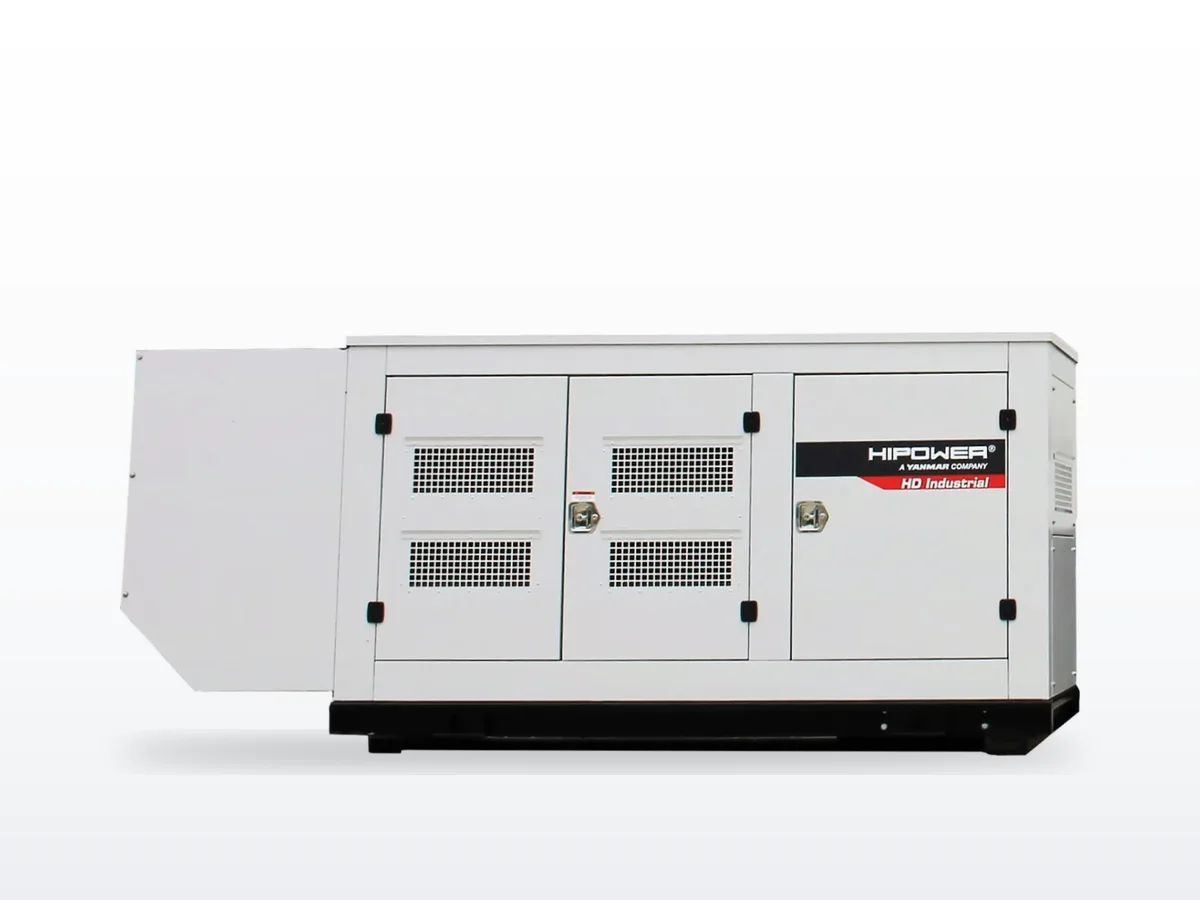
The Hipower HJW Series is a 12-model line of stationary diesel standby generators spanning 55 to 410 kW, powered exclusively by John Deere diesel engines. All models carry UL 2200 and CSA listings and EPA Tier 3 certification, making them permittable for commercial and industrial standby applications across North America. The series is one of the few diesel generator lines to support all four common North American voltages — 120/208V, 120/240V, 277/480V, and 347/600V — from a single product family, which simplifies specification for projects with mixed electrical service requirements or Canadian deployments.
The engine platform transitions at two key boundaries within the series. The 55–130 kW range uses the John Deere 4045 four-cylinder 4.5-liter turbocharged diesel — a compact, well-established engine with a broad service network. At 155 kW, the series moves to the John Deere 6068 six-cylinder 6.8-liter engine for the additional torque needed at 150+ kW. From 205 kW through the top-of-line 410 kW (HJW-410), all models use the John Deere 6090 nine-liter six-cylinder — the largest John Deere engine in the HJW lineup — with output calibrated through fuel and boost tuning at each kW step. All models use Stamford alternators.
The HJW is a Tier 3 series, which distinguishes it from the Tier 4 Final HFW lineup. For new installations in California and states requiring Tier 4 Final compliance, the HFW is the current-standard option. The HJW remains appropriate for replacement projects, jurisdictions without Tier 4 requirements, and existing-fleet standardization on the John Deere platform.
How to Choose#
Engine tier selection: If Tier 4 Final is required for the installation (new construction in California or EPA-regulated regions), the HFW series is the correct choice. If Tier 3 is acceptable — replacement units, non-California installations, or air permit allowances — the HJW provides proven John Deere reliability at a lower capital cost.
By output class: The 55–130 kW range (HJW-55 through HJW-130) covers light and small commercial standby; single-phase output is available in these models. The 155–205 kW range (HJW-155 and HJW-205) uses the 6068 six-cylinder and covers mid-commercial applications. The 225–410 kW range (HJW-225 through HJW-410) uses the 9.0L 6090 engine and targets larger commercial and industrial standby.
Phase requirements: The HJW-55 through HJW-130 are available in single-phase (M6U) and three-phase (T6U) configurations. From HJW-155 onward, models are three-phase only. Confirm the service panel configuration before selecting a model.
Voltage: All models support 277/480V. The 347/600V option is available across most of the line — confirm availability on the specific model if Canadian deployment or 600V distribution is required. Smaller models additionally support 120/208V and 120/240V.
Common Applications#
- Commercial standby: All 12 HJW models are rated for commercial standby — the primary use case for the series. Office buildings, retail centers, warehousing, and light-commercial properties where code requires standby power and a John Deere diesel service network is preferred.
- Industrial standby (8/12 models rated): Mid-range models (HJW-155 through HJW-410) cover industrial facilities where Tier 3 is acceptable and John Deere parts availability through the agricultural and construction equipment dealer network is an operational advantage.
- Light-commercial (4/12 models rated): The smaller 4045-powered models (55–130 kW) serve light-commercial and small-building applications where the John Deere four-cylinder engine's compact footprint and single-phase availability are practical advantages.
Service & Maintenance#
All 12 HJW models share an oil change interval of 250 operating hours or 12 months. Fuel filter service is at 500 hours; air filter at 500 hours. The 250-hour oil interval is shorter than the FPT-powered HFW series (500 hours) and reflects the John Deere 4045 engine family's factory specification in generator duty.
Three failure modes are documented across all 12 HJW models. Fuel filters in extended standby service tend to clog at or before the 500-hour interval due to fuel varnish and microbial growth — replace at 500 hours or annually, and do not defer past annual service regardless of runtime. Starting batteries in standby service lose capacity from the float-charge cycle; test annually and maintain a float charger connected during extended standby periods. Coolant hose connections on the Stamford alternator and engine block weep at fittings under long-term thermal cycling — inspect at every oil change interval and replace at the first sign of seepage.
Application Guidance#
The Hipower HJW Series is purpose-built for replacement projects, existing-fleet standardization, and new commercial or industrial standby installations in jurisdictions where Tier 3 is acceptable — covering 55 to 410 kW on John Deere engines with UL 2200 and CSA listings across all 12 models. The series' strongest differentiator is the John Deere service network: agricultural and construction equipment dealers stock the 4045, 6068, and 6090 parts nationally, which is a logistical advantage for fleet operators who already maintain John Deere diesel equipment and want parts and service from a single source. The 347/600V voltage support — the broadest in the Hipower stationary diesel lineup — makes the HJW usable in Canadian installations and US facilities with legacy 600V distribution without a step-up transformer.
The HJW is not the right choice for new installations in California or other Tier 4 Final-regulated jurisdictions. For those applications, the Hipower HFW Series on FPT Industrial Tier 4 Final engines covers 60–350 kW with current emissions compliance and a longer 500-hour oil interval. Above 410 kW, the HJW has no larger sibling in the Hipower stationary John Deere lineup — the next step is the Hipower HDI Series (Volvo 400–600 kW or Mitsubishi 800–2,000 kW, Tier 2/3) or the mission-critical Hipower HMW Series (MTU, Tier 4 Final). For competing Tier 3 stationary diesel in this range, the Doosan G Series and Blue Star Perkins Diesel Standby are comparable alternatives.