Series Overview#
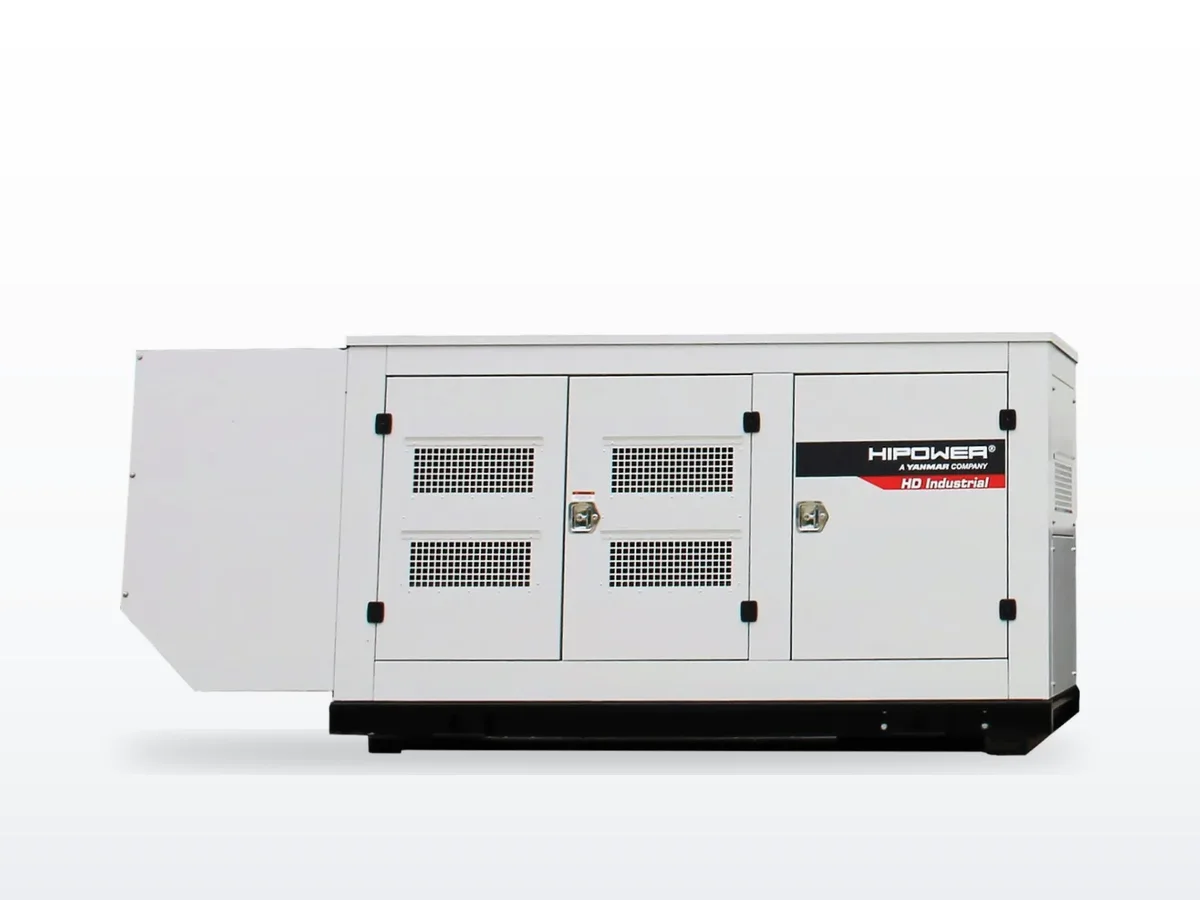
The Hipower HDI Series is the company's workhorse heavy-duty diesel lineup, covering 60 to 2,000 kW across 19 models and three engine families. The series is designed to deliver industrial-grade specifications — NFPA 110 Level 1 ratings, Stamford alternators, and in-house enclosures — at 15–25% below the pricing of equivalent Caterpillar, Cummins, Kohler, or Generac units. This value proposition makes the HDI the most commonly specified Hipower product for commercial developers, general contractors, and industrial specifiers who need reliable standby without the premium brand carry cost.
The engine platform transitions at defined capacity thresholds. FPT Industrial (Iveco) powers the 60–350 kW range, with the N45, N67, C87, and C13 engine families stepping up in displacement as output increases. Volvo Penta picks up at 400 kW (HDI-400V) and carries through to 590 kW (HDI-600V) using the TAD1353GE and TAD1641GE-B platforms. Above 600 kW, Mitsubishi Heavy Industries 12- and 16-cylinder turbocharged intercooled engines power the 800 through 2,000 kW range, with the HDI-2000 — a 2 MW unit on a Mitsubishi 16-cylinder — representing the largest single-unit diesel Hipower builds.
All HDI models are built at Hipower's 515,000 sq ft facility in Olathe, Kansas, where enclosures, fuel tanks, switchgear, and controls are manufactured in-house. The Stamford alternator is standard across the series. Single-phase availability in the lower models and broad voltage support (120/240V through 277/480V) makes the series adaptable across North American electrical services.
How to Choose#
FPT-powered range (60–350 kW): The HDI-60F through HDI-350F use FPT (Iveco) engines and Tier 3 certification. The -60F and -80F are available in single-phase; from -130F upward, the units are three-phase only at 277/480V. Choose these models for commercial and light-industrial standby where Tier 3 is acceptable and the FPT engine service network is an advantage.
Volvo-powered range (400–590 kW): The HDI-400V, HDI-515V, and HDI-600V use Volvo Penta TAD-series engines with Tier 3 certification. The Volvo platform offers a well-established service network and strong load acceptance characteristics for mid-large commercial applications.
Mitsubishi-powered range (800–2,000 kW): For large-frame industrial and data center applications, the HDI-800 through HDI-2000 use Mitsubishi 12- and 16-cylinder engines rated to Tier 2. The HDI-2000 competes directly with the Cat C175 and Cummins QSK95 at substantially lower cost. These units are appropriate where Tier 2 compliance is acceptable (non-California new installations) and where cost efficiency at the MW scale is the primary driver.
Tier compliance: Tier 3 models cover most FPT and Volvo units; Tier 2 applies to the Mitsubishi-powered upper range. For California new installations requiring Tier 4 Final, the HFW series covers 60–350 kW on FPT engines, and the HMW series covers 270 kW and above on MTU engines.
Common Applications#
- Industrial standby: The full 19-model range covers industrial facilities from small machine shops (60 kW) to large manufacturing plants (2,000 kW). The Stamford alternator and NFPA 110 Level 1 rating make HDI units code-acceptable for industrial life-safety requirements in most jurisdictions.
- Commercial standby: 16 of 19 models carry commercial-standby application ratings, covering office buildings, retail centers, hospitality facilities, and mixed-use commercial developments across the full kW range.
- Data centers (edge to enterprise): 13 of 19 HDI models are rated for data center applications. The Mitsubishi-powered upper range (800–2,000 kW) competes with Tier 2 data center generator specifications at a meaningful cost advantage.
- Healthcare facilities: 3 of 19 models are rated for healthcare, primarily in the mid-range where NFPA 110 Level 1 compliance and Stamford alternator voltage regulation are matched to medical equipment requirements.
Service & Maintenance#
All 19 HDI models share a uniform service schedule: oil change, fuel filter, and air filter at 500 operating hours. This is a straightforward interval to manage across a fleet, and the FPT, Volvo, and Mitsubishi engine families all support this cadence with readily available filter consumables.
No specific failure modes have been documented for the HDI series in the available data. General best practices for diesel standby apply: float-charge the starting battery continuously, run monthly load tests at a minimum of 30% nameplate load to prevent fuel system varnish, and replace coolant per the engine OEM's specification interval. For Mitsubishi-powered upper models in rental or infrequent-use service, pay particular attention to injector condition — high-output turbocharged engines in low-utilization standby can develop deposit buildup faster than engines under regular load.
Application Guidance#
The Hipower HDI Series is purpose-built for commercial and industrial standby applications where proven specifications — NFPA 110 Level 1, Stamford alternators, in-house enclosures — are required at 15–25% below the capital cost of equivalent Caterpillar, Cummins, Kohler, or Generac units. The FPT-powered models (60–350 kW) are the right fit for commercial developers, general contractors, and industrial specifiers in non-California jurisdictions or where Tier 3 is acceptable; the Volvo-powered mid-range (400–600 kW) adds a well-established service network advantage; and the Mitsubishi-powered upper tier (800–2,000 kW) competes directly with Cat C175 and Cummins QSK95 pricing at the MW scale. Edge and enterprise data center projects where Tier 2 is permissible and cost efficiency is the primary driver are the strongest match for the upper HDI models.
The HDI is not the right choice where Tier 4 Final compliance is mandatory. For new California installations in the 60–350 kW range, the Hipower HFW Series provides the same FPT engine platform at Tier 4 Final with a longer 500-hour oil interval. For mission-critical applications requiring NFPA 110 Level 1, IBC seismic Zone 4, and 200 mph wind certification at 270 kW and above, the Hipower HMW Series on MTU engines carries the full certification stack the HDI does not. For buyers who need Big 4 brand accountability at the megawatt scale, the Cummins QSK Series and Kohler KD Series are the primary alternatives.