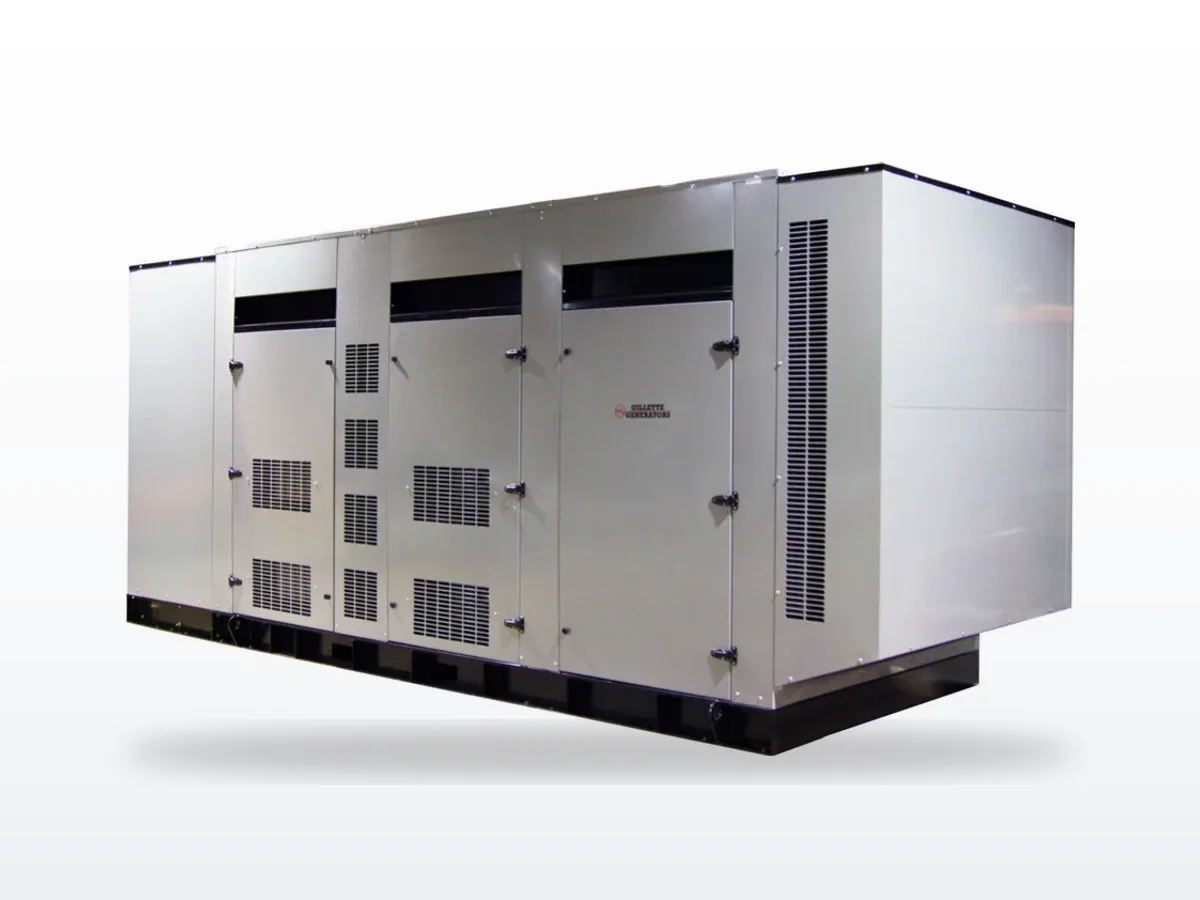
Series Overview#
The Gillette SPMI Series is the company's large-format diesel standby lineup, covering 800 kW to 2,000 kW (2 MW) across four models. Every unit in the series is built on Mitsubishi's heavy-duty S-series diesel platform — liquid-cooled V-engines that are standard equipment in industrial power plants worldwide. This is Gillette's answer for loads that exceed what the Volvo-powered SPVD series (ceiling: 700 kW) can handle.
The series uses two engine families. The SPMI-8000 (800 kW) and SPMI-1M (1,000 kW) run Mitsubishi's S12-series V12 diesels — the S12A2 at 33.9L and the S12H at 37.1L respectively. The SPMI-1.5M (1,500 kW) and SPMI-2M (2,000 kW) both use the S16R V16 at 65.37L displacement, differentiated by output calibration: the 1.5M produces the equivalent of 2,346 bhp standby while the 2M reaches 2,923 bhp. All four models pair with Stamford AVK alternators — purpose-built for large industrial gensets — and the Deep Sea Electronics DSE 7420 MKII controller with UL 6200 certification.
Gillette's value proposition at this scale is the same as in the rest of their lineup: factory-direct pricing against a Mitsubishi engine platform that any qualified industrial diesel technician can service, using a DSE controller that any controls technician can program. At outputs from 800 kW to 2 MW, the SPMI series competes directly with CAT, Cummins, and Kohler utility-class standby products at significantly lower acquisition cost, with 3–7 day typical lead times versus the 12–20 week queues common among the major OEMs.
All SPMI models are three-phase only, liquid-cooled, and rated Tier 2 — appropriate for emergency standby duty in jurisdictions that permit Tier 2 equipment. The series does not offer a Tier 4 Final variant; buyers requiring Tier 4 Final compliance at comparable output levels should evaluate the T4D series (ceiling: 600 kW) or contact OnPoint for alternatives.
How to Choose#
800 kW — SPMI-8000 (Mitsubishi S12A2): The entry model in the series. The 33.9L S12A2 V12 produces the rated 800 kW standby. Supports all four voltage configurations including 120/208V and 120/240V, making it suitable for both three-phase 208V and 480V distribution systems. Appropriate when the load requirement falls between the SPVD-7000 (700 kW Volvo) and the SPMI-1M.
1,000 kW / 1 MW — SPMI-1M (Mitsubishi S12H): Bridges the S12A2 and S16R platforms. The 37.1L S12H delivers 1,000 kW with the same voltage flexibility as the SPMI-8000. If load sizing lands between 800 kW and 1,500 kW, compare the SPMI-1M against the SPMI-1.5M with your AHJ on the 500 kW headroom difference.
1,500 kW — SPMI-1.5M (Mitsubishi S16R, standard calibration): Steps up to the S16R V16 platform and narrows to 277/480V and 346/600V voltages only. If your distribution system runs 208V, the SPMI-8000 or SPMI-1M are the only SPMI options. The SPMI-1.5M and SPMI-2M use an identical physical platform with different engine calibrations.
2,000 kW / 2 MW — SPMI-2M (Mitsubishi S16R, high-output calibration): Gillette's largest single-engine unit. Same S16R block and enclosure as the SPMI-1.5M, recalibrated for 2,000 kW standby. If load growth is anticipated within the same physical installation, the SPMI-2M provides 33% more headroom over the SPMI-1.5M from the same footprint. Available in 277/480V and 346/600V only.
Voltage selection: For loads requiring 120/208V or 120/240V service, your options within the SPMI series are limited to the SPMI-8000 and SPMI-1M. The 1.5M and 2M are 480V/600V only.
Common Applications#
-
Data centers: The SPMI series is sized for data center standby requirements that exceed what a single sub-800 kW unit can cover. The 800 kW to 2 MW range aligns with the N+1 standby configurations common in tier III and tier IV data facilities. The DSE 7420 MKII's paralleling capability supports multi-generator synchronization when N+1 redundancy requires more than one unit.
-
Hospitals and healthcare campuses: All four SPMI models appear in hospital and campus application contexts. At 800 kW to 2 MW, these generators cover full-campus emergency power including surgical suites, critical care, HVAC, and life-safety systems simultaneously. The PMG excitation system on the Stamford AVK alternators provides stable voltage regulation under dynamic hospital load swings.
-
Industrial plants and manufacturing facilities: Heavy manufacturing, process operations, and industrial facilities with significant motor loads benefit from the high transient capability of Mitsubishi's S-series diesels. The 800–2000 kW range handles large motor starting and variable load profiles typical in industrial environments.
-
Municipal infrastructure and utilities: Water treatment plants, pumping stations, and public utility infrastructure requiring reliable large-scale standby power. The Tier 2 rating is commonly accepted for emergency standby applications under most municipal codes.
-
Campus-wide emergency systems: University campuses, hospital complexes, and multi-building commercial developments using a centralized standby approach rather than distributed unit-by-unit backup. The SPMI series is sized for the central plant model.
Service & Maintenance#
All four SPMI models share identical service intervals: oil and fuel filter changes at 500-hour or 12-month intervals (whichever comes first), air filter inspection at 1,000 hours, and coolant system service at 6,000 hours. These are consistent with Mitsubishi's published maintenance schedules for S-series industrial diesels in standby duty.
The most significant failure modes identified across the series are turbocharger degradation (typically manifesting around 12,000 hours as power loss and heavy exhaust smoke) and fuel system fouling — either in the dual Mitsubishi PS8 injection systems (SPMI-8000 and SPMI-1.5M) or the dual Bosch P-type systems (SPMI-1M). At this power class, each unit runs dual fuel injection systems, so uneven cylinder output from a single fouled injector bank can cause measurable output asymmetry before progressing to a hard fault. The PMG excitation systems on the Stamford AVK alternators have a typical lifecycle of 20,000+ hours but are a high-severity failure when they do occur — voltage regulation failure under load is an immediate critical event for data center and hospital applications.
Practical maintenance priorities for SPMI operators: (1) Fuel quality management is essential. At 800–2000 kW, the fuel consumption rates are substantial; stored diesel in large tanks is prone to microbial contamination and water accumulation. Biocide treatment and annual fuel polishing are strongly recommended. (2) Turbocharger inspection at 6,000-hour coolant service intervals catches early oil seal degradation before it progresses to a catastrophic failure. (3) Battery bank condition monitoring — the 24V starting systems use multi-battery banks at this scale. Failed start on a 2 MW generator during a grid outage is a critical infrastructure failure; annual battery load testing is non-negotiable.
Application Guidance#
The Gillette SPMI Series is purpose-built for large-scale single-engine diesel standby from 800 kW to 2 MW where factory-direct pricing against Mitsubishi S-series V-engines is the value proposition and 3–7 day lead time matters versus the 12–20 week queues typical of CAT, Cummins, and Kohler utility-class equivalents. The SPMI-8000 and SPMI-1M's support for 120/208V and 120/240V configurations is a specific differentiator at the 800–1,000 kW range — most competitor platforms at these output levels are 480V/600V only. For facilities where the distribution system runs 208V and a 1 MW standby requirement exists, the SPMI-1M may be the only practical single-engine option without transformer addition. The open-architecture DSE 7420 MKII controller and Stamford AVK alternators mean any qualified industrial electrician can troubleshoot controls — no proprietary tool requirement.
This is a Tier 2 series with no Tier 4 Final option — for jurisdictions requiring Tier 4 Final compliance at 800 kW+ standby, the SPMI series is not applicable, and the T4D series tops out at 600 kW. For requirements below 800 kW on industrial diesel, the Gillette SPVD Series (250–700 kW Volvo Penta) and Gillette SPJD Series (60–210 kW John Deere) are the preceding tiers. Above 2 MW, Gillette has no single-engine option — evaluate the Generac SD/MD Series (2,250–3,000 kW Baudouin) or consult OnPoint for paralleling configurations using multiple SPMI-2M units.
FAQ#
See frontmatter for FAQ items.