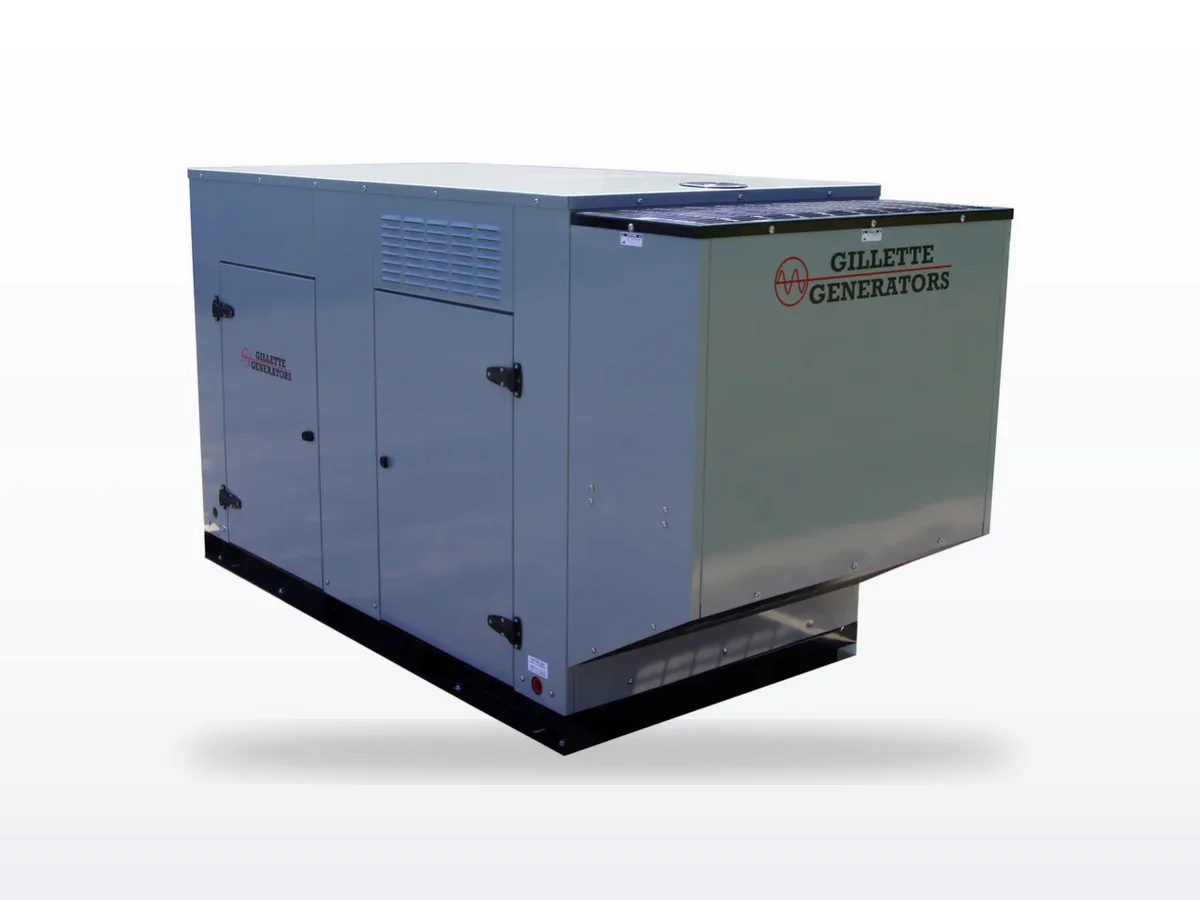
Series Overview#
The Gillette SPJD Series is the company's John Deere diesel standby lineup, covering 60 kW to 210 kW across four models. John Deere's 4045 and 6068 industrial diesel platforms power the series — engines that appear across Kohler REOZ generators, Blue Star JD generators, and dozens of other assemblers at the same output levels. The SPJD series captures the serviceability and parts availability advantage of these universally deployed engines at Gillette's factory-direct pricing.
The series uses two engine families. The SPJD-600 (60 kW) and SPJD-1000 (100 kW) use John Deere's 4.5L 4045 turbocharged inline-4 — the SPJD-1000 adds charge air cooling to the base 4045 for the 67% output increase over the SPJD-600. The SPJD-1550 (155 kW) and SPJD-2100 (210 kW) step to John Deere's 6.8L 6068 turbocharged inline-6 — the same platform in two output calibrations (HF285 standard at 155 kW, HF485 high-output at 210 kW) sharing an identical physical enclosure. All four models use DSE 7420 MKII controllers with UL 6200 and Stamford alternators.
All SPJD models are rated EPA Tier 3, appropriate for emergency standby use in most jurisdictions. Single-phase and three-phase configurations are available. The series begins where most commercial diesel standby requirements start (60 kW) and tops out at 210 kW — the ceiling of the 6068 platform. Above 210 kW, Gillette transitions to Volvo Penta engines in the SPVD series (floor: 250 kW). Below 60 kW, the Perkins-powered SPD series starts at 30 kW.
The John Deere service network advantage is genuinely meaningful in the 60–210 kW commercial diesel segment. Any John Deere authorized dealer — of which there are thousands across North America — can service these engines. This matters for municipal, telecom, and remote-site operators who need on-call diesel service without negotiating a factory service agreement.
How to Choose#
60 kW — SPJD-600 (John Deere 4045T): Entry point. The naturally aspirated 4.5L at 60 kW serves smaller commercial sites where diesel is required: telecom towers, pump stations, small commercial buildings without gas service. Supports 120/240V, 120/208V, 277/480V, and 600V (ungrounded) — the 600V option is unique within the SPJD series and matches Canadian distribution systems.
100 kW — SPJD-1000 (John Deere 4045HF285): The charge-air-cooled 4045 at 100 kW. Same engine family as the SPJD-600 but adds charge air cooling for a substantial output increase. Standard four-voltage support. This is a common specification for commercial buildings, municipal facilities, and institutions in the 75–125 kW standby range.
155 kW — SPJD-1550 (John Deere 6068HF285): Steps to the 6.8L 6-cylinder. The 6068HF285 is the standard output variant — arguably the most widely deployed industrial diesel in the 125–200 kW generator market globally. Strong cross-brand service knowledge from John Deere dealer networks.
210 kW — SPJD-2100 (John Deere 6068HF485): The high-output 6068 at 210 kW. Same physical enclosure as the SPJD-1550. If load is between 155 kW and 210 kW, the SPJD-2100 provides the headroom without stepping to the larger Volvo SPVD series footprint. This is the output ceiling of the John Deere platform at Gillette; above 210 kW, the SPVD-2500 (250 kW Volvo) is the next step.
Common Applications#
-
Commercial facilities: All four SPJD models serve commercial applications — the 60–210 kW range covers the full spectrum of small to mid-size commercial building standby from retail and restaurants (60–100 kW) up to larger office buildings and commercial complexes (155–210 kW).
-
Municipal infrastructure: All four models appear in municipal application contexts. Water distribution, pumping stations, government buildings, and public facilities frequently specify John Deere diesel because of the engine's established track record in municipal equipment fleets and the availability of factory-authorized service through John Deere dealerships.
-
Wastewater and pump stations: Three of four models serve wastewater and pump station applications — installations where diesel standby is typically required by code (no natural gas available, NFPA 110 compliance), runtime requirements are demanding, and service access may be limited to qualified diesel mechanics rather than generator specialists.
-
Telecom infrastructure: Two of four models serve telecom applications. Cellular tower sites, fiber distribution nodes, and telecom switching facilities frequently use diesel standby in the 60–100 kW range where natural gas is unavailable and the site is unstaffed. John Deere service availability at remote locations is a relevant factor.
-
Hospitals and light-industrial facilities: The SPJD-1550 and SPJD-2100 appear in hospital and light-industrial contexts where the 155–210 kW range covers essential standby loads without the footprint or cost of a larger unit.
Service & Maintenance#
All four SPJD models share identical service intervals: oil and fuel filter changes at 500-hour or 12-month intervals, air filter service at 1,000 hours, and coolant system service at 6,000 hours. These align with John Deere's published maintenance schedules for 4045 and 6068 industrial engines in standby generator duty.
Battery failure is the most prevalent documented failure mode across all four SPJD models — every model documents failed starts or slow cranking at the approximately one-year interval. This is not a John Deere engine issue but a standby duty issue: batteries on float charge degrade silently, and a standby unit is only tested under its worst conditions (during an actual outage). Annual battery load testing and replacement on a 3–4 year calendar cycle is the correct response.
Coolant hose weeping at clamp connections appears in two of four models around 8,000 hours. This is a normal aging characteristic of rubber hose materials and can be managed by replacing hoses proactively at the 6,000-hour coolant service interval. Fuel quality issues (hard starting, filter clogging, injector fouling) appear in three of four models at the 4,380-hour range — roughly corresponding to 6-month fuel degradation in standby applications. Annual fuel treatment with biocide and periodic fuel polishing address this directly.
The 6068 platform in the SPJD-1550 and SPJD-2100 has a turbocharger with a documented failure mode at 12,000 hours. Turbo shaft play inspection at coolant service intervals (6,000 hours) provides adequate early warning. The charge air cooler on the SPJD-2100 also warrants inspection for core fouling and efficiency degradation at major service intervals.
Application Guidance#
The Gillette SPJD Series is the correct diesel standby choice for commercial, municipal, telecom, wastewater, and light-industrial applications from 60 to 210 kW where North American service network depth is a priority and buyer wants factory-direct pricing on the same John Deere 4045 and 6068 platforms used by Kohler REOZ and other major OEMs. Every John Deere authorized dealer in North America can service these engines — for municipal and telecom operators who need on-call diesel service at any hour in any geography without a factory service agreement, this service network reach is operationally significant. The SPJD-600's 600V (ungrounded) support is a specific differentiator for Canadian 600V distribution systems not available in most competing models in this range.
Above 210 kW, the John Deere 6068 platform reaches its output ceiling and the SPJD series ends — the Gillette SPVD Series (starting at 250 kW Volvo Penta) is the direct continuation. Below 60 kW on diesel, the Gillette SPD Series (starting at 30 kW Perkins) fills the gap the SPJD series does not cover. For applications requiring Tier 4 Final compliance, the SPJD's Tier 3 rating is disqualifying — evaluate the Gillette T4D Series (T4D-1000 through T4D-2500, 100–250 kW Tier 4 Final). For commercial standby applications where natural gas is available and diesel storage is operationally burdensome, the Gillette SP Series (natural gas, 25–1,050 kW) covers the same facility types without fuel storage compliance overhead.
FAQ#
See frontmatter for FAQ items.