Series Overview#
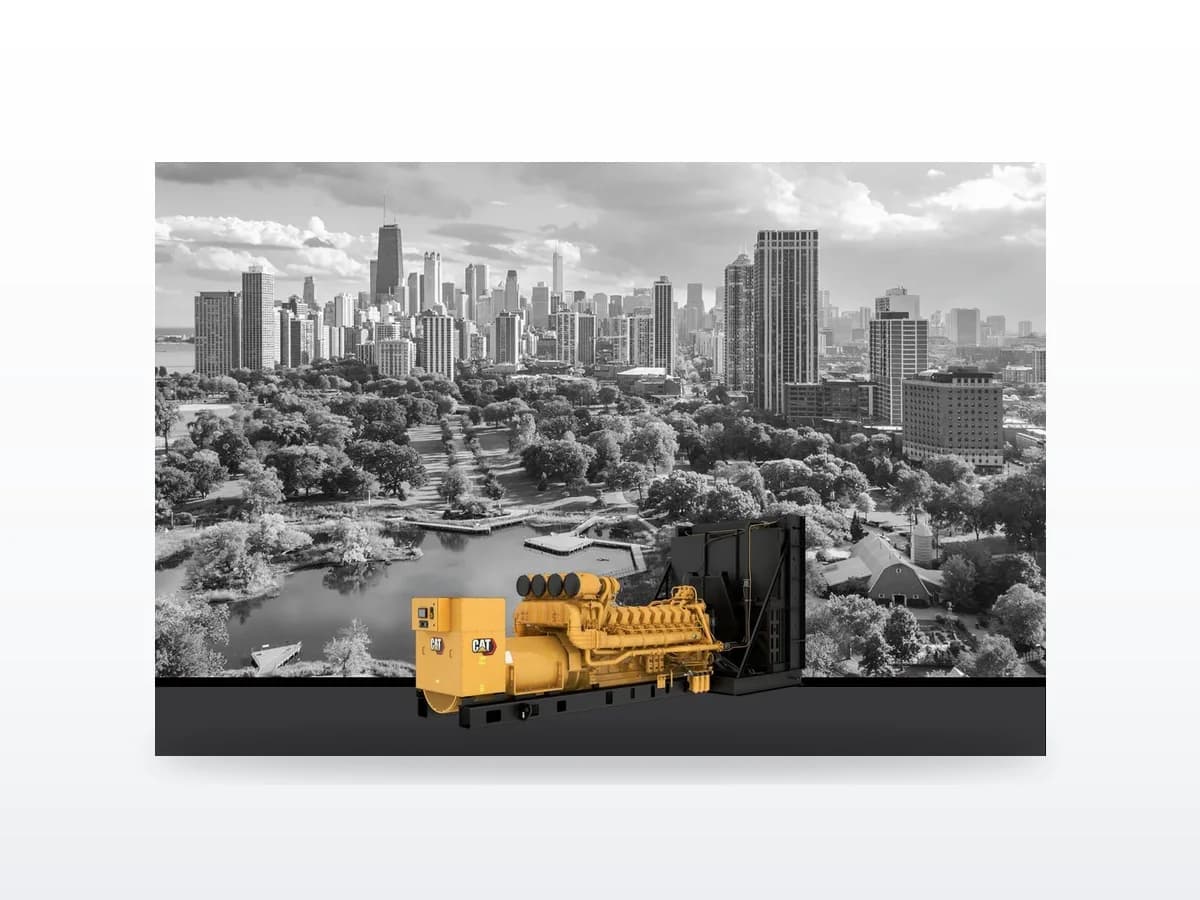
The Cat C175 Series occupies the apex of Caterpillar's diesel generator product line, delivering 3,100 to 4,000 kW from two platform variants: the C175-16 (V-16, up to 3,100 kW) and the C175-20 (V-20, up to 4,000 kW). Both are built on Caterpillar's SCAC (separate circuit aftercooled) engine architecture with common rail fuel injection and ADEM A4 electronic controls — a combination that supports continuous, prime, standby, and mission-critical duty cycles from a single platform.
At this capacity tier, the C175 Series is specified for applications where multi-megawatt power from a single generating unit is either operationally required or space-constrained. Data center pods requiring 3+ MW of backup, large industrial facilities with process-critical loads, and campus-scale installations are the primary buyers. The broad voltage range — from 220V through 13,800V medium voltage — means the C175 can interface directly with medium-voltage bus infrastructure without intervening step-up transformers, reducing both capital cost and single-point failure risk.
The C175 Series carries Caterpillar's standard ecosystem advantages: roughly 200 US dealers, parts availability extending back to earlier Cat platforms, and a used equipment market with demonstrably stronger resale values than comparable large-displacement competitors. For buyers with 10+ year ownership horizons and multi-megawatt requirements, the C175 is the reference specification against which other platforms are compared.
How to Choose#
Output requirement (C175-16 vs C175-20): The C175-16 covers standby loads up to 3,100 kW. If your design requires more than 3,100 kW from a single generator — or if you want a substantial margin above 2,500 kW without moving to a paralleling array — the C175-20 at 4,000 kW is the appropriate platform. Most installations below 3,000 kW standby should evaluate the Cat 3516E before committing to the C175 footprint and capital cost.
Voltage configuration: Both models support a wide voltage range. For installations connected to low-voltage distribution (277/480V), either model can be configured accordingly. For medium-voltage bus integration (4,160V, 11,000V, 13,800V), both platforms are available with matching alternator configurations. The C175-16 additionally supports 3,300V for international applications, while the C175-20 supports 11,000V configurations common in British-standard 50 Hz markets.
Paralleling arrays: The C175-20 is frequently specified in paralleling configurations where two or three units provide 8,000–12,000 kW of combined capacity. If your target capacity falls between 3,100 and 8,000 kW, a paralleling array of C175-16 or C175-20 units may offer better redundancy architecture than a single large unit. Evaluate N+1 vs 2N redundancy requirements when sizing.
Duty cycle: Both models are rated for standby, mission-critical, prime, and continuous duty. If the application involves significant annual runtime hours (prime or continuous duty), confirm the specific duty cycle rating with your Cat dealer, as standby and prime ratings differ on the C175 platform.
Common Applications#
-
Data centers: The C175 Series is sized for hyperscale and enterprise data center facilities requiring 3–4 MW of backup power per generator. Medium-voltage output options enable direct integration with campus distribution infrastructure, and the paralleling capability supports n+1 redundancy architectures at the pod level.
-
Mission-critical industrial facilities: Chemical plants, refineries, water treatment facilities, and large manufacturing operations that cannot tolerate process interruption specify the C175 for its ability to carry large motor loads and sustain power through extended outages on continuous or prime duty ratings.
-
Paralleling arrays for campuses: University and hospital campus power systems that need 6–16 MW of total backup capacity commonly deploy C175 units in paralleling switchgear arrangements. Each unit contributes to the shared bus, and individual units can be taken offline for maintenance without dropping the entire array.
-
Large commercial standby: High-density commercial developments — large convention centers, airport terminals, and mixed-use towers — where a single large generator is more practical than multiple smaller units in constrained mechanical spaces.
-
Prime and continuous power: Remote industrial sites, mining operations, and off-grid installations where the C175's continuous duty rating and field-proven engine architecture provide long-term reliability without grid dependence.
Service & Maintenance#
The C175 Series requires oil changes every 500 hours or 12 months (whichever occurs first) and air filter service at 1,000-hour intervals. At these output levels, oil volume is substantial — budget accordingly for oil disposal and ensure your service provider has the equipment to handle large-format engine maintenance.
No failure mode data specific to the C175-16 or C175-20 is documented in the current model library, which reflects the relatively small installed base of this platform and its typically careful facility-level maintenance programs. General large-diesel maintenance priorities apply: fuel quality management is critical at this scale, as injector fouling from degraded standby fuel is the most common cause of unplanned downtime across all large diesel platforms. Implement a fuel polishing and testing program with defined replacement intervals.
Caterpillar's ADEM A4 electronic controls on both C175 models enable remote monitoring integration via Cat's EMCP control panel ecosystem. At the power levels this series represents, remote monitoring and automated load testing schedules are standard practice rather than optional. Coordinate with your Cat dealer on programming the control system for your specific load testing requirements and NFPA 110 compliance schedule.
For medium-voltage configured units, engage only qualified high-voltage technicians for any work on the alternator or output connections. The available voltages on these platforms (up to 13,800V) represent lethal hazards that require specialized safety protocols beyond standard generator maintenance procedures.
Application Guidance#
The CAT C175 Series is purpose-built for applications where multi-megawatt power from a single generating unit is either required or space-constrained — hyperscale data center pods, large industrial facilities with process-critical loads, and campus-scale installations requiring 3,100 to 4,000 kW of backup or prime power from a single generator. The C175-16 at 3,100 kW and C175-20 at 4,000 kW both support medium-voltage output to 13,800V, enabling direct bus integration with campus distribution infrastructure without intervening step-up transformers and reducing both capital cost and single-point failure exposure. SCAC cooling and Common Rail injection on both models support continuous, prime, standby, and mission-critical duty cycles from the same platform — a genuine advantage over platforms that require separate duty-rated variants.
Most installations below 3,000 kW should evaluate the CAT 3500 Series Large Diesel (1,000–3,000 kW) before committing to the C175's footprint and capital cost — the 3516E at 3,000 kW covers most requirements that don't explicitly demand 3,100+ kW from a single unit. The C175 is also not the right fit for facilities with loads addressable through a paralleling array of smaller units, which can provide better N+1 redundancy architecture than a single large unit at comparable or lower total capital. At this output level, direct competition comes from the Kohler KD Series (Industrial Diesel) (900–4,000 kW) and the Cummins QSK95 platform at approximately 3,000 kW — CAT's advantage is dealer density and parts ecosystem depth; Kohler's is vertical engine-plus-alternator integration from a single OEM.