
Series Overview#
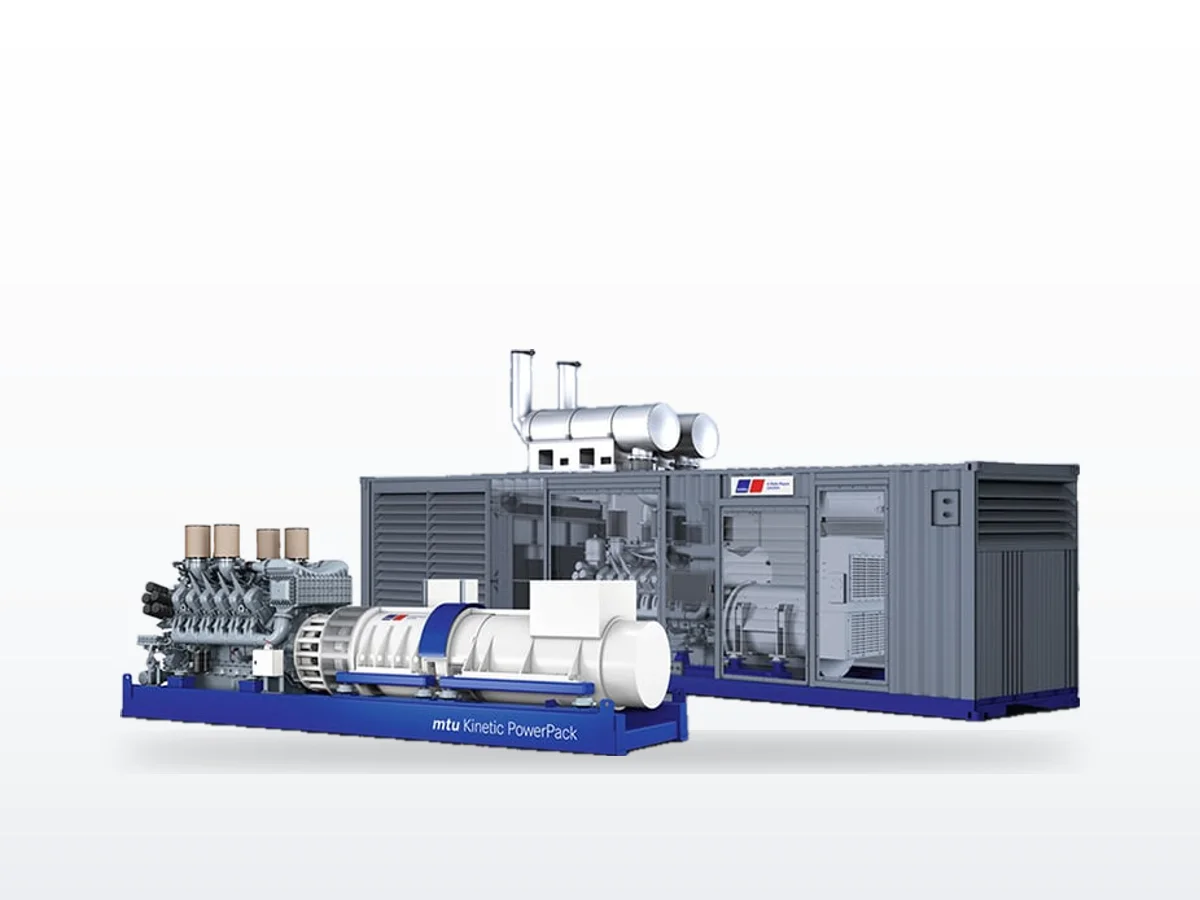
The MTU Onsite Energy Gas lineup consists of five natural gas and LP standby generator models spanning 100 to 500 kW — the GS100, GS150, GS200, GS350, and GS500. These generators are designed for installations where diesel fuel storage is impractical, prohibited, or simply unnecessary because utility natural gas is available at the site. All models are EPA certified with 3-way catalysts and support dual-fuel operation (natural gas and LP vapor) as factory options.
Unlike the MTU diesel lineup — which uses MTU and John Deere engines across a consistent R-series and 1600-series architecture — the gas generator line draws from three engine OEMs:
| Model | kW (NG) | kW (LP) | Engine | Config |
|---|---|---|---|---|
| GS100 | 100 | 100 | MTU 6.8LT V10 | 6.8L, V10 |
| GS150 | 150 | 100 | Doosan 8.1L CAC | 8.1L, inline-6 |
| GS200 | 200 | 130 | Doosan 11.1L CAC | 11.1L, inline-6 |
| GS350 | 350 | 245 | Doosan 18.3L CAC | 18.3L, V10 |
| GS500 | 500 | 350 | PSI 31.8L CAC | 31.8L, V12 |
All models use Bosch electronic isochronous governors (plus or minus 0.5% speed regulation), 3-way catalysts for EPA compliance, and unit-mounted radiators rated for 50 degrees C ambient. The GS100 uses a 12V starting system; the GS150 and above use 24V.
How to Choose#
GS100 (100 kW standby, MTU 6.8LT V10): The most compact gas unit in the lineup at 87 inches long. Unique in that the NG and LP ratings are equal at 100 kW — no LP derating. The V10 architecture is unusual at this power level but delivers a compact package. Choose for small commercial sites under 100 kW where dual-fuel flexibility with equal power output on both fuels is valued.
GS150 (150 kW NG / 100 kW LP, Doosan 8.1L CAC): First of the Doosan-powered inline-6 models. The 33% LP derating is significant — if LP is the primary fuel, the effective capacity is only 100 kW. The 8.1L engine is a proven industrial platform. Choose for mid-size commercial sites where natural gas is the primary fuel and 150 kW covers the standby requirement.
GS200 (200 kW NG / 130 kW LP, Doosan 11.1L CAC): Largest inline-6 gas unit in the MTU lineup. The 35% LP derating is the steepest in the series. At 200 kW on natural gas, this is the right-sized option for facilities needing more power than the GS150 but not ready for the substantially larger GS350. Shares the same footprint length as the GS150 (142 inches) but is taller and heavier.
GS350 (350 kW NG / 245 kW LP, Doosan 18.3L CAC): Moves to the V10 architecture and crosses the 10,000-pound threshold. Gas supply infrastructure at 3,499 CFH requires dedicated utility service engineering. Choose for large commercial or light-industrial sites with confirmed gas supply capacity at this flow rate.
GS500 (500 kW NG / 350 kW LP, PSI 31.8L CAC): The flagship gas unit — nearly 19 feet long, 18,740 pounds, and available in medium-voltage 4,160V configuration (unique in the MTU gas line). Gas supply at 6,072 CFH demands a 3-inch NPT inlet and dedicated utility service. The Leroy-Somer alternator is a departure from the MTU/Stamford alternators used elsewhere in the lineup. Choose for industrial-scale gas standby where diesel elimination at 500 kW is a design requirement.
Common Applications#
- Commercial standby (no diesel storage): Buildings where fire code, landlord restrictions, or environmental policy prohibit on-site diesel fuel storage. The gas lineup provides standby power fed directly from the utility gas main.
- Dual-fuel redundancy: Sites that want fuel supply redundancy — natural gas primary with LP backup — can configure any model for dual-fuel switchover, ensuring standby power even if utility gas is interrupted.
- Data center edge: The GS100 and GS200 serve edge data centers and network facilities under 200 kW where natural gas is available and diesel logistics are impractical.
- Industrial facilities with gas infrastructure: Manufacturing and process plants that already have high-capacity natural gas service can add standby generation without building diesel fuel storage infrastructure.
- Environmentally sensitive sites: Installations where emissions regulations, community requirements, or corporate sustainability goals favor gaseous fuel over diesel.
Service & Maintenance#
All MTU gas generators share 500-hour oil change intervals and 20,000-hour major overhaul schedules. The gas-specific service items that distinguish these units from the diesel lineup include:
3-way catalyst: The primary emissions management component. Catalyst efficiency degrades over time — typically after 8,000–12,000 operating hours depending on gas quality and load profile. Annual exhaust gas analysis is recommended to verify catalyst performance. Catalyst substrate can fracture from detonation events — monitor knock sensor data on models with engine knock detection.
Charge air cooler (GS150, GS200, GS350): Coolant ingestion into the intake manifold from a failed charge air cooler is the highest-consequence failure mode on the Doosan-powered models. Inspect end caps and connections at every service interval. Immediate shutdown is required if white smoke or coolant loss is observed.
Gas supply pressure: All models require 7–11 inches of water column at the generator inlet. Pressure drops during cold-weather starts or simultaneous building gas demand can cause start failures or rough running. Verify pressure at the generator connection, not at the meter, during commissioning and periodically during service.
Battery systems: The GS100 uses 12V (925 CCA). The GS150 through GS350 use 24V (1,050 CCA per battery). The GS500 uses 24V with four 8D batteries (2,800 CCA total). Gas engines can be harder to start than diesels due to the spark ignition sequence — battery condition is critical. Load-test at every service interval and replace proactively.
Intercooler water pump (GS500 only): The PSI 31.8L V12 has a separate intercooler water circuit independent of the main jacket water. Pump seal failure causes charge-air temperature rise, reduced power, and increased knock risk. Monitor coolant levels in both circuits.
Application Guidance#
The MTU Onsite Energy Gas lineup provides a natural gas and LP alternative at every major power tier from 100 to 500 kW. The primary decision between gas and diesel comes down to fuel infrastructure: sites with reliable utility natural gas service and restrictions on diesel storage are natural candidates for gas generators. Sites in areas with frequent, prolonged utility outages — where both electric and gas service may be interrupted simultaneously — should carefully evaluate whether gas standby provides true backup or whether on-site diesel storage is the safer choice.
The LP derating across the lineup (30–35% on all models except the GS100) is a critical sizing consideration. If LP is the primary or backup fuel, size the generator at the LP rating, not the NG rating. The GS100 is the exception — equal 100 kW output on both fuels makes it the most flexible dual-fuel option in the series.
Gas generators are significantly larger and heavier than diesel equivalents at the same power level. The GS350 at 172 x 99 inches dwarfs the diesel 8V1600 DS350 at 118 x 74 inches. The GS500 at nearly 19,000 pounds requires structural engineering for the concrete pad. Plan for these physical constraints during site design.
For diesel alternatives at equivalent power levels, the MTU 4R0113 Series covers 50–100 kW, the MTU 6R0113 Series covers 150–200 kW, the MTU 8V1600 DS350 covers 350 kW, and the MTU 10V1600 DS500 covers 500 kW. Buyers comparing the MTU gas lineup against CAT DG-Series or Cummins N6 Series should compare LP deratings, gas supply requirements, and local dealer coverage for the respective engine OEMs (MTU, Doosan, PSI vs CAT or Cummins).