
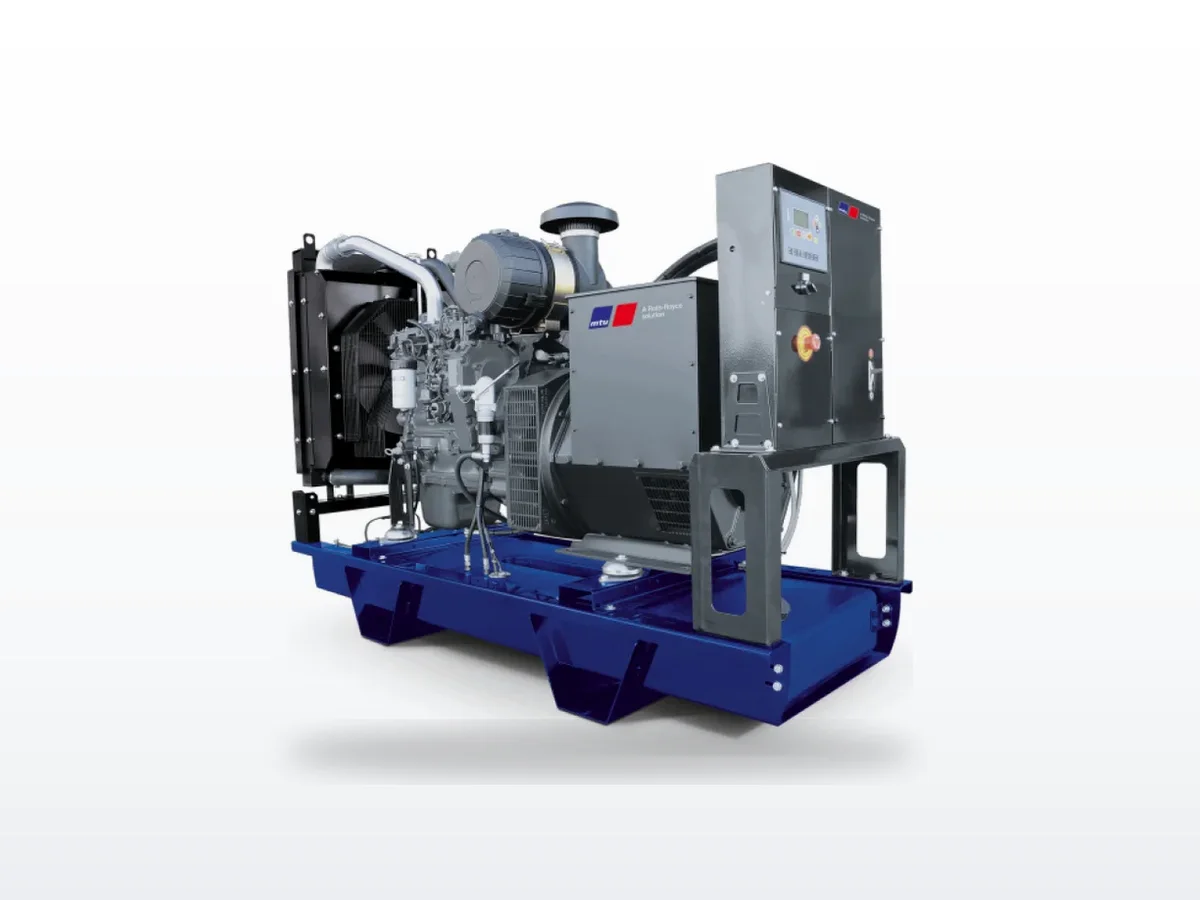
Series Overview#
The MTU 4R0113 Series consists of two diesel generator models — the DS50 (50 kW standby, 45 kW prime) and the DS100 (100 kW standby, 90 kW prime) — both built on the John Deere 4045, a 4.5-liter 4-cylinder engine platform. Both carry EPA Tier 3 certification and are available in single-phase and three-phase configurations from 120/240V through 347/600V. The 4R0113 Series fills the light commercial and small industrial standby range between the entry-level 3R0096 DS30 at 30 kW and the 6R0113 Series at 150–200 kW.
Despite sharing the same 4045 block and displacement, the DS50 and DS100 are mechanically distinct engines with different service profiles. The DS50 uses the 4045TF280 — naturally aspirated with mechanical injection and a droop governor — while the DS100 uses the 4045HF285 — turbocharged and aftercooled with electronic fuel injection and the JDEC electronic isochronous governor. This makes the DS50 the simpler unit to maintain, while the DS100 offers tighter speed regulation and better fuel efficiency per kilowatt.
Both models share the John Deere 4045 platform's key advantage: broad parts availability through both MTU Onsite Energy distributors and the independent John Deere dealer network worldwide.
How to Choose#
DS50 (50 kW standby, 45 kW prime, John Deere 4045TF280): The mechanically simpler of the two. Naturally aspirated with mechanical injection — no turbocharger to service, no ECU to diagnose, and robust cold-start performance. The mechanical droop governor provides plus or minus 0.5% speed regulation, which is adequate for most resistive and motor loads but may not satisfy sensitive electronic equipment requirements. Choose when the load study produces a standby requirement under 50 kW and maintenance simplicity is valued over fuel efficiency.
DS100 (100 kW standby, 90 kW prime, John Deere 4045HF285): Maximum output from the 4045 platform. The turbocharged and aftercooled engine with JDEC electronic isochronous governor delivers plus or minus 0.25% speed regulation and better fuel efficiency per kilowatt. The DS100 also carries SCAQMD certification, making it eligible for the most restrictive air quality jurisdictions. Choose when the load study requires between 50 and 100 kW or when electronic isochronous governing is required for sensitive loads.
The DS100 is physically larger (100 x 48 inches versus 70 x 32 inches for the DS50) and nearly 30% heavier. Both use 12V starting systems and share the same 250-hour oil change interval.
Common Applications#
- Small commercial standby: The 50–100 kW range covers small to mid-size commercial buildings — offices, retail centers, restaurants, and professional services — where standby requirements are modest but reliability expectations are high.
- Light industrial: Pump stations, small manufacturing facilities, and warehouse operations with critical systems under 100 kW.
- Data center edge: The DS100 is appropriate for edge data centers and network operations centers with tight frequency regulation requirements and loads under 100 kW.
- Healthcare (small): Clinics, urgent care centers, and small medical offices where NFPA 110 compliance is required. The DS100's SCAQMD certification is relevant for California healthcare installations.
Service & Maintenance#
Both models follow John Deere service intervals: oil and filter changes every 250 hours or 12 months. The two engines have distinct service considerations:
DS50 (mechanical injection): The 4045TF280's mechanical injection system avoids ECU complexity but is sensitive to fuel quality. Water contamination in diesel is the leading cause of injection pump and injector failures. The fuel filter with water separator must be drained and inspected at every service interval. In areas with temperature extremes, replace the separator more frequently. Battery condition is the other common failure mode — 12V starting systems on infrequently exercised standby units are susceptible to sulfation.
DS100 (turbocharged, electronic): The 4045HF285 adds the charge air cooler as a critical inspection point. Check for coolant seepage at the cooler end caps and intake manifold connections at every service interval — a failed charge air cooler can allow coolant into the intake, causing hydrostatic lock and catastrophic engine damage. The JDEC electronic governor is reliable but occasionally produces J1939 fault codes from intermittent wiring harness connections — inspect all ECU harness connectors during annual service.
Application Guidance#
The MTU 4R0113 Series is the right specification for sites requiring 50–100 kW of diesel standby power. The choice between DS50 and DS100 is driven by load requirement and service philosophy: the DS50 rewards facilities that value mechanical simplicity and can tolerate droop governing, while the DS100 serves installations that require electronic isochronous control or SCAQMD compliance.
Below 50 kW, the MTU 3R0096 DS30 covers the 30 kW class. Above 100 kW, the MTU 6R0113 Series moves to the John Deere 6068 inline-6 at 150–200 kW, offering smoother vibration characteristics and greater thermal headroom. Sites considering natural gas at 100 kW should evaluate the MTU 10V0068 GS100 — same power output without diesel fuel storage requirements. Buyers comparing against Cummins C50/C100 D5 or Caterpillar DE33/DE65 units should weigh the John Deere parts availability advantage and local dealer network coverage against the broader service networks of the competing brands.