
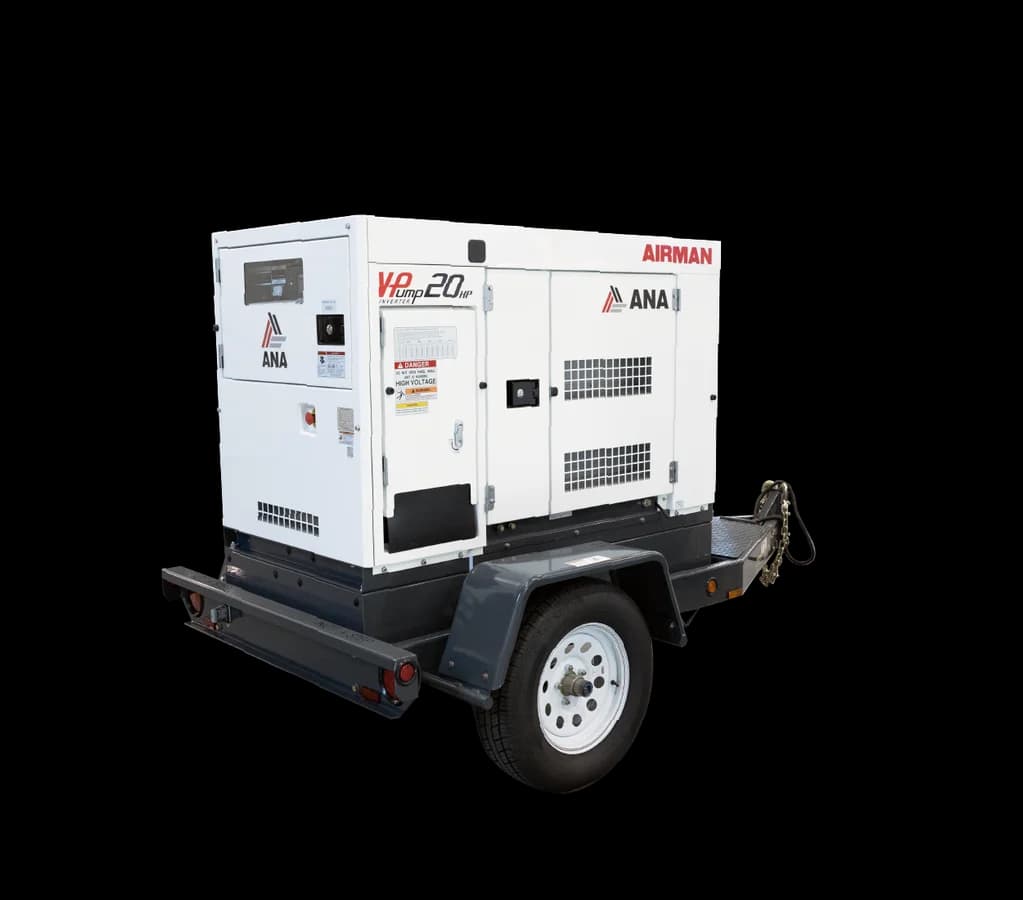
Series Overview#
The Airman SDG V-Pump Series is a specialized portable generator line consisting of two models — the SDG25SV (22 kW standby) and SDG45SV (39 kW standby) — that integrate a Mitsubishi FR-F800 variable frequency drive (VFD) directly into the generator enclosure. The VFD enables direct pump motor starting and speed control without a separate external VFD panel, making the V-Pump series a self-contained power-and-drive solution for dewatering and motor control applications on construction sites and rental deployments.
Both models are built on Airman SDG generator platforms — the SDG25SV is based on the SDG25S with an Isuzu 4LE2T engine, and the SDG45SV is based on the SDG45S with an Isuzu 4LE2X engine. Both are Tier 4 Final certified, include Airman's standard 110% fluid containment, and are built by Hokuetsu Industries in Japan. The VFD integration is factory-installed, not a field conversion, ensuring the generator-to-drive interface is properly engineered for the combined system.
The V-Pump designation targets construction dewatering as the primary application, but the integrated VFD capability extends to any variable-speed motor control application where an on-site diesel generator and motor controller are both required. The SDG25SV at 2,227 lbs with a 52-gallon tank is compact enough to position alongside dewatering pumps in confined site areas.
How to Choose#
SDG25SV (20 kW prime / 22 kW standby, Isuzu 4LE2T): For smaller dewatering jobs and pump applications where the motor load fits within the 20 kW prime capacity. The 52-gallon tank and 2,227 lbs operating weight make this the more mobile of the two units — deployable in tight spaces. Choose when the pump motor load is at or below 20 kW running and the compact footprint is important.
SDG45SV (36 kW prime / 39 kW standby, Isuzu 4LE2X): For larger pump motors and dewatering applications requiring 36 kW prime capacity. Nearly double the capacity of the SDG25SV, appropriate for larger dewatering operations, higher-head pump systems, or applications running multiple smaller motors simultaneously. Choose when the pump motor load exceeds the SDG25SV's capacity or when reserve margin is required.
For both models: match the motor load (FLA and LRA) to the generator prime rating. The VFD soft-start reduces inrush current, but the generator must still sustain the running current without derating. Consult the Mitsubishi FR-F800 documentation for motor sizing compatibility with the VFD.
Common Applications#
- Construction site dewatering: Excavation dewatering, trench pumping, and groundwater control are the primary applications. The SDG V-Pump eliminates the need for a separate VFD panel at the pump location, reducing setup time and equipment count on active construction sites.
- Rental fleet dewatering service: Equipment rental companies serving construction and infrastructure projects can deploy a V-Pump unit as a complete dewatering solution — one piece of equipment handles both power generation and pump motor control.
- Variable-speed motor applications: HVAC fan speed control, compressor drives, and process motor applications at temporary or construction sites where utility power is unavailable and variable-speed motor control is required.
Service & Maintenance#
Both SDG V-Pump models share the standard Airman service schedule: oil and fuel filter changes every 500 hours or 12 months, air filter service every 500 hours. The base generator maintenance is identical to the SDG25 and SDG45 conventional models.
The Mitsubishi FR-F800 VFD adds a maintenance consideration: the VFD contains capacitors and cooling fans that have finite service lives. Follow the Mitsubishi FR-F800 maintenance schedule in addition to the generator service intervals. Capacitor replacement intervals and cooling fan inspection are typically specified in the VFD's operations manual.
The three common generator failure modes — fuel filter clogging, starting battery degradation, and coolant hose weeping — apply identically to the V-Pump models. On dewatering sites where units are actively running and fuel consumption is high, the 500-hour service interval may govern before the 12-month calendar interval. Monitor the service meter on actively running units.
Application Guidance#
The Airman SDG V-Pump Series is purpose-built for construction dewatering and pump motor control applications where both a diesel generator and a variable-frequency drive are required at the same job location. At 22 to 39 kW standby from two Isuzu Tier 4 Final models, the SDG25SV and SDG45SV eliminate the need for a separate external VFD panel by integrating a factory-installed Mitsubishi FR-F800 drive directly into the generator enclosure — reducing equipment count, setup time, and cabling complexity on active excavation and dewatering sites. Both models include Airman's standard 110% fluid containment, making them CARB-compliant for California dewatering work.
This series is not appropriate when the load requirement exceeds 39 kW — at that point you need a conventional SDG Series generator with a separately procured VFD matched to the actual motor and load size. It is also not the right choice for general-purpose power applications where variable-speed motor control is not the primary need; the Airman SDG Series provides the same Isuzu engine platforms across 11–336 kW without the VFD overhead and at lower cost for standard jobsite power. For larger dewatering operations or multi-pump configurations requiring more generator capacity with trailer mobility, the Atlas Copco QAS Series covers 22–616 kW as a portable platform, though VFD integration would require a separate external drive in that configuration.