
Series Overview#
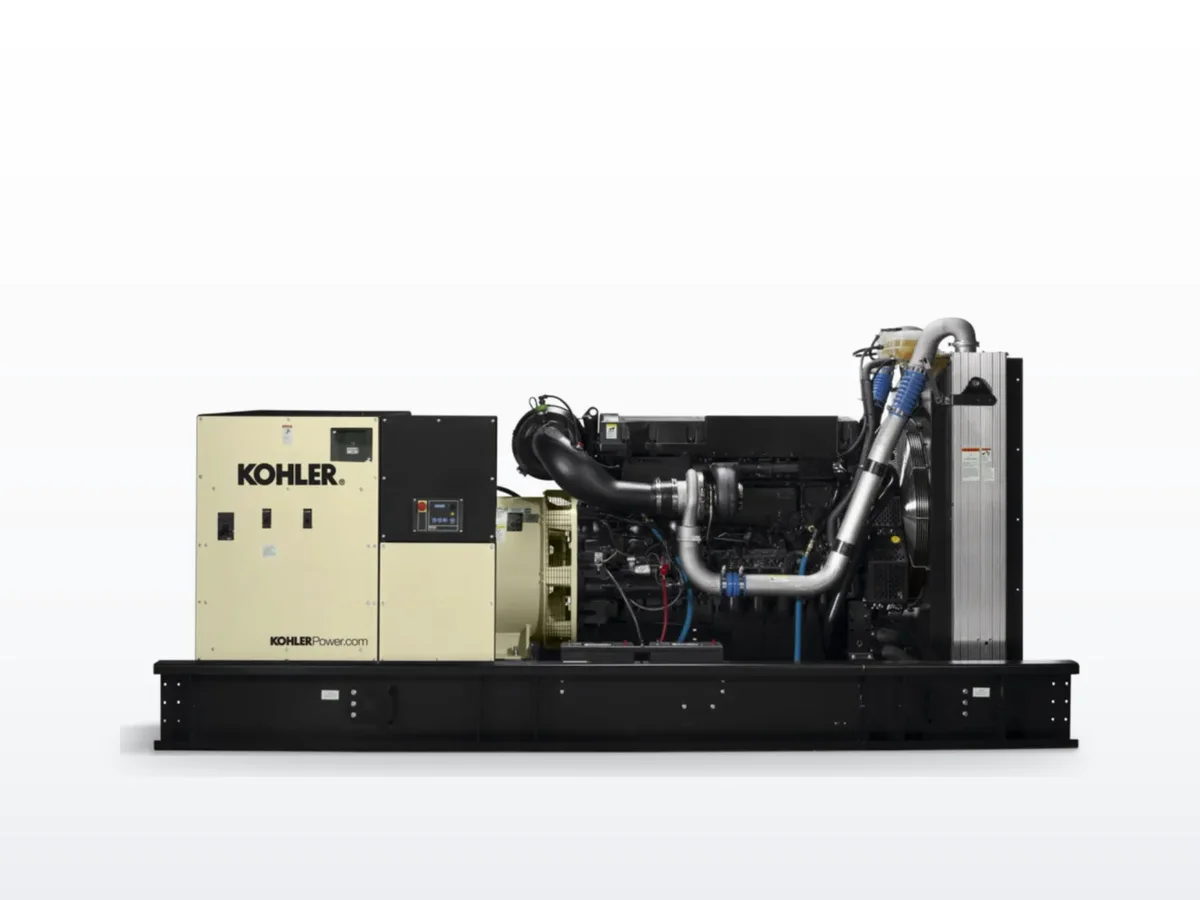
The Kohler REOZ Series (Diesel Industrial Large) covers 12 models from 515 to 2500 kW standby, filling the power range between Kohler's commercial REOZ line and the proprietary-engine KD Series. Where the KD Series uses Kohler-built engines throughout, the large REOZ Series draws on three industry-leading engine OEMs depending on power class: Volvo, Mitsubishi, and Detroit Diesel/MTU. All 12 models are EPA Tier 2 certified for stationary emergency standby applications.
The series organizes into three distinct engine families. At the lower end — 515 to 600 kW standby — the REOZVB designation indicates Volvo TAD-series turbocharged inline-6 engines. The Volvo TAD1641GE-B, TAD1642GE-B, and TWD1643GE (or TWD1644GE) are purpose-built industrial genset engines widely supported in North America. Moving up from 750 kW through 2000 kW, the REOZMD designation indicates Mitsubishi heavy-duty multi-cylinder engines: the S12A2-Y2PTAW-2 at 750 kW and the S12R and S16R families (65.4 L, 16-cylinder V-configuration) at 1250 kW through 2000 kW. At 2500 kW, the REOZDC stands alone — powered by a Detroit Diesel/MTU 16V4000G83L, a 76.3-liter V16 producing up to 2,740 kW maximum shaft power.
Voltage flexibility is a distinguishing capability of this series. While the Volvo-powered 500–600 kW models support 277/480V and 120/208V, the Mitsubishi-powered models from 750 kW upward add medium-voltage options: 4160V, 12470V, 13200V, and 13800V. This allows large facilities to receive generator output at distribution voltage, eliminating the step-up transformer that would otherwise be required between a low-voltage generator and a medium-voltage switchgear bus. The 2500REOZDC supports the same medium-voltage range at the 2.5 MW level.
The ROZMC variants (1250ROZMC, 1600ROZMC, 2000ROZMC) are non-EPA-certified models intended for export or non-regulated markets, available in both 50 Hz (1500 RPM) and 60 Hz (1800 RPM) configurations. Buyers specifying domestic US installations should confirm the REOZMD designation, which carries the EPA Tier 2 certification required for permitted standby applications.
How to Choose#
500–600 kW: REOZVB platform (Volvo). Choose between the 500REOZVC (515 kW standby), 550REOZVB (550 kW standby), and 600REOZVB (600 kW standby). All three use Volvo inline-6 engines and support 277/480V and 120/208V. If your facility load calculation lands in this range after demand factor analysis, the 550REOZVB provides a practical mid-step before transitioning to the Mitsubishi platform at 750 kW.
750 kW: 750REOZMD (Mitsubishi S12A2). This is the entry point for medium-voltage output capability and the Mitsubishi platform. If your facility distribution is at 4160V or above, the 750REOZMD is the lowest-output option that can deliver at medium voltage.
1250–2000 kW: REOZMD platform (Mitsubishi S12R and S16R). This range covers the most common single-unit configurations for large data centers and hospital campuses. The 1250REOZMD (1280 kW standby), 1600REOZMD (1600 kW standby), 1750REOZMD (1780 kW standby), and 2000REOZMD (2000 kW standby) all use Mitsubishi S-series engines with full medium-voltage support. The 2000REOZMD represents the practical upper limit of the Mitsubishi S16R platform as a single-unit installation.
Export variants: ROZMC. The 1250ROZMC, 1600ROZMC, and 2000ROZMC are rated for 50 Hz or 60 Hz operation and are not EPA-certified. Specify these only for international or non-regulated applications.
2500 kW: 2500REOZDC (Detroit Diesel/MTU 16V4000). For applications requiring a single 2.5 MW unit — hyperscale data centers, major hospital campuses, large wastewater treatment plants — the REOZDC uses a fundamentally different engine architecture from the rest of the series. Parts and service support for the MTU 16V4000 requires MTU-trained technicians; factor this into your service contract planning.
Common Applications#
-
Data centers and colocation facilities. All 12 models are rated for data center standby. Medium-voltage output capability (on REOZMD and REOZDC models) is particularly valuable for large campus-scale data center installations where medium-voltage distribution is the primary power architecture.
-
Hospital and healthcare campuses. The Mitsubishi S16R-powered models (1250–2000 kW) are commonly installed at regional hospital systems and major medical centers requiring single-unit or paralleled backup capable of powering entire clinical buildings.
-
Heavy industrial and manufacturing. Large manufacturing facilities with significant process loads, compressors, and motor drives operate in this power class. The REOZ large series handles the sustained prime-power demands of industrial applications as well as standby duty.
-
Government and utility infrastructure. Large municipal water treatment facilities, substations, and emergency operations centers deploying in this power class benefit from the medium-voltage output options, allowing direct integration with existing distribution infrastructure.
-
Mission-critical paralleling arrays. The 2000REOZMD is a common choice for data center paralleling arrays, where multiple 2 MW units provide scalable N+1 redundancy with smaller individual unit footprints than a single 4 MW machine.
Service & Maintenance#
All 12 models in the large REOZ Series share consistent service intervals: oil and fuel filter changes every 500 hours or 12 months, air filter service every 1,000 hours, and coolant changes at 6,000 hours. These intervals apply across the Volvo, Mitsubishi, and MTU engine platforms.
Starting battery failure is the most widely observed failure mode across this fleet, present on all 12 models. For large industrial generators that cycle only during monthly exercises and actual outages, battery state-of-health checks should be included in every semi-annual inspection. A battery that passes a visual check can still fail to deliver sufficient cold-cranking current when the unit has been sitting.
Fuel injection system issues are the next most significant failure category. The Mitsubishi-powered REOZMD models (8 of the 12 total) show fuel injection pump and injector faults as a common failure mode at approximately 10,000 hours — symptoms include hard starting, black smoke, and uneven cylinder loading. Turbocharger wear typically appears around 12,000 hours in the Mitsubishi platform and 15,000 hours in the MTU 16V4000.
For the 2500REOZDC (MTU-powered), charge air cooling system inspections are important — reduced output and intake temperature alarms are common failure indicators around 12,000 hours. The MTU 16V4000 requires MTU-certified service personnel for major maintenance events; plan service contracts accordingly before commissioning.
Application Guidance#
The Kohler REOZ large industrial diesel series is purpose-built for mission-critical and heavy commercial applications requiring 515 kW to 2,500 kW of standby capacity from a single unit, with medium-voltage output capability from the 750 kW Mitsubishi-platform models upward. The medium-voltage options (4160V, 12470V, 13200V, 13800V) on the REOZMD and REOZDC models are the defining advantage over the commercial REOZ line — they eliminate the step-up transformer tier in data center and hospital distribution architectures, reducing installation cost and improving power path efficiency. Data centers with campus-scale deployment, regional hospital systems, large municipal infrastructure, and heavy industrial facilities with process loads in the 500 kW–2.5 MW range are the natural buyers. All 12 models are EPA Tier 2 certified; for domestic US installations, confirm the REOZMD designation (not the export ROZMC variant).
This series is not appropriate for applications below 500 kW — the Kohler REOZ diesel commercial standby series serves 10–510 kW on John Deere and Kohler engines with broader Tier 3/Tier 4 Final options. Gaseous fuel requirements are not served by this series; the Kohler Industrial Gaseous 500REZK is the upper boundary of Kohler's gas standby line. Buyers evaluating the REOZMD (Mitsubishi-powered) against MTU Series 4000 alternatives in the 1,250–2,000 kW range should weigh the MTU platform's fuel efficiency advantage and DCCP data center rating against Kohler's North American service infrastructure and Decision-Maker controller ecosystem. The CAT 3500 Series large diesel is the other primary competitor in the 1,000–2,500 kW band.