
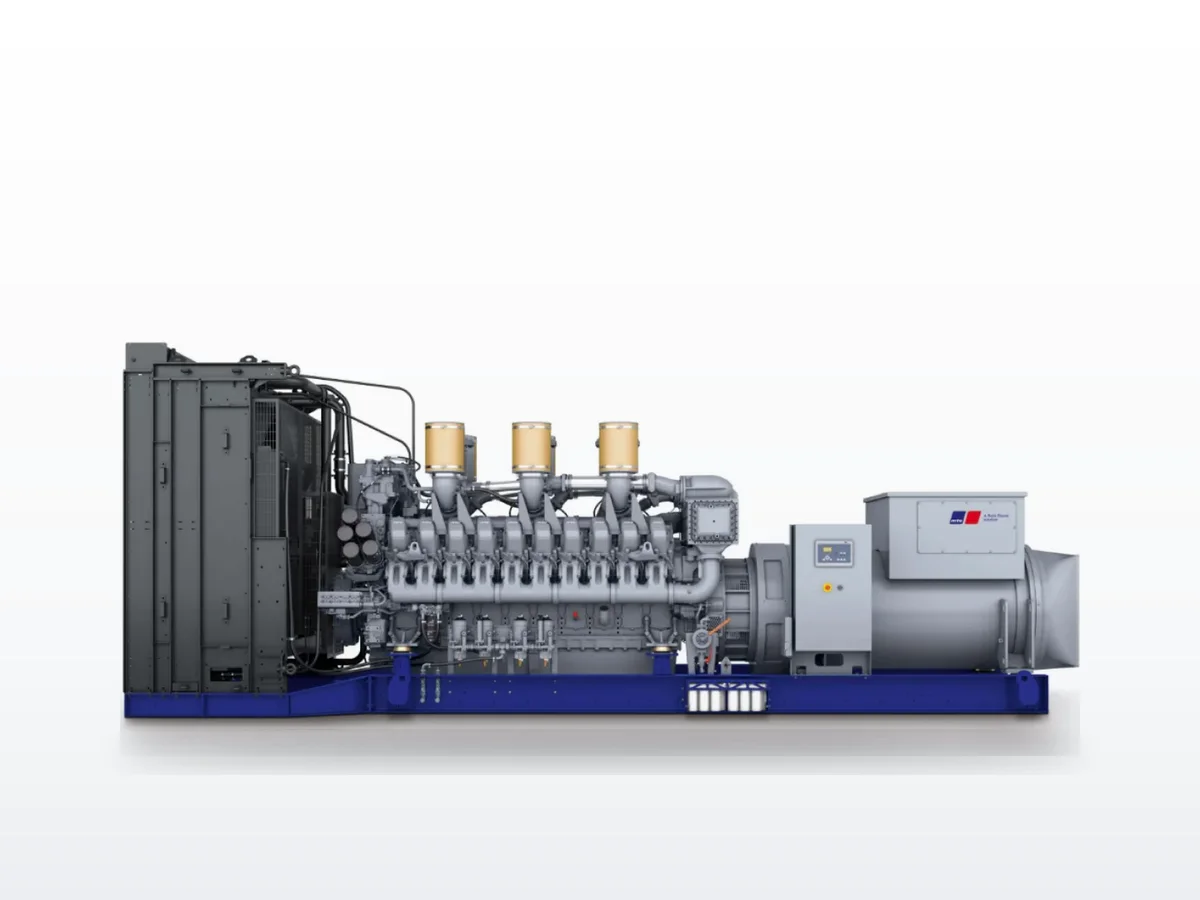
Series Overview#
The MTU Series 4000 Diesel is Rolls-Royce Power Systems' flagship stationary generator line for large mission-critical applications, spanning six models from 1,250 to 2,500 kilowatts of standby capacity. Built on MTU's proprietary 4000-series engine platform — a 57.2-liter V12 for the three lower-output models and a 76.3-liter V16 for the three higher-output models — the Series 4000 is the generator of choice for hyperscale data centers, major hospital complexes, high-rise buildings, and large industrial facilities where power density, fuel efficiency, and sustained high-load reliability are the primary selection criteria.
The six models divide into two sublines: the 12V4000 platform (DS1250, DS1500, DS1750) running on the 57.2-liter V12 engine producing 1,250–1,750 kW standby, and the 16V4000 platform (DS2000, DS2250, DS2500) running on the 76.3-liter V16 engine producing 2,000–2,500 kW standby. MTU's brand context is relevant here: MTU diesel engines are documented to run 5–10% more efficiently than comparable CAT and Cummins engines at equivalent loads, and the Series 4000's high power density — more kilowatts per square foot of generator footprint than most alternatives in this class — makes it a compelling specification when both fuel cost and floor space carry a premium over the generator's service life.
All Series 4000 generators are three-phase, Tier 2 certified, and available in voltage configurations from 380V through 13,800V. The medium-voltage options (4,160V, 12,470V, 13,200V, 13,800V) are particularly significant for large data center applications where direct medium-voltage distribution to UPS rooms eliminates a transformer tier in the power distribution architecture.
How to Choose#
The Series 4000 selection is organized around the engine platform boundary:
12V4000 subline (V12, 57.2L):
- DS1250 (1,250 kW standby / 1,135 kW DCCP): Entry point to the Series 4000. Choose when the load study requires between 1,000 and 1,250 kW from a single unit. The DCCP rating (1,135 kWe) is the operative specification for data center continuous duty.
- DS1500 (1,500 kW standby, FCO calibration): Uses the Fuel Consumption Optimized (FCO) engine calibration — designed to minimize fuel burn during intermittent standby duty cycles rather than maximize continuous output. Choose when emergency standby use dominates and fuel cost over the generator's life is a priority.
- DS1750 (1,750 kW standby / ~1,588 kW DCCP): Maximum output from the V12 platform. Choose when 1,500 kW standby is insufficient but the project economics or space constraints favor the V12 over stepping up to the V16.
16V4000 subline (V16, 76.3L):
- DS2000 (2,000 kW standby / 1,800 kW prime): Entry point to the V16 platform. The 16V4000G74S engine — same block designation as the DS2250. For facilities that have outgrown 1,750 kW but do not need 2,250 kW.
- DS2250 (2,250 kW standby / 2,045 kW prime/DCCP): Mid-range V16. True 2 MW continuous from a single unit. The 16V4000G74S engine — shared designation with DS2000 at a higher calibration.
- DS2500 (2,500 kW standby): Flagship. The 16V4000G94S — ECU9-generation engine at maximum V16 output. Choose when 2,250 kW standby is insufficient and the facility cannot step up to a 20-cylinder platform.
For voltage configuration: 480V is standard for most US applications. Medium-voltage options (4,160V and above) require coordination with the electrical engineer — they eliminate the LV-MV transformer but introduce medium-voltage switchgear requirements.
Common Applications#
- Hyperscale and colocation data centers: The primary market for the Series 4000. Paralleling arrays of 1,250–2,500 kW units are standard configurations for data centers deploying 10–100 MW of backup generation. The Series 4000's power density and fuel efficiency advantage compound across large fleets.
- Large hospitals: NFPA 110 Type 10 Class X compliance for major medical centers. A single DS2000 or DS2500 can cover the full essential electrical system of a large regional hospital from a single generator position.
- Mission-critical facilities: Federal government facilities, military installations, and national security infrastructure where sustained, proven reliability is non-negotiable.
- High-rise and large campuses: Buildings and campuses with central plant electrical distribution where a single generator position must carry the full facility standby load. Medium-voltage output options allow direct integration with high-rise distribution architecture.
- Paralleling arrays: The Series 4000 is the generator platform of choice for N+1 and 2N paralleling arrays at enterprise data centers. Multiple units combine through paralleling switchgear to meet total facility load with redundancy.
Service & Maintenance#
All Series 4000 models share a consistent service schedule: oil and fuel filter changes every 500 hours or 12 months, air filter service every 1,000 hours. The centrifugal oil filter — unique to MTU's Series 4000 and not found on competing platforms — requires inspection and cleaning at each major service interval as a separate item. Bypass warnings and elevated oil pressure differentials are the most common failure mode across all six models.
The four 8D starting batteries (24VDC system) represent the highest single-point failure risk at a scheduled inspection. Slow cranking and failure to start are documented across all six models. Battery capacity testing under load should be performed annually, and the full bank should be replaced proactively before the manufacturer's recommended replacement interval. Do not wait for a slow-crank symptom — a generator that will not start at a critical facility inspection is a more consequential failure than the cost of battery replacement.
Common rail fuel injector wear is the most severe-consequence scheduled maintenance item on the Series 4000: rough running, smoke, and power imbalance between cylinders on 12 or 16 cylinders is documented starting at 12,000–15,000 hours on the V16 models. Fuel quality is the primary risk factor — water intrusion or microbial contamination in large standby fuel tanks (documented capacity up to 154 gallons on some models) accelerates injector degradation. Implement fuel polishing and sampling on any tank that does not turn over fuel regularly.
The intercooler water circuit is a moderate-consequence item on the V16 models — reduced boost pressure and power derating from intercooler scaling or failure are documented at 9,000–12,000 hours. Include intercooler inspection in annual service.
Application Guidance#
The MTU Series 4000 is purpose-built for hyperscale data centers, major hospital campuses, high-rise buildings, and large industrial facilities that require single-unit standby at 1,250–2,500 kW with the highest available power density and fuel efficiency in the class. The DCCP (Data Center Continuous Power) rating on select models — permitting unlimited runtime at 100% load with a 10% overload margin under Uptime Institute Tier III/IV rules — is the defining specification advantage for hyperscale and colocation data centers where generators run continuously during utility events rather than on standby-only duty cycles. Medium-voltage output options (4,160V through 13,800V) on all six models eliminate the LV-MV transformer tier in large data center and campus distribution architectures, reducing capital cost and improving efficiency. The V12 (DS1250–DS1750) and V16 (DS2000–DS2500) sublines provide the right-sized MTU option across the full megawatt-class range, with paralleling arrays of Series 4000 units being the standard architecture for 10–100 MW hyperscale data center deployments.
This series is not appropriate when the standby requirement is below 1,250 kW — the MTU Series 2000 DS1000 covers 1,000 kW standby in a more compact and lower-cost package, and the MTU 12V1600 Series covers 750–900 kW. For applications where Tier 4 Final compliance is required, the Series 4000's Tier 2 certification will not meet that standard — evaluate CAT C-Series Tier 3 models for lower-output regulated applications or confirm with the AHJ whether emergency standby use is exempt. Buyers evaluating the Series 4000 against CAT 3500 Series large diesel and Cummins QSK Series at 1,250–2,500 kW should weigh the MTU's documented fuel efficiency advantage (5–10% lower fuel burn at equivalent load), the Series 4000's superior power density, and the requirement for MTU-trained service personnel for the centrifugal oil filter and major high-hour maintenance events that the CAT and Cummins dealer networks do not typically service.