Series Overview#
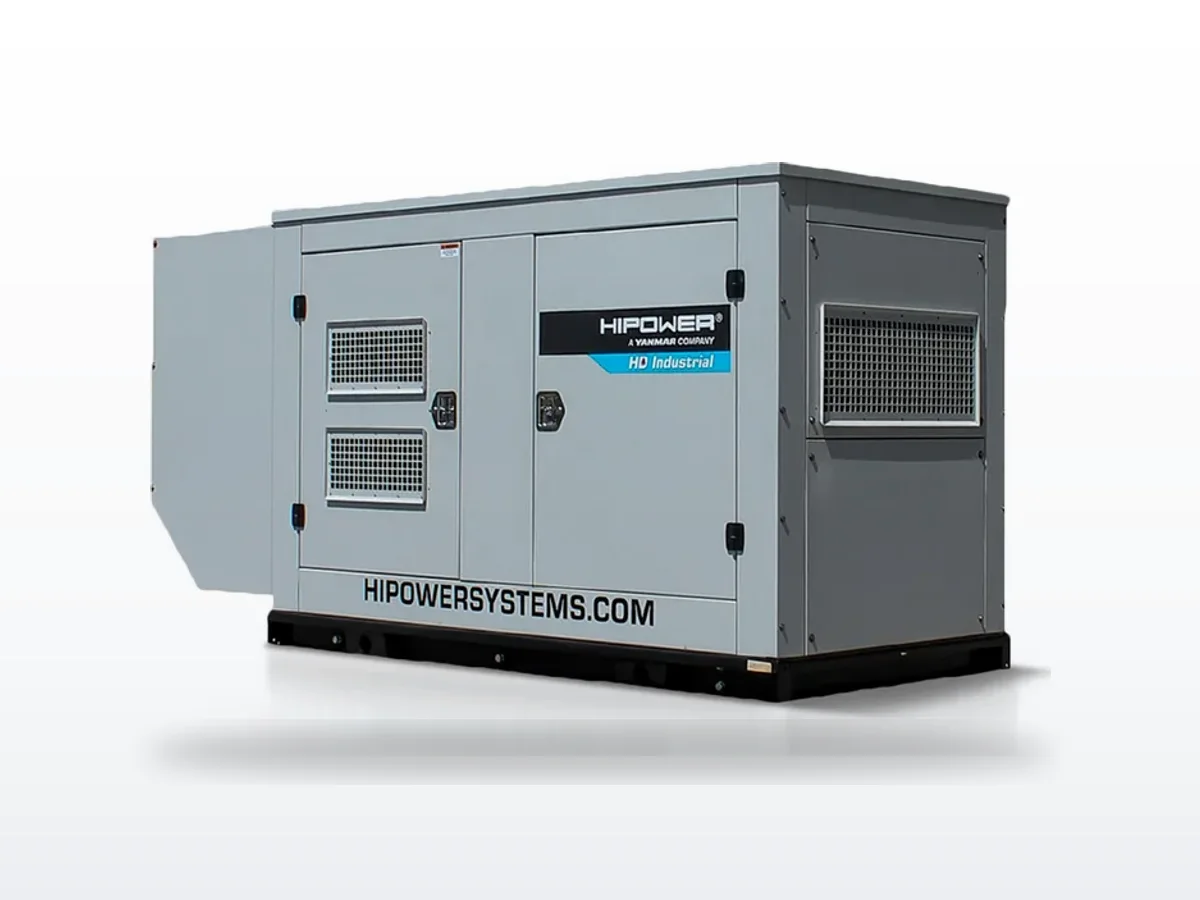
The Hipower HNG Series covers the 159 to 400 kW stationary natural gas standby segment with five models powered by PSI spark-ignited engines. All five are CARB certified under the EPA Stationary Spark Ignition standard, enabling California permit-by-rule for new standby installations without air district variance. The series is three-phase only, supporting 120/208V, 277/480V, and 347/600V — the broadest voltage range in Hipower's stationary gas lineup and one that accommodates the full range of US commercial electrical services as well as Canadian 600V distribution.
At 159–400 kW, the HNG occupies a capacity band where diesel standby at equivalent output would require a large storage tank, SPCC compliance plan, and ongoing fuel management. Natural gas supply from the utility eliminates all of this. The HNG-400 is the upper limit of Hipower's stationary natural gas line; above 400 kW, the HRNG series continues with trailer-mounted configurations, and the HNI series provides PSI-powered stationary units from 30 to 1,000 kW.
The HNG is distinct from the HNI in its three-phase-only design and three-voltage support — the HNI covers more of the range but the HNG may be preferred for specific commercial projects where three-phase output and 347/600V support are required and the simpler product line is preferred. Both series use PSI engines and CARB certification.
How to Choose#
Coverage within the HNG range: The HNG-160 (159 kW), HNG-210 (208 kW), HNG-265 (263 kW), HNG-355 (354 kW), and HNG-400 (400 kW) provide five distinct output steps in this range. Select the model that provides 10–20% headroom above the calculated standby load — natural gas engines benefit from load margin to maintain clean combustion and consistent speed regulation.
Voltage selection: All five models support 120/208V, 277/480V, and 347/600V. For US commercial buildings, 277/480V is most common. For Canadian installations or US facilities with legacy 600V distribution (common in older industrial facilities), the 347/600V option is available from the factory — not a field modification.
Gas supply requirements: At 159–400 kW, the gas service infrastructure must be appropriately sized. A properly calibrated gas pressure regulator and supply line with adequate flow capacity are prerequisites. At 400 kW (HNG-400), gas supply deficiency at full load is the documented primary risk — verify regulator capacity and confirm the supply line can support the full BTU demand before installation.
CARB compliance: For all five models, CARB certification enables permit-by-rule in most California air districts. Confirm the applicable air management district's permit-by-rule threshold — some districts have lower kW limits for automatic approval.
Common Applications#
- Commercial standby: All five HNG models are rated for commercial standby. Large office buildings, mid-size medical facilities, commercial mixed-use developments, and large retail anchors in the 159–400 kW class are the core commercial market. Natural gas eliminates the diesel tank, SPCC plan, and delivery schedule at a scale where diesel storage becomes a real operational burden.
- Industrial standby: All five models carry industrial standby ratings, covering manufacturing operations, food processing, and distribution facilities with established natural gas service where diesel logistics are operationally unacceptable or cost-prohibitive at this scale.
Service & Maintenance#
All five HNG models share: oil change at 1,000 hours or 12 months; air filter at 500 hours; spark plug replacement at 1,000 hours. The 1,000-hour oil interval is the most operationally significant maintenance advantage over comparable diesel units, which require 250–500 hour changes.
Three failure modes recur across the HNG fleet. Spark plug erosion from natural gas combustion is universal — on a 400 kW PSI engine, deferred plug replacement causes measurable power loss and risks combustion irregularity; replace all plugs on the 1,000-hour schedule. Ignition module misfires, documented on 3–5 of the 5 models, appear as cylinder dropout under load and require per-cylinder coil output diagnosis rather than shotgun module replacement. Gas pressure regulators are subject to inlet pressure drop under high-load conditions — test regulator output at each service event and verify supply line sizing is matched to the unit's full-load BTU demand, particularly on the HNG-355 and HNG-400 where full-load gas demand is highest.
Application Guidance#
The Hipower HNG Series is purpose-built for commercial and industrial facilities with established natural gas service needing three-phase stationary standby at 159 to 400 kW — the scale where diesel storage at equivalent output requires a 750-gallon-plus tank, an SPCC plan, and ongoing fuel management that commercial operators routinely seek to eliminate. CARB certification across all five models enables California permit-by-rule, and the 347/600V option accommodates Canadian installations and US facilities with legacy 600V distribution from the same factory build. The 1,000-hour oil interval is the most operationally significant advantage over diesel units in this class.
The HNG is not appropriate above 400 kW stationary — the Hipower HNI Series continues gas standby coverage through 1,000 kW and includes PSI-powered models across a broader 17-model lineup that overlaps with the HNG range. For facilities where diesel is the only option (no gas service, or critical applications where gas supply reliability is a concern), the Hipower HFW Series (60–350 kW, Tier 4 Final) and Hipower HDI Series (60–2,000 kW, Tier 2/3) cover diesel standby in this output band. For competing stationary natural gas in the 159–400 kW range, the Blue Star PSI Large Gaseous and CAT G Series Gas generators are the primary alternatives.