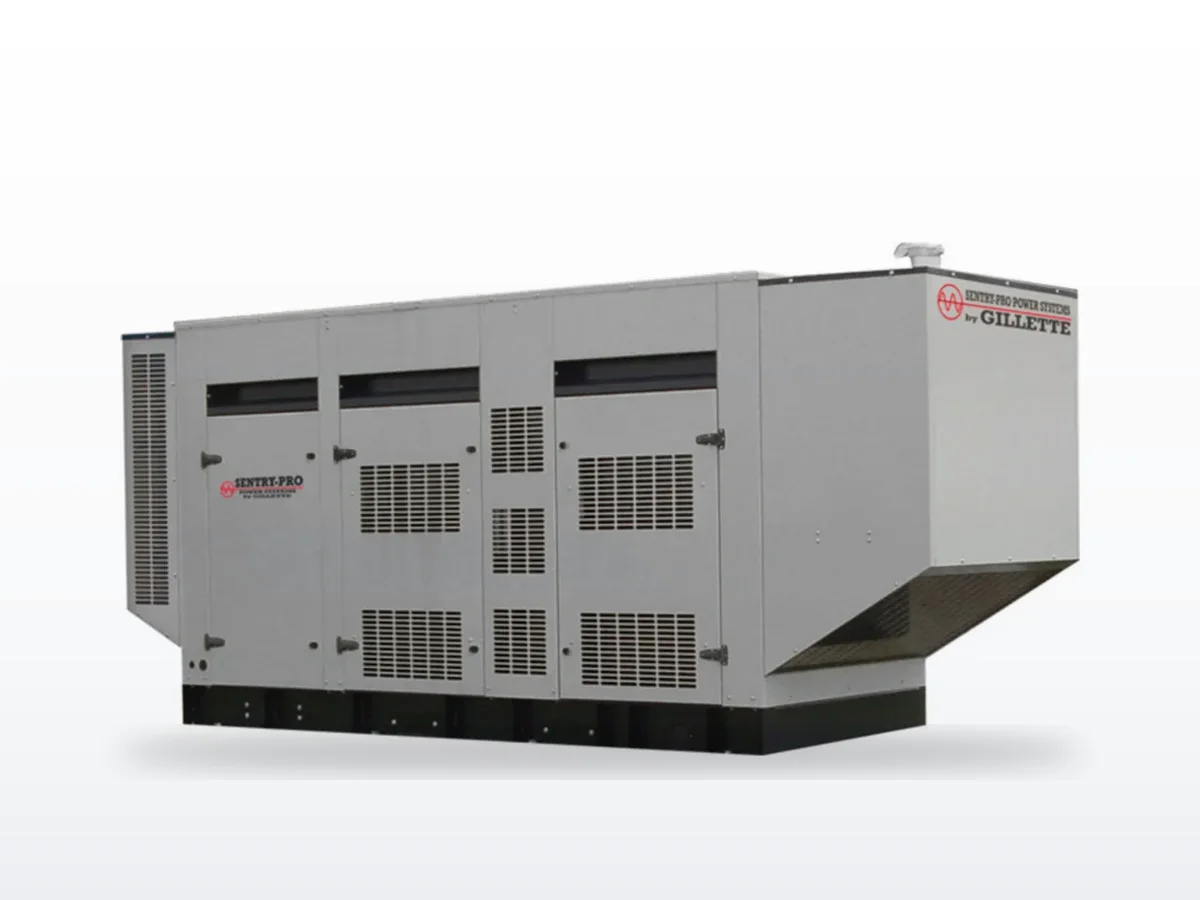
Series Overview#
The Gillette T4D Series is the company's Tier 4 Final diesel lineup, covering 100 kW to 600 kW across seven models. It is the only Gillette diesel series rated for non-emergency prime power applications under current EPA regulations — Tier 4 Final compliance is required for diesel generators used as a primary power source outside of emergency standby duty in most jurisdictions. Every T4D model uses Volvo Penta VE-series engines with SCR (selective catalytic reduction) aftertreatment and DEF (diesel exhaust fluid) injection, dual-certified for both EPA Tier 4 Final and EU Stage V.
A key characteristic of the T4D series is the equal standby and prime power rating across six of seven models. The T4D-1000 through T4D-3500 are rated identically for both standby and prime duty — 100 kW, 150 kW, 200 kW, 250 kW, 300 kW, and 350 kW respectively. Only the T4D-6000 carries differentiated ratings: 600 kW standby and 570 kW prime. This means buyers specifying T4D units for prime power applications receive no hidden prime derating on most models — the nameplate output is the sustained continuous output.
The series draws on three Volvo Penta engine families. The T4D-1000 uses the TAD581VE (5.13L I4 with SCR); the T4D-1500 uses the TAD881VE (7.7L I6 — the Tier 4 Final counterpart to the SPVD-2500's TAD852GE); the T4D-2000 steps to the TAD1180VE (10.8L I6, a Tier 4 Final-specific displacement); the T4D-2500, T4D-3000, and T4D-3500 all use the 12.8L TAD13xx VE-series (the Tier 4 Final counterparts to the SPVD-3000/3500/4000 Tier 3 models); and the T4D-6000 uses the TWD1683GE (16.1L I6 with water-to-air aftercooling and SCR). All models pair with Stamford alternators and Basler DGC-2020 controllers.
Gillette's T4D pricing maintains the same 15–30% discount against major OEM equivalents with the same 3–7 day lead time. For prime power applications where the project schedule or budget cannot accommodate a CAT or Cummins Tier 4 Final unit, the T4D series is the factory-direct alternative.
How to Choose#
100 kW — T4D-1000 (Volvo TAD581VE, 5.13L I4): Entry point. The most compact T4D unit, appropriate when load falls below the 150 kW band and Tier 4 Final compliance is required. Rated identically for standby and prime.
150 kW — T4D-1500 (Volvo TAD881VE, 7.7L I6): Steps to a 6-cylinder platform. If comparing T4D-1500 against the SPVD-2500 (same 7.7L Volvo lineage, Tier 3): the T4D-1500 is required when Tier 4 Final is mandated; the SPVD-2500 is appropriate for emergency standby where Tier 3 is accepted.
200 kW — T4D-2000 (Volvo TAD1180VE, 10.8L I6): The 10.8L displacement is unique to the T4D Tier 4 Final lineup — it does not appear in the SPVD Tier 3/2 series. This reflects how Tier 4 Final engine design differs from lower-tier platforms; the larger displacement relative to output provides the thermal margin needed to support SCR system heat requirements.
250–350 kW — T4D-2500, T4D-3000, T4D-3500 (Volvo TAD13xx VE-series, 12.8L I6): Three models from one engine family. Same selection logic as the SPVD 12.8L family: choose by output level. Note that the T4D-3000 and T4D-3500 use water-to-air aftercooling (vs. air-to-air on the T4D-2500) — the transition to water-to-air at 300 kW is driven by the combined thermal load of the high-output 12.8L engine and the SCR aftertreatment system.
600 kW — T4D-6000 (Volvo TWD1683GE, 16.1L I6, standby 600 kW / prime 570 kW): The only T4D model with different standby and prime ratings (600/570 kW). It is also the only T4D model with DPF aftertreatment in addition to SCR. If DPF regeneration management is operationally challenging for your application (remote sites with limited runtime, for example), this is a factor to evaluate. The T4D-6000 is the ceiling of the T4D series; loads above 600 kW Tier 4 Final require consultation on alternative configurations.
Single-phase vs. three-phase: Single-phase configurations are available on most T4D models. Confirm with OnPoint for specific model/voltage combinations.
Common Applications#
-
Prime power for remote and off-grid sites: All seven T4D models are classified for prime power applications. For construction sites, remote operations, mining support facilities, and agricultural operations using diesel prime power in Tier 4 Final-regulated jurisdictions, the T4D series provides the required emissions compliance.
-
Hospitals and healthcare: All seven models serve hospital applications. For healthcare facilities in jurisdictions requiring Tier 4 Final compliance even for standby equipment, or for prime power applications within hospital campuses, the T4D is the appropriate series.
-
Municipal infrastructure with prime power requirements: 7 of 7 models serve municipal applications. Water and wastewater facilities, remote municipal buildings, and infrastructure requiring continuous diesel prime power in Tier 4 Final zones.
-
Construction and rental power: 4 of 7 models serve construction and rental applications. Tier 4 Final compliance is mandatory for most diesel equipment used on public construction projects in non-attainment air quality zones. The equal standby/prime ratings make T4D units suitable for construction site prime power without hidden capacity derating.
-
Data centers and commercial standby: 4 of 7 models serve data center applications. For data center operators in jurisdictions requiring Tier 4 Final for all diesel equipment regardless of standby classification, the T4D provides an emissions-compliant option.
Service & Maintenance#
All seven T4D models share the same base service intervals as the broader Gillette diesel lineup: oil and fuel filter changes at 500-hour or 12-month intervals, air filter service at 1,000 hours, and coolant system service at 6,000 hours.
The T4D series adds aftertreatment-specific maintenance requirements not present in the Tier 2/3 SPVD series. The SCR catalyst system requires periodic DEF fluid management — DEF quality and quantity must be monitored and maintained. DEF degradation or empty DEF reservoirs trigger derate warnings across 6 of 7 T4D models; this is the most prevalent failure mode in the series. On prime power units, DEF consumption correlates directly with operating hours and must be factored into resupply logistics for remote sites.
The T4D-6000 adds DPF maintenance requirements. The DPF requires active or passive regeneration cycles to burn accumulated particulate. In applications where the engine runs at low loads for extended periods (below the regen activation threshold), forced active regeneration cycles must be scheduled. Backpressure fault codes (documented in the T4D-6000 failure modes) indicate a DPF regen is needed.
Fuel quality management is critical across all T4D models. Tier 4 Final high-pressure common-rail injection systems are more sensitive to fuel contamination than older mechanical injection systems — injector fouling from degraded or contaminated fuel can trigger expensive warranty-voiding damage. For prime power applications, diesel fuel turnover rates are high enough to reduce degradation risk. For standby applications accumulating hours primarily through testing, annual fuel polishing is strongly recommended.
Battery management follows the same protocol as the broader Gillette lineup: annual load testing, replacement on a 3–4 year cycle. Five of seven T4D models document battery failure as a common risk.
Application Guidance#
The Gillette T4D Series is the correct specification when Tier 4 Final or EU Stage V compliance is a hard requirement for a diesel generator in the 100–600 kW range — non-emergency prime power applications under current EPA rules, California CARB-mandated equipment on public projects, and facilities in non-attainment air quality zones where the AHJ requires Tier 4 Final even for emergency standby. The equal standby and prime power ratings across the T4D-1000 through T4D-3500 (no prime derating on six of seven models) is a genuine operational advantage for construction sites and remote deployments where the generator serves as the primary power source — buyers get the full nameplate output on prime duty without the hidden derating common in generators rated only for standby. Volvo Penta VE-series engines with SCR and DEF are well-established in this compliance role; the component architecture is the same as Volvo Penta's Stage V European market engines.
The T4D series is not appropriate for emergency standby applications in jurisdictions where Tier 3 or Tier 2 equipment is still permitted for that duty cycle — buyers would be paying the Tier 4 Final premium and managing DEF logistics unnecessarily. In those cases, the Gillette SPVD Series (250–700 kW, Tier 3/Tier 2, no DEF requirement) provides equivalent output at lower complexity. DEF management is the primary operational burden this series adds — for remote off-grid prime power sites where DEF resupply logistics are difficult, evaluate natural gas prime power alternatives like the Gillette PR Series (80–540 kW natural gas prime) if gas is available. Above 600 kW Tier 4 Final, there is no Gillette T4D option; consult OnPoint for major OEM alternatives or evaluate whether a natural gas prime power solution from the Cummins Large Gas 750–1000 kW series fits the load requirement.
FAQ#
See frontmatter for FAQ items.