
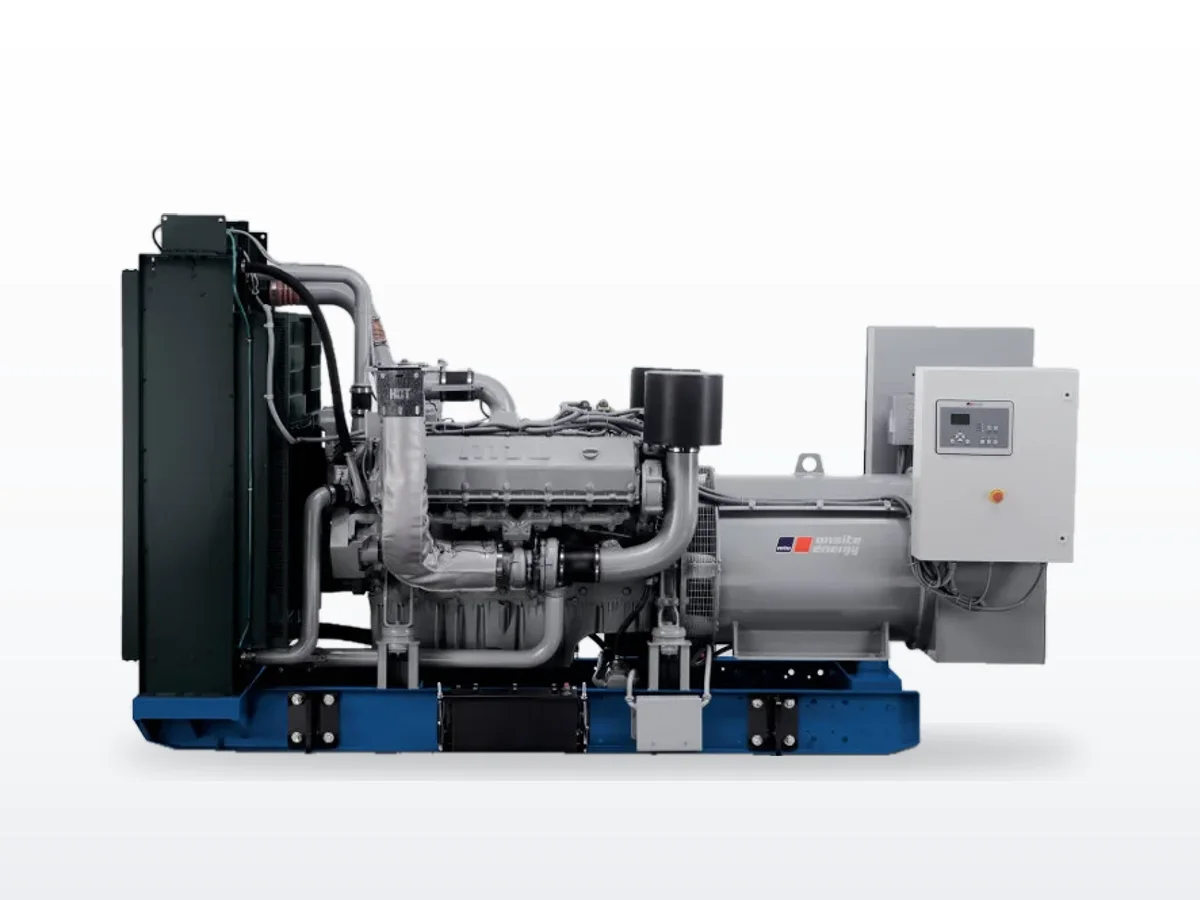
Series Overview#
The MTU 12V1600 Series consists of two diesel generator models — the DS750 (750 kW standby, 690 kW prime) and the DS900 (900 kW standby, 820 kW prime) — built on the MTU 12V1600 engine platform, a 22.44-liter, 12-cylinder turbocharged and aftercooled diesel. Both carry EPA Tier 2 and SCAQMD certifications for stationary emergency operation and are available in three-phase configurations from 208V through 600V. The 12V1600 Series fills the power range between the mid-market generators (up to ~750 kW from Generac, Cummins, and Kohler) and the MTU Series 2000 DS1000 at 1,000 kW.
MTU's 12V1600 engine is compact relative to its output class — a 22.44-liter V12 is a smaller displacement per kilowatt than competing platforms at 750–900 kW, which reflects the MTU engineering approach of extracting higher specific output through precision fuel injection, turbocharged/aftercooled aspiration, and advanced engine management. This power density advantage translates to a smaller generator footprint, which matters in the mechanical rooms of data centers, high-rise buildings, and hospitals where floor space is constrained.
Both models use permanent magnet Leroy-Somer alternators, contributing to the tight voltage regulation performance that data center loads require. The DS750 and DS900 share the same 12V1600 block with different calibration variants — the DS900 (G91S) runs at higher BMEP than the DS750 (G71S), which has maintenance implications at high-hour intervals.
How to Choose#
DS750 (750 kW standby, 690 kW prime, 12V1600G71S): The more conservative output tune on the 12V1600 platform. Appropriate when the load study produces a standby requirement between 650 and 750 kW. The G71S calibration runs at lower BMEP than the G91S, which typically translates to longer intervals before high-wear items like crankshaft seals and fuel transfer pumps require attention. Choose when 750 kW covers the load with adequate reserve and minimizing service intensity at high hours is a priority.
DS900 (900 kW standby, 820 kW prime, 12V1600G91S): Maximum output from the 12V1600 platform. The G91S produces up to 996 kWm (1,335 bhp) — the engine is working harder at any given load point than the DS750. Appropriate when the load study requires between 750 and 900 kW standby. Crankshaft seal and fuel transfer pump conditions should be monitored more closely on high-hour DS900 units given the higher BMEP calibration.
Both models are available in the same voltage range (208V–600V) and share the same service intervals. The choice is driven purely by standby power requirement.
Common Applications#
- Commercial standby: The 750–900 kW range covers large commercial buildings — major office towers, large hotels, convention centers — where standby requirements exceed the output of mid-range platforms but the Series 4000 is cost-overkill.
- Healthcare: Regional hospitals and large medical centers with life-safety standby requirements between 600 and 900 kW. The 12V1600's compact footprint suits equipment room installations in facilities built before megawatt-class generator spaces were standard.
- Data centers (mid-size): Edge data centers, mid-size colocation, and enterprise data rooms with a single-unit standby requirement in the 700–900 kW range. The permanent magnet alternator and tight voltage regulation support sensitive UPS loads.
- High-rise buildings: The 12V1600's compact footprint and three-phase voltage range covering 208V through 600V make it suitable for high-rise mechanical rooms and integrated building standby systems.
- Municipal and industrial: Water treatment facilities, government buildings, and industrial plants with three-phase standby requirements in the 700–900 kW class.
Service & Maintenance#
The 12V1600 Series follows standard MTU service intervals: oil and fuel filter changes every 500 hours or 12 months, air filter service every 1,000 hours. Two platform-specific failure modes require attention at extended hours:
Crankshaft seal seepage: The MTU V12 crankshaft seals at the front and rear are documented to develop seepage on high-hour units. A pressure test at 10,000 hours is recommended as a proactive assessment — catching early seepage before it progresses to an active leak prevents oil contamination of the alternator and generator room flooring.
Fuel transfer pump wear: Flow pressure reduction from pump wear is documented at approximately 5,000 hours. Fuel transfer pump condition should be checked at each 500-hour service interval — a pressure test takes minutes and provides clear go/no-go data.
The starting battery bank requires annual load testing under cold-crank conditions. Battery voltage sag during cranking — where resting voltage tests acceptable but cranking voltage drops below the threshold to sustain the starter motor — is the failure mode. Replace the full bank proactively at 48 months regardless of resting voltage test results.
Application Guidance#
The MTU 12V1600 Series is purpose-built for the 750–900 kW standby class at facilities where power density — kilowatts per square foot of generator footprint — is a material constraint. The 22.44-liter V12 delivers 750 or 900 kW in a package more compact than competing platforms at equivalent output, which matters in the mechanical rooms of high-rise buildings, hospitals built before megawatt-class generator rooms were standard, and mid-size data centers with constrained floor space. Permanent magnet Leroy-Somer alternators provide the tight voltage regulation that UPS-loaded data center environments require. For load studies producing standby requirements between 650 and 900 kW where MTU's fuel efficiency or power density advantages justify the premium over alternatives, the 12V1600 is the right-sized MTU specification — positioned between the John Deere-powered mid-range platforms (below 750 kW) and the Series 2000 DS1000 at 1,000 kW.
This series is not appropriate below 650 kW standby — the MTU 6R0225 DS400 at 400 kW and the MTU 6R0150 Series at 250–300 kW are right-sized for lower requirements. Above 900 kW, the MTU Series 2000 DS1000 picks up at 1,000 kW standby; at 1,250 kW and above, the MTU Series 4000 is the platform. Buyers comparing the 12V1600 against CAT C-Series (C32 at 1,000 kW) and Cummins QSK Series at similar capacity should weigh the MTU fuel efficiency data, compact footprint, and the requirement for MTU-trained service technicians for high-hour maintenance events — the CAT and Cummins dealer networks tend to be broader in most North American markets.