
Atlas Copco · QAS Series

Atlas Copco QAS 250

220 kW standby / 200 kW prime · Diesel · Liquid-cooled

200 kW prime diesel portable generator. John Deere-powered with 73 dBA operation, 385-gallon tank, and Leroy Somer alternator.

Standby power
220 kW / 200 kW prime
Voltage options
120/240V, 208V, 240V, 277/480V
Frequency / Phase
60 Hz · 1/3-phase
Engine
John Deere 6068HFG06 · 6.8L
EPA / Emissions
Tier 4 Final
Alternator
Leroy Somer LSA 46.2 L6
Commercialrental-fleettemporary-poweremergency-standby
Configure & QuoteDownload spec sheet

Overview#

The Atlas Copco QAS 250 delivers 200 kW of prime power (250 kVA) from a John Deere 6068HFG06 6.8-liter inline-six diesel engine at 1,800 RPM. The 385-gallon integral fuel tank gives 33.3 hours of autonomy at 75% load (90% of tank, 60 Hz), and the unit features an 800A main breaker for the full range of multi-voltage output configurations.

The Leroy Somer LSA 46.2 L6 alternator The sheet states 73 dB(A) at 7 m (23 ft) and 75% load.

Leroy Somer LSA 46.2 alternator upgrade#

The QAS 250 uses the Leroy Somer LSA 46.2 L6 alternator (the QAS 150 and QAS 200 use the LSA 44.3 series) with an AREP excitation system; the sheet states ±0.5% voltage regulation with the standard D350 AVR and ±0.25% with the DVC 550 parallel option.

This alternator platform is shared with the QAS 330, which uses the LSA 46.2 L9 variant from the same family. The QAS 330 uses the larger John Deere 6090HFG06 9-liter engine.

Our service experience#

The QAS 250 enters the heavy-duty tier of the Atlas Copco portable lineup, where units are commonly deployed on large construction sites and for utility-scale temporary power. The John Deere 6068 engine family has aftermarket support through John Deere's dealer network.

Atlas Copco's after-sale service continues to be the brand's primary weakness at this size class. The higher value of these units makes the service gap more impactful — downtime on a 200 kW unit is expensive, and waiting weeks for factory parts or service calls is not acceptable. For QAS 250 owners in Northern California, OnPoint provides responsive local service for both engine and genset-level maintenance.
Engineering specifications

Acoustic

Sound @ 7m, 75% load
73 dBA
Enclosure
Sound-attenuated

Fuel system & runtime

Integral fuel tank
385 gal
Fuel use @ full load
14.11 GPH
Fuel use @ 75% load
10.16 GPH
Fuel use @ 50% load
7.45 GPH
DEF tank
25 gal

Documents & downloads

Spec sheets & manuals

Ready to order this model?

Configure your Atlas Copco QAS 250

Lock the enclosure, fuel system, transfer switch, and add-ons — we'll confirm pricing, availability, and lead time within one business day. Prefer a free-form quote? That option is still here.

Estimate runtime for the Atlas Copco QAS 250

Adjust load percent and tank size to estimate runtime. Pre-filled with this model's spec where available.

Estimate runtime on this tank

Estimated runtime

35.4 hours(1.5 days)

Fuel consumption ≈ 10.88 GPH at 75% load. Estimate based on industry-typical 1800 RPM standby curves (≈0.07 GPH/kW at full load). Actual consumption varies by engine, ambient temperature, fuel quality, and tuning.

Frequently Asked Questions

What is the prime and standby rating of the Atlas Copco QAS 250?
The QAS 250 delivers 200 kW prime power and 220 kW standby power.
What engine does the Atlas Copco QAS 250 use?
The QAS 250 is powered by a John Deere 6068HFG06 6.8-liter inline-6 turbocharged diesel engine with intercooler running at 1,800 RPM, rated 295 hp continuous. The QAS 330 uses the larger 6090HFG06 (9 L).
Is the Atlas Copco QAS 250 EPA Tier 4 Final compliant?
Yes. The QAS 250 is EPA Tier 4 Final and CARB compliant, legal for operation throughout California. The John Deere 6068HFG06 uses DOC and SCR aftertreatment with a 25-gallon DEF tank.
How does the QAS 250 differ from the QAS 330?
Both list a 385-gallon fuel tank and a 25-gallon DEF tank; the QAS 250 uses the John Deere 6068HFG06 (6.8 L) and the QAS 330 the 6090HFG06 (9 L). The QAS 330 extracts 264 kW prime (vs. 200 kW) through the larger Leroy Somer LSA 46.2 L9 alternator vs. the QAS 250's LSA 46.2 L6. Both operate at 73 dBA.
What fuel does the Atlas Copco QAS 250 use?
The QAS 250 runs on diesel with DEF required for SCR aftertreatment. The 385-gallon integral fuel tank gives 33.3 hours of autonomy at 75% load (90% of tank, 60 Hz) per the sheet. The 25-gallon DEF tank is coordinated with the same refuel window.
Who services Atlas Copco generators in Northern California?
PowerGen provides local service and maintenance for Atlas Copco QAS units including the John Deere-powered QAS 250 and QAS 330. We serve the Bay Area and Northern California with faster response times than the Atlas Copco factory service network.

More in the QAS Series

Atlas Copco's portable diesel workhorse — 22 to 616 kW, Tier 4 Final, Leroy Somer alternators, 5–8 dB quieter than the competition.

Similar models

Atlas Copco

Atlas Copco QAS 235

Swedish-engineered QAS series.

206 kW standby · Diesel · Liquid-cooled

234 kVA (187 kW prime) portable diesel generator. Swedish-engineered QAS series with FPT engine.

Tier 4 Final3-phaseconstructionrental-fleet

Atlas Copco

Atlas Copco QAS 330

73 dBA, 9.0L John Deere 6090HFG06, 25.6 hr autonomy at 75% load (90% of tank, 60 Hz)

290 kW standby · Diesel · Liquid-cooled

264 kW prime diesel portable generator. John Deere-powered with 73 dBA operation, 385-gallon tank, and Leroy Somer alternator.

Tier 4 Final3-phaseconstructionrental-fleet
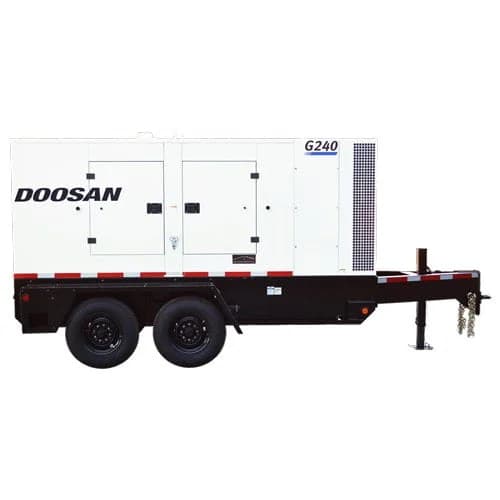
Doosan / Bobcat Doosan G240 200 kW liquid-cooled standby generator

Doosan / Bobcat

Doosan G240

Higher-output QSB7 variant in the same DualBox chassis as the G190 — 30% more power without a larger footprint. 27-hour runtime from 368-gallon tank at full load.

200 kW standby · Diesel · Liquid-cooled

190 kW prime diesel portable generator. Cummins QSB7-G9-powered with 69 dBA operation, 368-gallon tank, and 27-hour runtime.

Tier 4 Final3-phaseconstructionrental-fleet

Services for the Atlas Copco QAS 250

Need service or parts for the Atlas Copco QAS 250?

We service every major OEM and stock genuine parts for the most common models.

Last reviewed: