
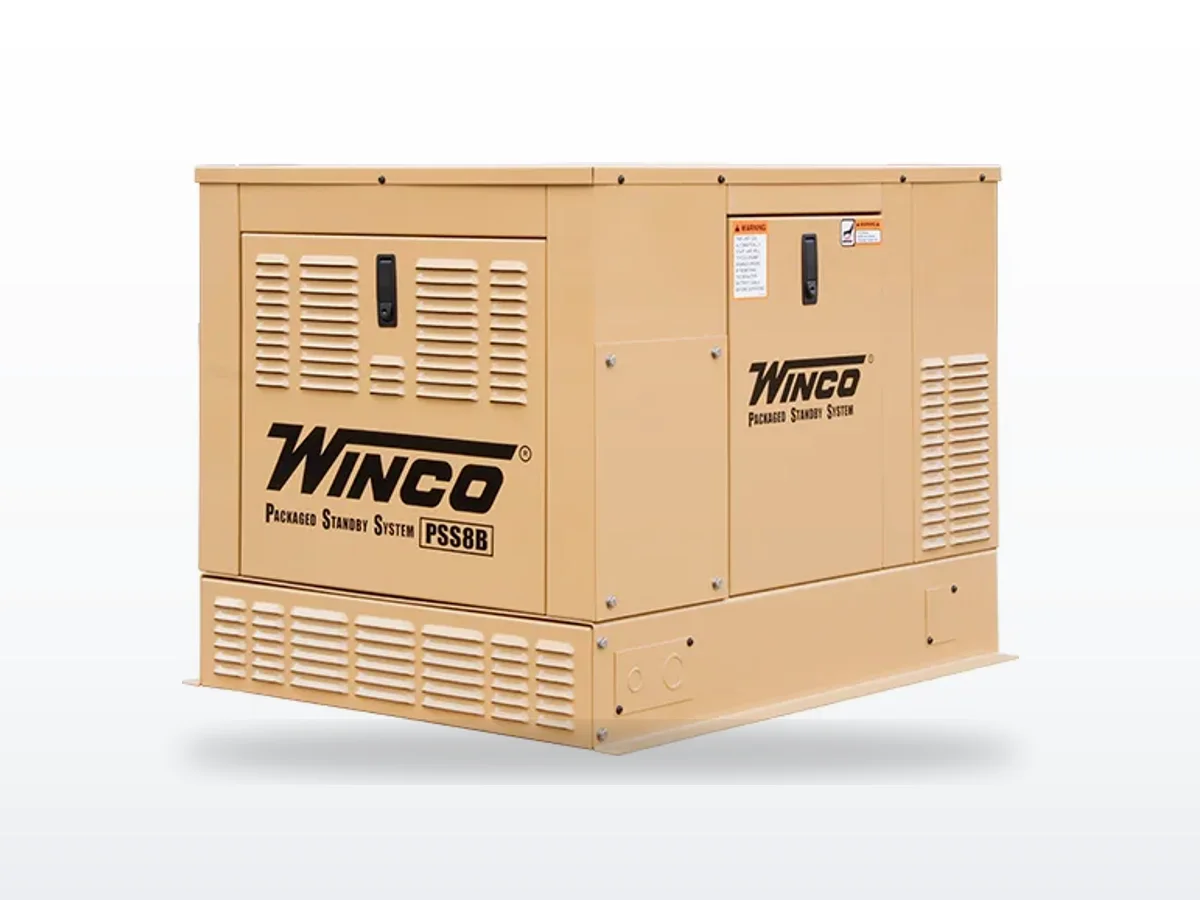
Series Overview#
The Winco PSS Home Standby Series is Winco's residential standby generator line, consisting of three models from 8 to 17 kilowatts of standby capacity. All models run on LP (propane) or natural gas, are air-cooled, and are designed for permanent outdoor installation with automatic start capability for residential whole-house or essential-circuit backup. Like all Winco generators, PSS Series units are 100% manufactured in Le Center, Minnesota.
The PSS Series uses two engine families: the Briggs & Stratton Vanguard V-Twin for the PSS8B2W and PSS20B2W, and the Honda GX690 for the PSS12H2W. The Honda GX690 is the largest commercial GX engine Honda produces — widely regarded for reliability and long service life — and its presence in the PSS12H2W gives that model a distinct engine-quality advantage over many comparably priced residential standby generators.
Fuel flexibility is built into every PSS model. All three units run on LP or natural gas, eliminating the diesel storage and fuel degradation concerns associated with diesel standby generators. For homeowners with existing propane infrastructure or natural gas service, the PSS Series provides a clean, reliable standby option without on-site fuel management.
How to Choose#
PSS8B2W (8 kW, Briggs & Stratton Vanguard): The entry-level PSS model. At 8 kW, this covers essential circuits — refrigerator, lights, sump pump, some heating — in a smaller home or for a homeowner who wants protection against most outage scenarios without powering the entire house. Appropriate for homes with natural gas service and modest backup power requirements.
PSS12H2W (12 kW LP / 10 kW NG, Honda GX690): The mid-range model and the Honda-powered option in the lineup. At 12 kW on LP (10 kW on NG), it covers a broader set of home loads including central air conditioning in many cases. Homeowners who prioritize engine quality and long-term reliability are well-served by the Honda GX690 platform. Note the output difference between LP and NG — if the home has natural gas service, the 10 kW NG rating is the governing capacity.
PSS20B2W (17 kW LP / 15 kW NG, Briggs & Stratton Vanguard): The largest PSS model. At 17 kW on LP (15 kW on NG), it can power most loads in a large home — central HVAC, well pump, water heater, kitchen appliances, and lighting simultaneously. The right choice for homeowners who want true whole-house coverage or those in regions with frequent multi-day outages.
The choice between LP and NG primarily follows what utility infrastructure exists at the property. Natural gas eliminates the need for a propane tank and delivery logistics; LP provides fuel storage independence from the gas distribution system during extended regional disruptions.
Common Applications#
- Residential whole-house standby: All three PSS models are rated for residential standby. The PSS20B2W at 17 kW covers most loads in a large home; the PSS12H2W covers a mid-size home with central AC; the PSS8B2W covers essential circuits in a small home or as an essential-only backup.
Service & Maintenance#
PSS Series generators require oil changes every 100 hours or 12 months, air filter service every 200 hours, and spark plug replacement every 200 hours. For a home standby unit that runs primarily during weekly exercise cycles and actual outages, the annual calendar interval typically governs all service items.
The two most common failure modes are carburetor/fuel system issues (hard starting, surging after extended idle) and starting battery degradation. Carburetor problems on gaseous-fuel engines are typically caused by debris or varnish in the carburetor from extended periods without running. The weekly automatic exercise cycle is the most effective preventive measure — it keeps the carburetor clear and verifies starting battery function.
Annual battery load testing is recommended. A battery that passes a resting voltage check may still fail under the cranking load of an actual start. Replace the battery proactively at 36–48 months regardless of apparent condition.
Application Guidance#
The Winco PSS Home Standby Series is purpose-built for residential whole-house and essential-circuit automatic standby on natural gas or LP, covering 8–17 kW from air-cooled engines with American manufacture and Honda or Briggs & Stratton Vanguard reliability. The PSS12H2W's Honda GX690 engine is the strongest engine-quality argument in the series — it is the largest commercial GX engine Honda produces and is widely regarded as the most reliable air-cooled V-Twin in the standby generator class. For homeowners who want Honda reliability in a residential standby unit, the PSS12H2W is one of the only options on the market that preserves that association. The dual LP/NG fuel capability across all three models eliminates diesel fuel management complexity and enables connection to the gas utility for indefinite standby availability without refueling.
This series is not appropriate for commercial applications — the PSS models are residential standby products only, rated for homes, not commercial loads, and output 120/240V single-phase without three-phase capability. For buyers who want the largest Winco residential gas standby option, the PSS20B2W at 17 kW LP (15 kW NG) is the ceiling; requirements above that capacity point to the Kohler RCA Series (14–26 kW air-cooled) or the Kohler RCL Series (24–60 kW liquid-cooled) for larger whole-house coverage. For buyers who need fuel flexibility in a portable rather than permanently installed format, the Winco HPS Tri-Fuel Series (HPS12000HE, 12 kW, gasoline/LP/NG) serves that use case without automatic start or transfer switch capability.