Series Overview#
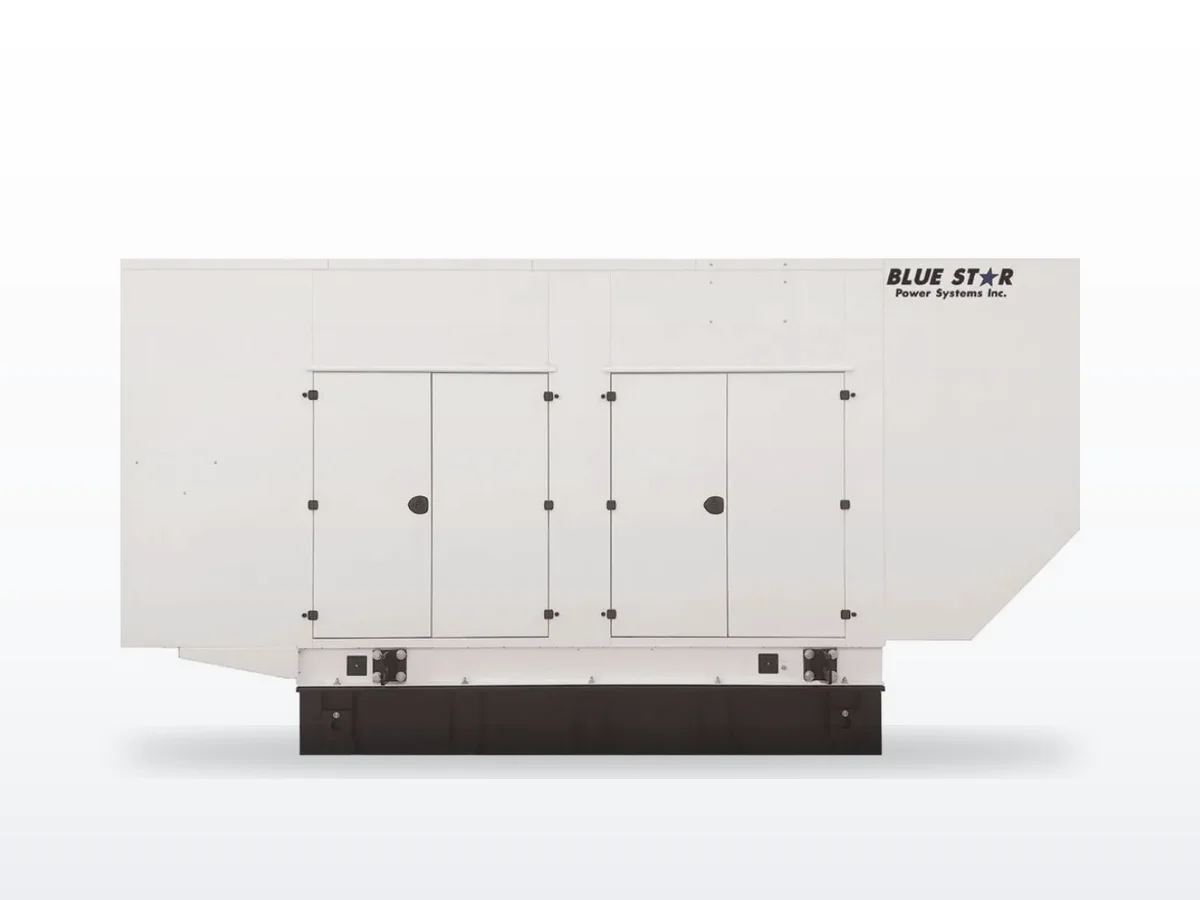
The Blue Star John Deere Diesel Mobile series is the smallest of Blue Star's mobile generator lineups, covering 40 kW to 80 kW standby output across three models on John Deere Tier 4 Final diesel engine platforms. All three are mounted on aluminum road trailers for towing and field deployment — the MP suffix in each model name identifies the mobile platform. Both standby and prime ratings are equal for all three models, making them suitable for continuous prime duty as well as emergency backup.
The series uses two John Deere engine platforms. The JD40-05FT4MP uses the 3029HG530 — a compact 2.9-liter, three-cylinder turbocharged and charge-air-cooled engine that meets Tier 4 Final through DOC/DPF aftertreatment, without requiring DEF fluid. The JD60-04FT4MP and JD80-03FT4MP both use the 4045HFG04 — a 4.51-liter, four-cylinder turbocharged and charge-air-cooled engine with SCR/DOC aftertreatment that requires DEF. This DEF-free versus DEF-required distinction is operationally significant for remote or extended deployments where DEF availability cannot be guaranteed.
Blue Star Power Systems (North Mankato, Minnesota; DEUTZ AG subsidiary since 2024) assembles all three units with the DSE DCP7310 controller and Stamford alternators on aluminum road trailers with integral fuel storage. Available voltages are 120/208V, 120/240V (single-phase), and 277/480V three-phase. The aluminum trailer construction reduces tare weight compared to steel alternatives, which matters when the towing vehicle has payload or gross weight limitations.
How to Choose#
JD40-05FT4MP (40 kW, John Deere 3029HG530, Tier 4 Final, DEF-free): The unique advantage of this model is its DEF-free Tier 4 Final compliance. Applications where DEF logistics are a barrier — remote construction sites, disaster recovery deployments far from DEF suppliers, events in areas without reliable fuel supply — benefit from the 3029HG530's DOC/DPF-only aftertreatment. Output is equal for standby and prime at 40 kWe. Single-phase and three-phase available.
JD60-04FT4MP (60 kW, John Deere 4045HFG04, Tier 4 Final, DEF required): The step up to 60 kWe on the 4.5-liter 4045 platform, with SCR/DOC aftertreatment and a 3.8-gallon DEF tank. The JD60 and JD80 share the same engine, which simplifies parts and service for fleets running both models. Choose the JD60 when the load study requires 60 kW and DEF supply can be managed at the deployment site.
JD80-03FT4MP (80 kW, John Deere 4045HFG04, Tier 4 Final, DEF required): The top of the series — the same 4045HFG04 as the JD60 but paired with a larger UCI274C alternator for 80 kWe output. The trailer footprint is shared with the JD60. Choose the JD80 when 60 kW is marginal for the load study or when reserve capacity is needed for motor starting.
For all three models, the 120/240V single-phase output is valuable for events and light-commercial temporary applications where single-phase loads predominate. The 277/480V three-phase output addresses construction site distribution panels, industrial temporary power connections, and three-phase motor loads.
Common Applications#
- Construction sites: All three models are rated for construction use. The Tier 4 Final certification meets EPA non-road emission requirements in emission control areas. The JD40's DEF-free operation is a practical advantage on remote construction sites. The JD60 and JD80 address larger site electrical loads for tower cranes, concrete batch plants, and site lighting.
- Temporary power: Planned utility outages, building renovations, and infrastructure maintenance requiring temporary power connections in the 40–80 kW range are core applications. The aluminum trailer and integral fuel tank allow rapid repositioning between sites.
- Municipal utility support: Municipal utilities and public works departments use trailer-mounted generators in this range for emergency pump station backup, lift station coverage during grid failures, and scheduled maintenance support.
- Telecom contingency: Temporary backup for cell towers, network equipment buildings, and emergency communication nodes. The compact trailer class fits access constraints at most telecom sites.
- Events and light-commercial: The JD40 and JD60 are rated for events — outdoor festivals, temporary markets, and construction site office trailers where single-phase or three-phase temporary power is needed for durations of days to weeks.
Service & Maintenance#
The uniform service schedule for the JD mobile series is: oil changes at 500 hours or 12 months, fuel filter replacement at 500 hours, air filter inspection at 1,000 hours, and coolant changes at 6,000 hours.
Fuel quality and tank contamination is the leading documented failure mode (all three models), presenting as hard starting, filter clogging, and injector fouling at approximately 4,380 hours. Mobile generators that are stored between deployments are particularly vulnerable — diesel held in the integral trailer tank for months degrades and accumulates water contamination. Drain and replace tank fuel that has been stored more than six months; add biocide treatment before extended storage periods.
Battery failure (all three models) — slow cranking or failed starts — is the other universal failure risk. Mobile units stored between deployments are especially vulnerable to battery self-discharge. Maintain a trickle charger on stored units; replace batteries on a 2–3 year preventive schedule.
Coolant hose wear (all three models) presents as slow coolant loss at clamps around 8,000 hours. Include a coolant hose pressure test and visual inspection at each 500-hour service interval. Mobile units experience additional vibration during towing that can accelerate clamp loosening — check hose fittings after long tow moves.
DEF system maintenance (JD60-04FT4MP and JD80-03FT4MP): SCR catalyst derates and NOx faults are documented on two of three models, typically around 4,380 hours. For mobile units: check DEF quality before each deployment, keep the DEF tank filled to minimize concentration changes, and follow the Volvo Penta DEF filter replacement schedule. A DEF quality fault in the field can trigger automatic engine derating that reduces available output below the site's load requirement.
Trailer roadworthiness: Before each tow movement, inspect wheel bearings, brakes, running lights, and trailer hitch condition. These are road-legal trailers subject to DOT requirements in most states; annual trailer inspections (separate from generator service) are standard practice for fleets.
Application Guidance#
The Blue Star John Deere Diesel Mobile series is purpose-built for towable temporary power in the 40–80 kW range — construction sites, municipal utility support, telecom contingency, and events where a road-legal trailer unit needs to be repositioned between deployments. The JD40-05FT4MP is the only DEF-free Tier 4 Final option in this trailer-mounted lineup below 100 kW, making it the specific model to specify for remote or disaster recovery deployments where DEF supply cannot be guaranteed. The JD60 and JD80 share a common John Deere 4045HFG04 engine platform, simplifying parts inventory for fleets running both models.
This series is not appropriate when the load requirement falls below 40 kW — for smaller portable requirements, the Airman SDG Series covers 11–336 kW with broader voltage flexibility. For loads above 80 kW in a trailer-mounted configuration, the Blue Star Volvo Penta Diesel Mobile series extends from 100 to 600 kW with Tier 4 Final certification across all eight models. When stationary standby installation is the requirement rather than mobile deployment, the Blue Star John Deere Diesel Standby series covers 30–300 kW on the same John Deere engine platforms in a skid-mounted configuration without the trailer overhead.