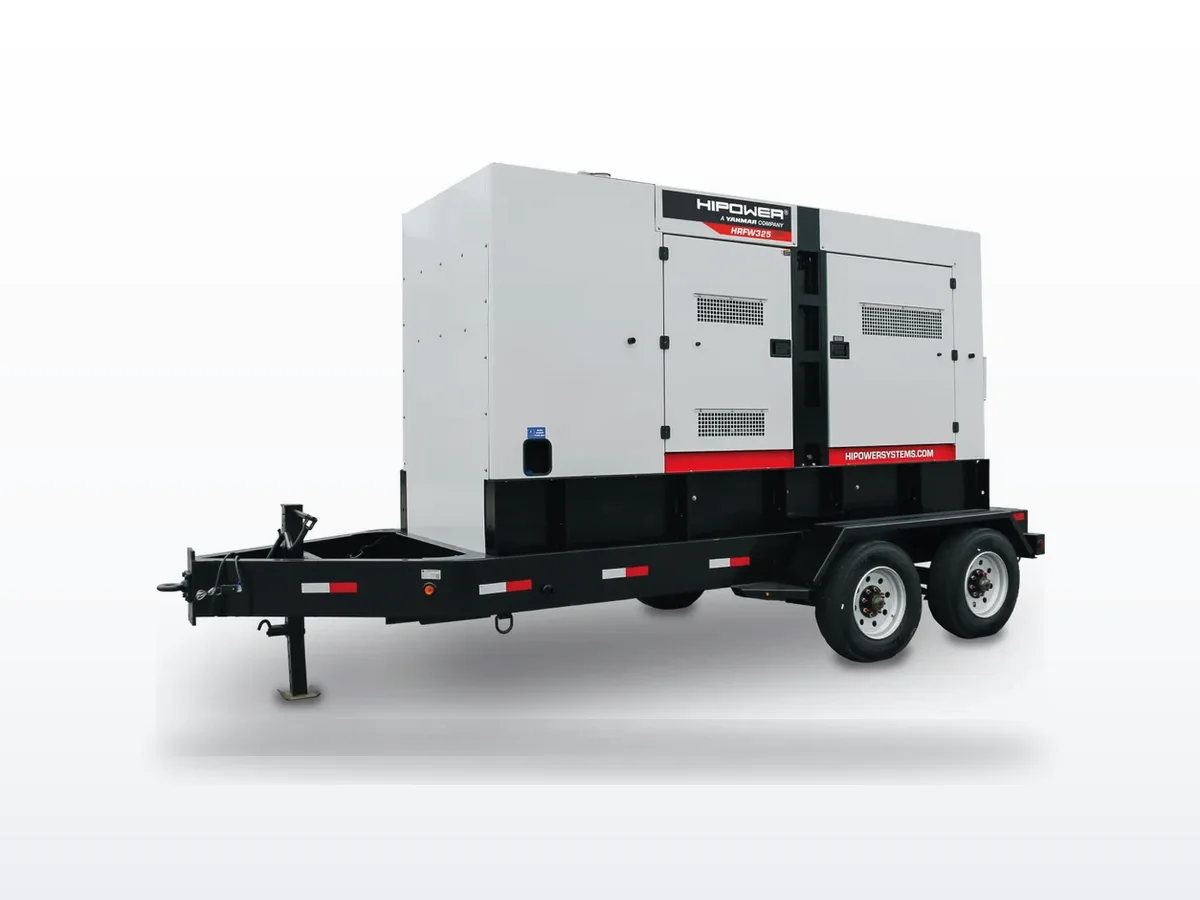
Series Overview#
The Hipower HRMW Series consists of a single model — the HRMW-1150 — which is the mobile counterpart to Hipower's stationary MTU-powered HMW lineup. At 1,150 kW, the HRMW-1150 brings the same MTU 16V2000 engine platform used in the stationary HMW-1020 and HMW-1205 to a highway-towable trailer format. EPA Tier 4 Final and CARB certification make it deployable throughout California and all regulated states, distinguishing it from the Volvo-powered HRVW series which does not carry an emissions tier designation.
The HRMW-1150 serves applications where 1+ MW of temporary power must be delivered to a site accessible by road, under the full Tier 4 Final compliance envelope. Data centers requiring emergency standby while permanent generators are serviced, utility substations during planned maintenance windows, and large construction projects in regulated California air districts are the primary use cases. The MTU 16V2000 platform carries a 30,000-hour TBO standard — the same figure published for stationary HMW installations — which translates to long-term reliability confidence even in high-utilization rental service.
The unit is available in 277/480V and 347/600V to accommodate both US and Canadian service configurations. Service intervals mirror the stationary HMW: oil and fuel filter changes at 500 hours or 12 months, air filter at 1,000 hours.
How to Choose#
The HRMW series contains one model — the HRMW-1150 — so the selection question is whether this platform fits the deployment requirement:
Choose the HRMW-1150 when: Tier 4 Final or CARB compliance is required at the deployment site; when the load requirement is in the 1,000–1,150 kW range; when 277/480V or 347/600V three-phase is the correct service voltage; or when the project requires the MTU engine platform's service infrastructure.
Compare against HRVW-1250/1375 when: Tier 4 Final is not required, and the Volvo Penta platform with its 250-hour rental-service interval may be preferred for high-turnover fleet operations. The HRVW-1250 and HRVW-1375 reach 1,088 kW and 1,210 kW respectively on Volvo Penta TWD engines.
Compare against the stationary HMW-1020/1205 when: The application is permanent installation rather than temporary deployment. The stationary HMW delivers the same MTU 16V2000 platform with the full NFPA 110 Level 1, IBC seismic Zone 4, and 200 mph wind certification stack that the mobile HRMW does not carry.
Common Applications#
- Data center emergency and bypass power: A single HRMW-1150 delivers 1,150 kW of Tier 4 Final standby capacity — sufficient to back a major compute hall during emergency or planned switchgear/generator maintenance without deploying multiple smaller trailer units.
- Critical infrastructure (utilities, substations): Utility substation maintenance windows require large temporary power sources that meet emissions compliance. The HRMW-1150's Tier 4 Final certification removes the air district variance step for California utility projects.
- Large construction in CARB-regulated jurisdictions: Major commercial and infrastructure construction projects in California require Tier 4 Final equipment on site. The HRMW-1150 provides 1+ MW of compliant temporary power in a single towable package.
- Rental fleet (large-scale emergency events): For emergency response scenarios — major facility outages, natural disaster response — the HRMW-1150 provides MW-class power from a single deployment, minimizing the logistics of managing multiple smaller units.
Service & Maintenance#
The HRMW-1150 shares the HMW stationary service cadence: oil and fuel filter changes at 500 hours or 12 months, air filter at 1,000 hours. This interval is longer than the Volvo-powered HRVW series (250 hours) and reflects the MTU engine's design for lower-frequency, higher-quality service.
Three failure modes require active management in mobile/rental service. The MTU high-pressure common-rail fuel system is sensitive to fuel contamination — verify fuel quality at every deployment site before connecting temporary fuel supply. Contaminated fuel from portable supply tanks or temporary fuel connections is the primary source of injector damage on this platform. The DEF dosing injector on the Tier 4 Final SCR system requires a DEF purge cycle at every shutdown; units sitting between deployments are particularly at risk of urea crystallization blocking the injector tip — include the purge cycle in the shutdown checklist without exception. Finally, trailer road equipment — wheel bearings and brakes — wears under frequent repositioning; inspect per DOT requirements at every redeployment.
Application Guidance#
The Hipower HRMW-1150 is purpose-built for deployments requiring over 1 MW of highway-towable temporary power under full EPA Tier 4 Final and CARB compliance — data centers needing emergency or maintenance bypass power, utility substations during planned windows, and large California construction projects where a single MW-class trailer eliminates the logistics of managing multiple smaller units. The MTU 16V2000 platform — the same engine used in the stationary HMW-1020 and HMW-1205 — carries a 30,000-hour TBO, providing long-term reliability confidence that other Volvo-based large trailer competitors at this output class do not publish. The 277/480V and 347/600V dual-voltage availability makes the unit deployable across both US and Canadian service configurations without factory reconfiguration.
The HRMW-1150 is overkill for applications below 1 MW — the Hipower HRVW Mobile Series (Volvo Penta, 544–1,210 kW, no specific emissions tier) covers the 500–1,000 kW trailer class at a lower cost where Tier 4 Final compliance is not required, with a 250-hour oil interval that suits high-turnover rental operations better than the HRMW's 500-hour MTU cadence. For stationary permanent installation at equivalent power, the Hipower HMW Series delivers the same MTU platform with the full NFPA 110 Level 1, IBC seismic Zone 4, and 200 mph wind certification stack that the mobile HRMW does not carry. For competing MW-class mobile diesel from established manufacturers, the Cummins QSK Series and CAT 3500 Series in trailer configurations are the primary alternatives.