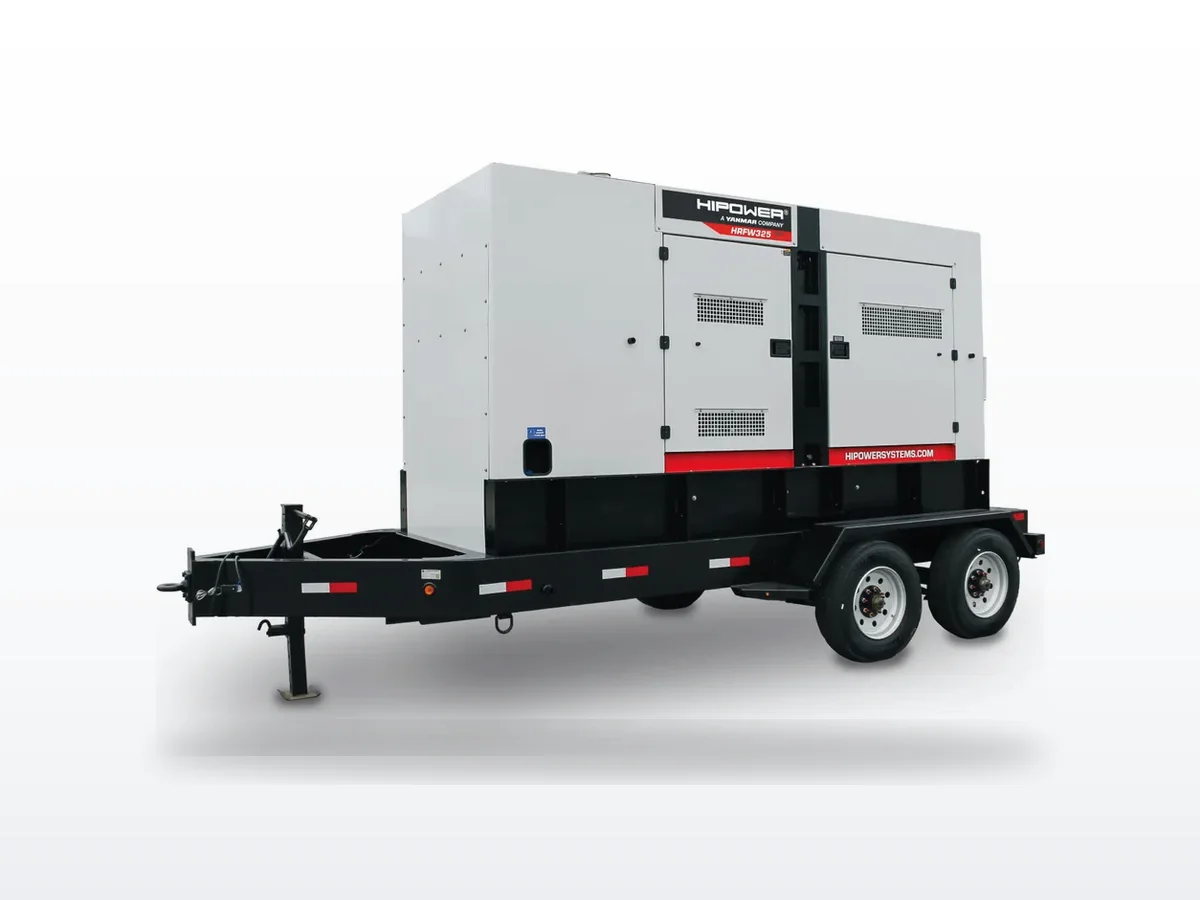
Series Overview#
The Hipower HRFW Mobile Series is a two-model line of FPT Industrial-powered trailer generators covering 286 to 352 kW (325 to 400 kVA). Both the HRFW-325 (286 kW standby / 260 kW prime) and HRFW-400 (352 kW standby / 320 kW prime) use FPT Industrial Cursor 13 diesel engines — a heavy-duty platform well-established in construction equipment and commercial vehicle applications, giving rental operators and construction fleets confidence in parts availability and technician familiarity across North American service networks.
Both units carry EPA Tier 4 Final certification, making them compliant for deployment on California construction sites and in all CARB-regulated states. The HRFW series is purpose-built for rental fleet and construction deployment: trailer-mounted for highway towing, with 277/480V three-phase output and service intervals calibrated for the more demanding duty cycle of repeated short-term deployments. Hipower manufactures the HRFW at its 515,000 sq ft facility in Olathe, Kansas, with in-house enclosures and controls.
The HRFW fills the 300 kW class in Hipower's mobile lineup. Below this range, the HRJW series (John Deere, 60–286 kW) covers smaller trailer generator requirements. Above the HRFW, the HRVW series (Volvo Penta, 544–1,210 kW) picks up large-frame trailer requirements. The HRFW is the mid-range FPT option for projects specifically requiring 300–350 kW of temporary diesel power.
How to Choose#
HRFW-325 vs. HRFW-400: The choice between the two HRFW models is straightforward. The HRFW-325 delivers 286 kW standby (260 kW prime); the HRFW-400 delivers 352 kW standby (320 kW prime). If the application load exceeds 286 kW at peak, or if the load profile sits near 260 kW prime on a sustained basis, step up to the HRFW-400. Both models use the same FPT Cursor 13 engine family and share identical voltage output, service intervals, and trailer configuration.
Prime vs. standby rating: For construction projects or industrial temporary power running the generator continuously for days or weeks, design to the prime rating — 260 kW for the HRFW-325, 320 kW for the HRFW-400.
Tier 4 Final requirement: If the deployment site requires Tier 4 Final compliance (California, CARB-regulated air districts), both HRFW models qualify. If Tier 4 Final is not required and a wider model range is acceptable, the HRJW series may provide equivalent output in the overlapping 286 kW range.
Common Applications#
- Construction site temporary power: Both HRFW models cover the 300 kW class for large commercial construction — temporary service for construction trailers, lifts, large power tools, and site lighting at the scale of mid-to-large construction projects.
- Rental fleet (300 kW class): Rental operators serving commercial and industrial customers fill the 300 kW temporary power segment with the HRFW. The FPT Cursor 13 engine's parts availability through construction equipment channels simplifies fleet maintenance logistics.
- Industrial planned outages: Industrial facilities conducting maintenance shutdowns that require 300–350 kW of temporary power for process equipment, lighting, and facility systems deploy HRFW units as drop-in temporary sources.
Service & Maintenance#
Both HRFW models share: oil and fuel filter changes at 250 hours or 6 months; air filter at 500 hours. These intervals are shorter than stationary commercial units, reflecting the harsher operating environment of rental and construction deployment.
Three failure modes are consistent across the two-model series. Trailer couplers experience wear from repeated hookup and release cycles — grease and inspect the coupler before each deployment; neglected coupler wear leads to unsafe hookup conditions and potential trailer separation. Fuel filters are contaminated by portable job-site fueling operations, which frequently introduces water and particulates; the 250-hour interval is the maximum, and sites with suspect fuel quality should shorten this to 125 hours. Starting batteries deep-discharge during storage between deployments — keep a battery maintainer connected whenever the unit is not in active service. Before any highway tow, inspect wheel bearings, brake condition, and all trailer lighting.
Application Guidance#
The Hipower HRFW Mobile Series is purpose-built for construction site and rental fleet deployment in the 300 kW class where Tier 4 Final compliance is required — specifically California CARB-regulated job sites and any regulated air district that restricts non-Tier-4 mobile equipment. Both models (HRFW-325 at 286 kW standby, HRFW-400 at 352 kW standby) use the FPT Industrial Cursor 13 — a platform common in heavy construction equipment — giving rental operators confidence in parts availability across construction equipment dealer networks. The 250-hour oil interval is appropriate for the mixed duty cycle of rental and construction deployment.
The HRFW is not the right choice for smaller construction sites or compact rental requirements. Below 286 kW, the Hipower HRJW Series (John Deere, 60–286 kW) covers the full range of smaller trailer generator requirements with nine models at a lower capital cost. Above 352 kW, the Hipower HRVW Mobile Series (Volvo Penta, 544–1,210 kW) picks up large-frame trailer requirements — though the HRVW does not carry a specific emissions tier designation, making the HRFW the correct choice where Tier 4 Final at the 300 kW class is the key specification criterion. For rental operators who need Tier 4 Final in this output class from a competing manufacturer, the Atlas Copco QAS Series and Airman SDG Series are the primary alternatives.