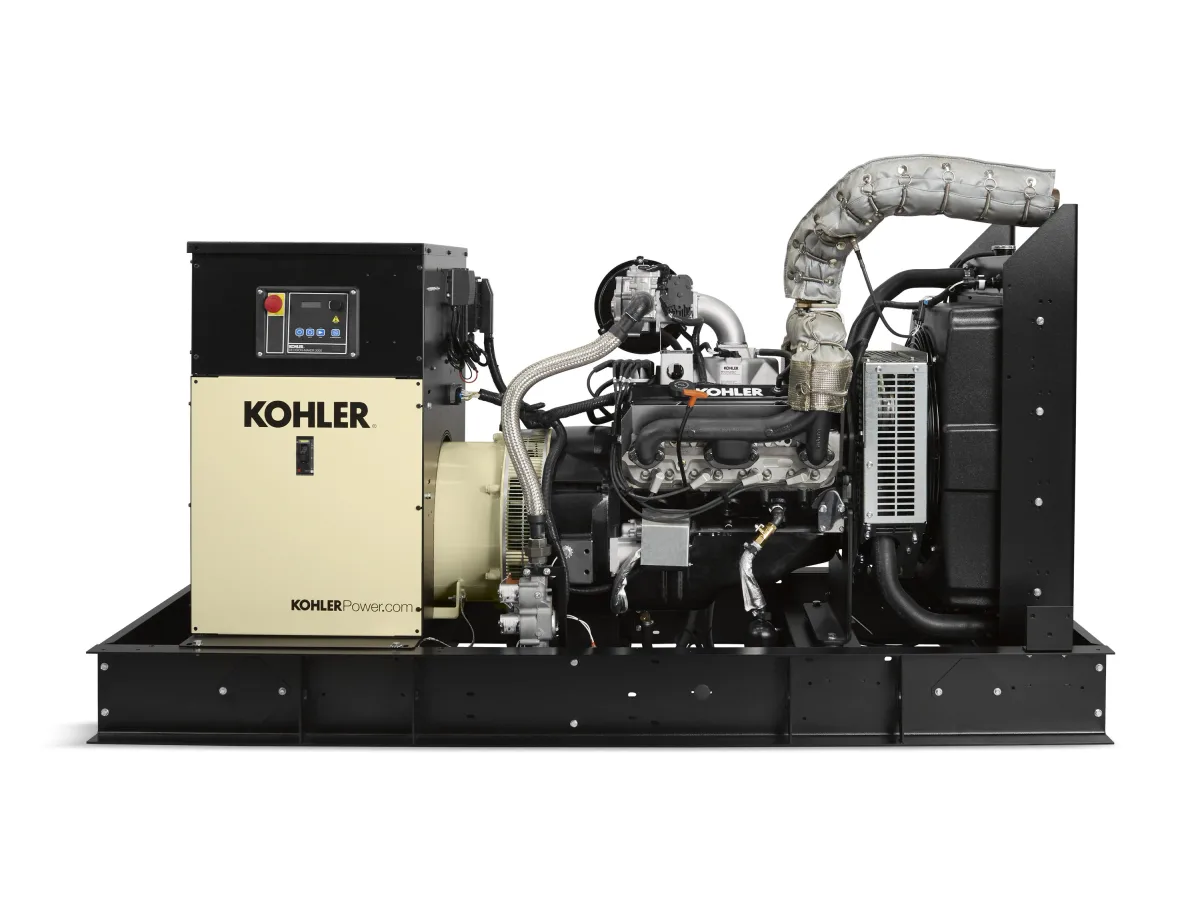
Overview#
The Stamford UCI224 is one of the highest-volume industrial alternator frames in the world for the 22-77 kW commercial standby class. Stamford, now part of Cummins Generator Technologies, has been refining the UCI architecture since the 1990s — the current production UCI224 is mature, reliable, and stocked by every major genset distributor.
For most 30-80 kW commercial gensets — diesel or gaseous — the UCI224 is either the OEM-installed alternator or a candidate for service replacement when re-engineered to the engine flange/SAE adapter. Specific drop-in compatibility with any given OEM platform must be confirmed against the genset's bill of materials before quoting a swap.
How the variants work#
The UCI224 series uses a single physical frame with different winding configurations:
| Variant | Approximate kW range (1800 RPM, 480V 3ϕ) | Notes |
|---|---|---|
| UCI224D | 22-32 kW | Smallest winding |
| UCI224E | 33-46 kW | Mid-range |
| UCI224F | 47-60 kW | Large mid-range |
| UCI224G | 60-77 kW | Top of UCI224 frame |
Above ~80 kW, gensets typically step up to the larger UCI274 or HCI4 frames.
Why we see it everywhere#
- Mature design. 25+ years of refinement, very few field-failure modes.
- Stocked everywhere. Every Stamford distributor in the US has UCI224 frames in inventory.
- AVR replacement. The SX460 AVR is the most-replaced alternator electronic in the world; field replacement takes 30 minutes with basic skills.
- Brushless reliability. No brush dust, no commutator wear, no slip-ring contamination.
Common service issues#
In our service experience:
- Year 5-10: SX460 AVR failures, typically traced to lightning surge or transient over-voltage on the main stator. Replacement is straightforward and a $200-400 part.
- Year 10-15: rotor diode failures (rotating rectifier in the rotor assembly). Symptom is voltage that won't build at start. Diagnosis requires a static test of the rotor diodes.
- Year 15-20: main bearing wear in single-bearing variants, especially in continuous-prime applications. Most standby alternators never reach this.
- Coastal environments: salt corrosion on terminal connections and screw heads. Dielectric grease at commissioning prevents most of this.
When to spec something else#
- Heavy nonlinear load (UPS rectifiers, VFDs >30% of capacity): consider PMG-excited alternators (Stamford HCI series with PMG option, or competitor PMG units).
- Tight voltage regulation requirements (under +/- 0.5%): upgrade AVR from SX460 to AS440 or MX341.
- Above 80 kW: step up to UCI274 or HCI4 frame.
- Marine or hazardous-area: specific marine-rated or Ex-rated alternators (different lineup).
OnPoint service notes#
We service Stamford UCI224 alternators across the central California coast as part of standard genset maintenance contracts. Common service items: AVR replacement, bearing regrease, megger testing during annual maintenance. We stock SX460 AVRs and rotor diode kits for the most-deployed configurations.