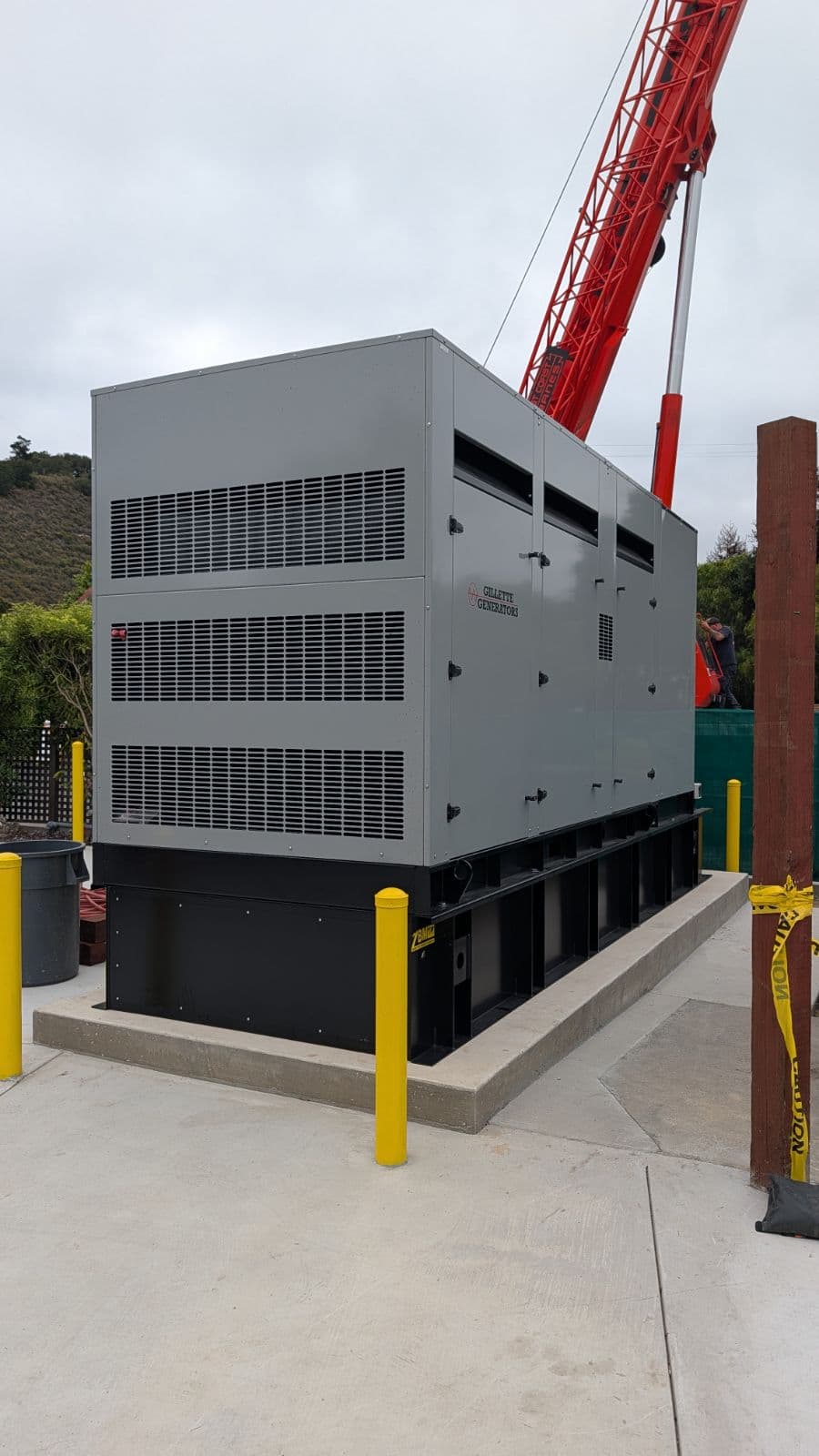
600 kW Gillette Diesel Generator for a Premier California Hotel
A luxury hotel on the California coast needed reliable backup power for guest rooms, restaurants, event spaces, and life safety systems. We specified and installed a 600 kW Gillette diesel generator with full NFPA 110 compliance and ongoing maintenance.
Background
Hotels operate around the clock, and their guests expect the lights to stay on. A power outage at a luxury hotel is not just an inconvenience — it is a business crisis. Elevators stop. HVAC shuts down. Kitchens go dark during dinner service. Electronic locks on 200+ guest rooms fail. The fire alarm panel loses power and the property falls out of life safety compliance. Conference events in progress are disrupted. And the reviews that follow a blackout at a premium-rate property can damage the brand for months.
This property — a full-service hotel on the Central California coast — had been relying on aging backup power equipment that was undersized for the facility's current electrical load. Renovations and expansions over the years had added guest rooms, a full-service restaurant, banquet facilities, and a spa, but the backup power system had not kept pace. The existing generator could cover life safety loads (emergency lighting, fire alarm, elevators) but could not maintain HVAC, kitchen operations, or guest room power during an extended outage. In a coastal area where winter storms regularly knock out grid power for hours, the gap between life safety minimum and full-facility operation was a real business risk.
The Challenge
The hotel needed a backup power system that could carry the full facility — not just the code-minimum life safety loads, but the guest-facing systems that keep a hotel operational and its guests comfortable during an outage. The requirements were specific:
- Full-facility coverage: guest rooms, HVAC, kitchen and restaurant, lobby and common areas, banquet/event spaces, spa, and all life safety systems
- NFPA 110 Level 1 compliance: the property's occupancy classification requires generator systems that meet the most stringent reliability tier — exercised monthly, load-bank tested annually, maintained to documented schedules
- Noise constraints: the generator pad is adjacent to guest areas, so sound attenuation was a hard requirement, not an afterthought
- Fuel autonomy: minimum 24-hour runtime at full load without refueling, to cover extended coastal storm outages
- Budget discipline: the property needed industrial-grade reliability without the price premium of the largest OEM brands
That last point is where the equipment selection became interesting. The traditional choice for a 600 kW hotel installation would be a Caterpillar, Cummins, or Kohler unit. All are excellent generators — and all carry pricing that reflects their brand position. For this property, the question was whether an alternative manufacturer could deliver equivalent reliability and performance at a lower acquisition cost, freeing budget for the sound attenuation, fuel storage, and ATS upgrades the project also required.
Our Approach
Equipment Selection: Why Gillette
We specified a Gillette 600 kW diesel generator for this installation. Gillette is a value-positioned manufacturer that uses the same tier-one engine and alternator components as the premium brands — but without the closed-ecosystem pricing structure.
The key advantages for this application:
- Open architecture: Gillette generators use industry-standard engines (John Deere, Volvo, Cummins) and Deep Sea Electronics controllers. Every component is serviceable by any qualified technician with access to standard OEM parts — the property is not locked into a single dealer network for maintenance
- Acquisition cost: 15-25% lower than comparable units from closed-ecosystem manufacturers, which freed budget for the sound-attenuated enclosure and extended fuel tank the project required
- Lead time: Gillette's factory-direct model delivered the unit weeks faster than the 16-20 week lead times quoted by other manufacturers at the time
- Industrial-grade construction: the same alternator quality, the same engine reliability, the same UL 2200 listing — packaged without the brand premium
Installation
The installation addressed the full power chain from generator to guest room:
- Generator pad and enclosure: level-3 sound-attenuated enclosure sized for the coastal environment, with corrosion-resistant hardware and marine-grade electrical connections
- Fuel system: extended-base fuel tank providing 24+ hours of runtime at full rated load, with fuel polishing system to maintain diesel quality during long standby periods
- Automatic transfer switch: new ATS rated for the full facility load, with programmed transfer sequences that prioritize life safety loads, then guest rooms, then kitchen/restaurant, then auxiliary systems
- Paralleling and load management: transfer logic configured to shed non-critical loads during partial-power scenarios, ensuring life safety and guest comfort systems always have priority
NFPA 110 Compliance Program
The hotel's occupancy classification requires NFPA 110 Level 1 compliance — the most stringent tier. Our ongoing maintenance program covers:
- Monthly exercise under load: the generator runs under automatic transfer for a minimum of 30 minutes monthly, with all parameters logged
- Annual load bank test: full-rated load test to verify the generator can carry 100% of its nameplate capacity
- Quarterly ATS inspection: transfer switch contacts, control logic, and timing verified every quarter
- Semi-annual fluid analysis: oil sampling and coolant testing to catch wear patterns before they become failures
- Complete documentation: every test, every measurement, every service visit documented in the property's compliance file — ready for the fire marshal or insurance auditor
The Results
The generator has performed through multiple extended outages since installation:
- Full-facility operation maintained during grid outages — guests experience a brief transition (under 10 seconds) and then normal hotel operations continue
- Zero guest complaints related to power during outage events — HVAC, lighting, elevators, electronic locks, kitchen, and entertainment systems all remain operational
- NFPA 110 Level 1 compliance maintained continuously — all monthly exercises, annual load bank tests, and quarterly inspections completed and documented on schedule
- Maintenance cost savings versus the quoted ongoing service costs from closed-ecosystem manufacturers — open-architecture components mean competitive parts pricing and no single-vendor lock-in
- 24+ hour fuel autonomy verified under load — sufficient to ride through the longest coastal storm outages without refueling
Key Takeaways
Hospitality properties have a unique backup power requirement: the generator does not just keep the building safe — it keeps the business running. The difference between "emergency power" and "full-facility backup" is the difference between evacuating guests to the lobby and having them not even notice the grid went down.
For hotel properties evaluating generator options, three factors deserve more weight than they typically receive:
- Sound attenuation is not optional — a generator that wakes up guests or disrupts outdoor dining areas fails even if it runs perfectly. Budget for proper enclosure engineering from the start.
- Total project cost matters more than unit cost — a lower-cost generator that frees budget for better ATS, fuel storage, and sound treatment often delivers a better overall outcome than a premium-brand unit that consumes the entire budget.
- Open-architecture equipment reduces long-term operating cost — when any qualified technician can service the generator with standard OEM parts, the property is not captive to a single dealer's pricing and availability.
Have a Similar Challenge?
Contact PowerGen for a free consultation. We'll design a backup power solution tailored to your facility.