Multi-Facility Healthcare EPSS Compliance Program: NFPA 110 Level 1 Across a Diverse Generator Fleet
A Northern California healthcare network with 7+ facilities and a mixed fleet of CAT, Cummins, MTU, John Deere, and Detroit Diesel generators — including medium-voltage 12.47KV units — relies on an ongoing maintenance and compliance program to meet NFPA 110 Level 1, NFPA 99, and Joint Commission EC.02.05.07 requirements across every site.
Background
When we first assessed this healthcare network's emergency power program, the scope of the challenge was immediately apparent. The fleet had been assembled over decades — facilities had procured generators independently, from different manufacturers, at different times, to meet the needs of each campus as it grew. The result was a patchwork: nine-plus engine platforms from CAT, Cummins, MTU, John Deere, Detroit Diesel, Ford, and Magnatec, with voltage configurations ranging from 208V all the way up to 12.47KV medium-voltage distribution. No two facilities had the same equipment profile.
A fleet this diverse, spread across seven-plus facilities, had predictably fragmented maintenance. Different sites operated on different service schedules, with different documentation standards and different approaches to deficiency tracking. The medium-voltage MTU units — operating at 12.47KV — required specialized technicians that most generator service providers do not staff. The facilities team faced an enormous compliance burden: Joint Commission surveys, HCAI inspections, and NFPA 110/99 requirements applied simultaneously across every campus, regardless of what equipment was installed. Large healthcare systems already contend with layers of compliance departments, procurement processes, and vendor management overhead. The last thing the facilities team needed was a service provider that added more bureaucracy to an environment already saturated with it.
What ultimately made this engagement work was fit, not just capability. The facilities team needed a partner that would show up, do the work, and produce the documentation administrators require — without the red tape. We know the facility engineers by name. We understand each building's quirks — which units run hot, which transfer switches have a history, which campuses have the most demanding survey schedules. Our technicians can discuss crankcase pressure readings and coolant temperature trends with a plant engineer in the morning and deliver a compliance-ready report to the administrative team by afternoon. That ability to speak both languages — technical generator expertise and healthcare compliance administration — is uncommon in this industry, and it is the reason this program has endured. When a Joint Commission surveyor requests documentation, the facilities team gets it the same day, not after a week of back-and-forth with a vendor's project management layer.
The Challenge
Hospital emergency power is not a single generator on a single rooftop. For a major healthcare network spanning the San Francisco Bay Area, it is dozens of generators across more than seven facilities — each with different equipment, different vintages, and different voltage configurations. Maintaining NFPA 110 Level 1 compliance across that kind of fleet requires more than routine oil changes. It requires a systematic program.
This network's generator fleet includes units from nearly every major manufacturer:
- Caterpillar — CAT C9, CAT 3412, CAT 3516C engines across multiple campuses
- Cummins — QSL9-G7, NTA-855-02, NTA855G2, and 4BT-3.9 units ranging from small 120/208V systems to full 480V standby power
- MTU — 12V4000G83 and 20V 4000 G43 units operating at 12.47KV medium-voltage distribution — among the most complex generator systems in any healthcare setting
- John Deere — 6090HF484, 6068HF285, and 6068tf250 engines serving facilities from 208V to 480V
- Detroit Diesel — 92 Power series units still in active service
- Ford — C5PG-6005A industrial power units at 208V
One facility alone operates CAT, John Deere, MTU, Ford, Detroit Diesel, and Cummins generators — a fleet diversity that means every technician visit requires multi-brand expertise, and every compliance record must account for manufacturer-specific testing protocols.
The medium-voltage MTU units present a particular challenge. Operating at 12.47KV, these generators feed hospital distribution systems at utility-scale voltage. Testing, maintenance, and compliance documentation for medium-voltage EPSS equipment demands specialized knowledge that most generator service providers simply do not have.
Our Approach
Rather than a one-time remediation project, this engagement is an ongoing compliance maintenance program spanning all facilities. The program is built around three pillars: scheduled preventive maintenance, responsive service calls, and continuous compliance documentation.
Multi-Brand Fleet Expertise
Each facility visit may involve servicing a Cummins QSL9-G7 in the morning and a CAT 3412 in the afternoon, followed by a medium-voltage MTU 12V4000G83 inspection. Our technicians carry the manufacturer-specific diagnostic knowledge to service every platform in the fleet — fuel systems, cooling systems, control panels, and the electrical distribution equipment downstream.
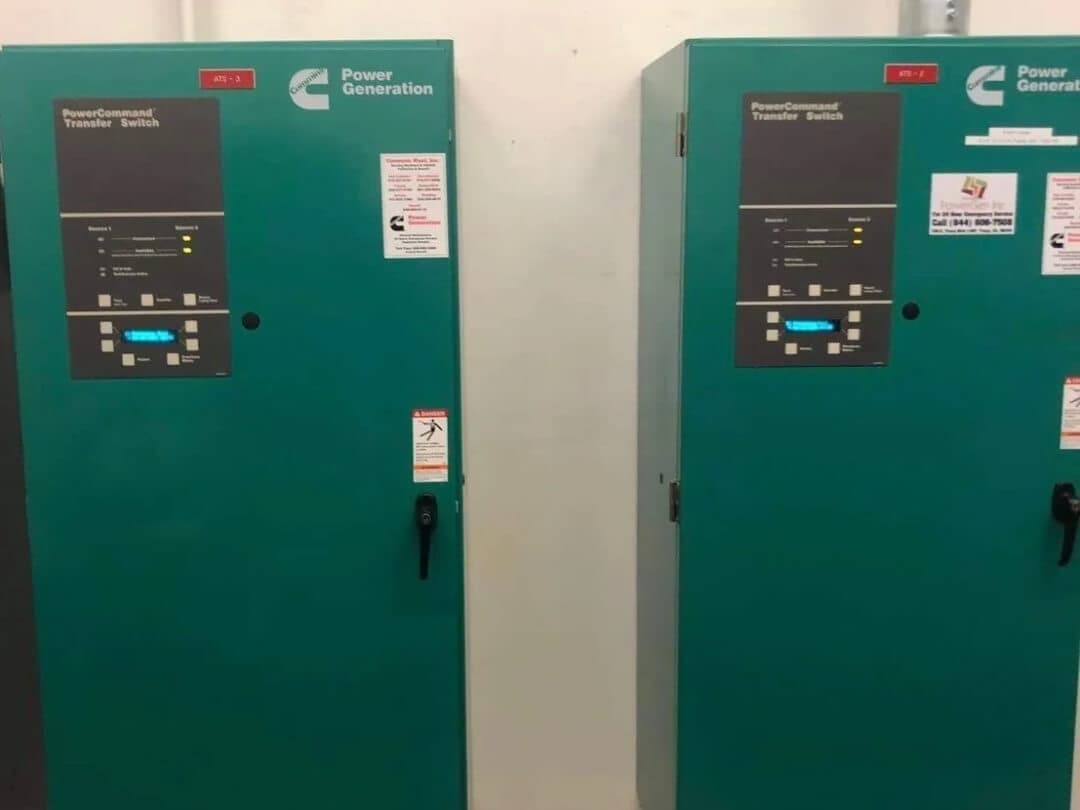
For the 3-phase 480V units that make up the majority of the fleet, maintenance follows a consistent NFPA 110 Chapter 8 protocol: monthly no-load exercise tests, annual load bank testing to nameplate capacity, and transfer switch verification at every visit. But the 12.47KV medium-voltage units require additional procedures — relay coordination verification, medium-voltage switchgear inspection, and protective device testing that goes beyond what standard generator maintenance covers.
Facility-by-Facility Compliance Coordination
Each facility operates under the same Joint Commission and HCAI requirements, but the equipment configuration at every site is different. A campus with a single Cummins 4BT-3.9 at 120/208V has a fundamentally different compliance profile than one running multiple MTU 20V 4000 G43 units at 12.47KV.
Our program maintains facility-specific maintenance schedules and compliance records for each site. When a Joint Commission surveyor reviews EC.02.05.07 documentation at any facility, the records reflect the actual equipment installed — complete with manufacturer-specific test parameters, nameplate data, and deficiency tracking.
Responsive Service Alongside Preventive Maintenance
Generator compliance is not only about scheduled maintenance. Equipment issues arise between visits — a battery charger fault, a coolant leak, a control panel alarm. With over 200 service tickets completed across this network, the program includes responsive service calls that are documented to the same compliance standard as preventive maintenance visits.
Every service call — whether a scheduled oil and filter change on a John Deere 6068HF285 or an emergency repair on a CAT 3516C — generates a complete service record with technician observations, corrective actions taken, and any open deficiencies requiring follow-up.
What the Program Delivers
This is not a project with a start and end date. It is a continuous compliance program that ensures every facility in the network meets NFPA 110 Level 1, NFPA 99, and Joint Commission EC.02.05.07 requirements at all times — not just before a survey.
- Full NFPA 110 Level 1 compliance maintained across all facilities, covering generators from 50kW to multi-megawatt medium-voltage systems
- Multi-brand service capability across CAT, Cummins, MTU, John Deere, Detroit Diesel, and Ford platforms — no subcontractors, no gaps
- Medium-voltage EPSS expertise for the 12.47KV MTU units that most service providers cannot touch
- Survey-ready documentation at every facility, updated continuously rather than assembled before inspections
- Deficiency tracking from identification through resolution — nothing falls through the cracks between visits
"Hospital systems don't fail because a generator won't start. They fail because nobody can prove the generator was tested correctly. The documentation is the compliance." — Senior Technician
Key Takeaways
The pattern we see repeatedly in healthcare is that compliance failures are not equipment failures. The generators run. What breaks down is the systematic maintenance program — especially when a facility has a mixed fleet from multiple manufacturers and multiple eras.
A healthcare network with a single brand and a single voltage class can get by with a simpler program. But when the fleet spans nine engine platforms, three voltage classes (208V, 480V, 12.47KV), and seven-plus facilities, the compliance program itself becomes the critical infrastructure. The generator is just a machine. The program is what keeps the hospital accredited.
For any healthcare facility managing a diverse generator fleet, the lesson is straightforward: compliance is not an event you prepare for before a survey. It is a continuous program that runs between surveys, built around the actual equipment installed at each site, documented to the standard that surveyors expect when they walk in unannounced.
"When you're managing medium-voltage generators in a hospital environment, there's no margin for error. The equipment demands respect and the documentation demands precision." — Senior Technician
Have a Similar Challenge?
Contact PowerGen for a free consultation. We'll design a backup power solution tailored to your facility.