Managing 60+ Diesel Generators Across a Hyperscale Data Center Campus
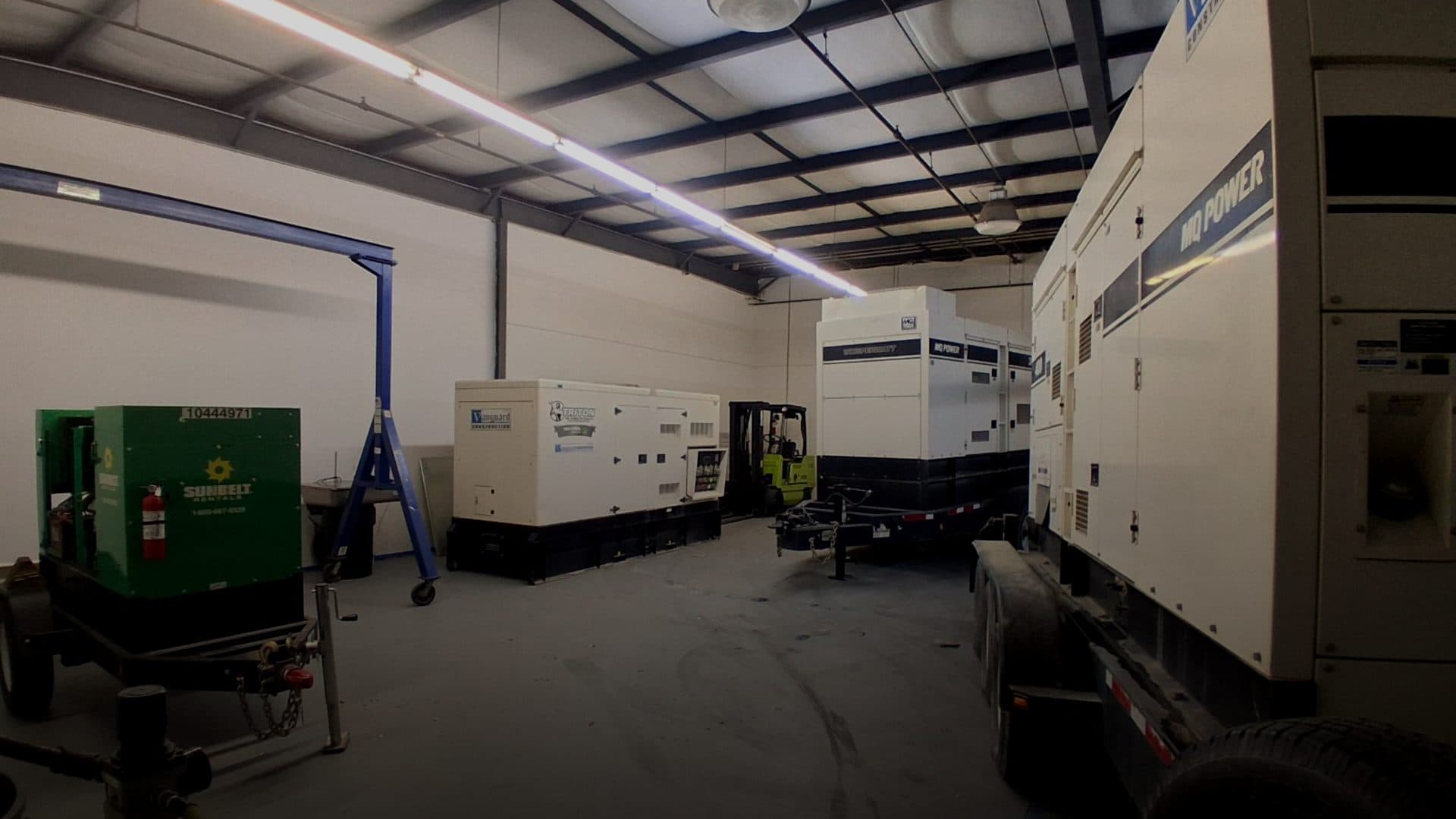
A hyperscale cloud provider's Northern California campus relies on our team to maintain a fleet of 60+ CAT 3516C diesel generators across 6 facilities, all configured in 2N paired redundancy. This is the story of an ongoing fleet maintenance program at scale.
The Scope
A hyperscale cloud provider operates six data center facilities across Northern California. Every facility depends on diesel backup generators to protect against utility outages — and at this scale, that means managing a fleet of over 60 CAT 3516C diesel generators, each in the 2,000 kW class, delivering a combined campus capacity exceeding 120 MW.
The generators are deployed in a strict 2N redundant configuration. Every power room has paired A/B generators — if one unit is offline for maintenance or fails during an outage, its paired counterpart covers the full load independently. This pairing is consistent across all six facilities, with designations like 092A/092B, 211A/211B, and 532A/532B reflecting the power room and redundancy assignment.
One facility also runs a dedicated CAT C18 as a house generator — a smaller unit that powers site services and office spaces independently from the 3516C fleet that protects the data halls.
Background
A hyperscale data center campus does not appear overnight. The six facilities in this program were built across multiple phases over several years — the non-sequential site codes reflect distinct construction waves, each adding new data halls and new generators to the fleet. As the campus grew from a handful of units to over 60 CAT 3516C generators, so did the operational complexity of keeping them all maintained, compliant, and ready to start on command. The operator made a deliberate fleet standardization decision early on: every data hall generator would be a CAT 3516C. That consistency simplifies parts procurement and technician training, but it also concentrates risk — a single-platform fleet of this size demands a service partner with deep expertise on the 3516C specifically, not a generalist who treats it as one model among many.
The campus had originally been serviced by the original equipment manufacturer's authorized service organization. On paper, it was the obvious choice — direct OEM support for an all-CAT fleet. In practice, the relationship exposed a gap between what a hyperscale operator needs and what a traditional OEM service model delivers. Response times were not meeting the urgency that critical infrastructure demands. When a 2,000 kW generator goes offline in a live data hall, the operator treats it as an immediate emergency requiring technicians on-site within hours. The previous provider operated more like a scheduled service organization — responsive on their own timeline, but not calibrated for the around-the-clock intensity of hyperscale operations. The service team was not proactive, and the pace at which they worked did not match the speed required to keep a campus of this scale fully protected.
PowerGen Services was brought in to close that gap. Beyond the core requirements — CAT large-diesel specialization, a regional technician team sized for fleet-scale coverage, and BAAQMD compliance documentation across 60+ permitted units — what set the relationship apart was the approach. The operator was not looking for another vendor to execute work orders. They wanted a partner that would bring ideas: recommending improvements to the maintenance program, identifying emerging issues before they became failures, and pushing the overall reliability posture forward. Hyperscale data centers operate at the frontier of what backup power infrastructure is asked to do, and the operator needed a service partner willing to learn alongside them rather than default to how things have always been done. As new facilities came online and the fleet expanded, the program scaled with that same mindset — same platform, same team, same standard, and a shared commitment to raising it.
The Challenge
Maintaining 60+ large diesel generators across six geographically distributed sites is a different problem than maintaining one or two units at a single facility. The challenges are organizational and logistical as much as they are mechanical:
- Standardization at scale: The entire fleet is CAT 3516C units, but serial numbers span multiple production batches (LYM, SBK, SEK series). Different batches can have different service bulletins, wear patterns, and parts availability timelines.
- Paired redundancy means maintenance windows matter: Taking generator 093A offline for service is only safe if 093B has been recently verified and is confirmed ready. Maintenance scheduling across paired units requires coordination — you never service both halves of a pair simultaneously.
- Six facilities, one program: Each site has its own layout, access constraints, and operational cadence. The maintenance program has to be consistent in quality and documentation while adapting to site-specific logistics.
- CARB and BAAQMD compliance: Northern California air quality regulations govern how many hours per year backup generators can run for non-emergency purposes (testing, maintenance verification). With 60+ units, tracking run hours across the fleet is an ongoing compliance requirement.
Our Approach
Our team manages this fleet through a structured, ongoing maintenance program that covers preventive maintenance, repairs, service calls, and periodic inspections across all six facilities.
Standardized Service Protocol
Every unit in the fleet follows the same maintenance protocol, adapted for the CAT 3516C platform. This includes oil and filter changes, coolant system inspections, fuel system checks, battery testing, and load verification. Standardizing on a single generator model across the entire campus simplifies parts inventory, technician training, and service scheduling.
Paired-Unit Coordination
The A/B redundancy architecture drives our scheduling discipline. Before any generator is taken offline for maintenance or repair, its paired unit is confirmed operational. Our technicians coordinate service windows to ensure that no power room ever loses both of its backup generators simultaneously. This is tracked per power room, not just per facility — the pairing is the fundamental unit of scheduling.
Multi-Site Fleet Coverage
Our service team rotates across all six facilities on a scheduled cadence. Service tickets — which span maintenance, repairs, service calls, and inspections — are tracked per unit, per site, and per visit. With 259 service events across the fleet, every unit has a documented service history that supports warranty compliance, regulatory reporting, and long-term reliability trending.
Dedicated Technician Team
A consistent team of technicians services the entire fleet. Familiarity with the specific sites, units, and operational procedures eliminates the ramp-up time that comes with rotating unfamiliar crews through critical infrastructure. The technicians know which units have had recurring issues, which facilities have access constraints, and which paired configurations require special scheduling attention.
The Results
This is not a project with a start and end date — it is an ongoing program. The results are measured in fleet readiness and operational continuity:
- 60+ CAT 3516C generators maintained across 6 facilities under a single coordinated program
- 2N redundancy preserved throughout all maintenance activities — no power room has lost paired coverage during scheduled service
- 259 documented service events spanning maintenance, repairs, service calls, and inspections, providing a complete fleet history
- Standardized fleet on a single generator platform (CAT 3516C) simplifies parts, training, and service delivery across the entire campus
- House generator separation at one facility (CAT C18 for site services) ensures data hall generators are never diverted to non-critical loads
Key Takeaways
The value of a fleet maintenance program at this scale comes from three things: standardization, coordination, and documentation.
Standardization on the CAT 3516C across 60+ units means every technician knows the platform, every parts order follows the same catalog, and every service procedure is repeatable. In a mixed-fleet environment, that efficiency disappears.
Coordination around the A/B paired redundancy model is what separates data center generator maintenance from industrial generator maintenance. The pairing is the constraint — every maintenance decision starts with "what is the status of the other unit in this pair?"
Documentation across 259 service events creates the fleet history that supports reliability analysis, compliance reporting, and informed capital planning. When a unit reaches the point where repair costs exceed replacement value, the service history is what justifies the capital request.
For any organization operating backup power at scale, the lesson is that the generators are only as reliable as the maintenance program behind them. A fleet of 60+ units does not maintain itself — it requires a structured program with consistent technicians, paired-unit scheduling discipline, and complete documentation.
Have a Similar Challenge?
Contact PowerGen for a free consultation. We'll design a backup power solution tailored to your facility.